Sources of Environmental Law



Проверьте себя
Право
Короткие вопросы помогут вспомнить главное в документе.
Загрузка вопросов…

Navigation
- General Provisions
- The Concept of a Source of Law
- Normative legal act
- Normative Agreement
- Legal Custom
- Judicial Practice
General Provisions
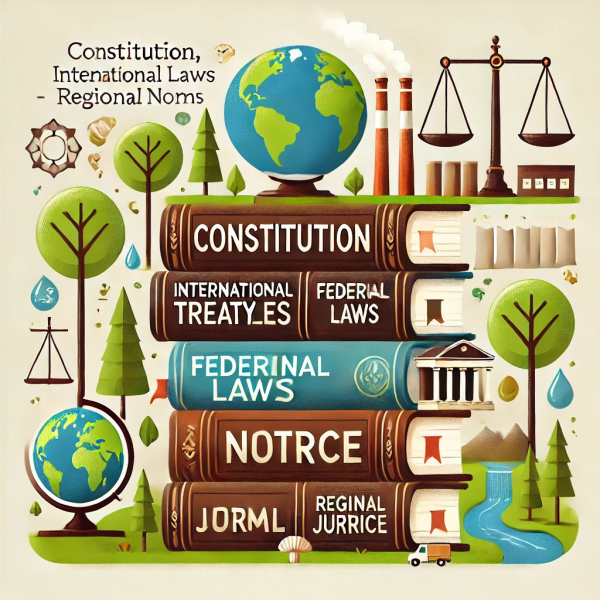
Sources of environmental law are ways of codifying and expressing legal norms regulating the relations between humans, society, and the environment.
Basic sources include normative legal acts, international treaties, general principles of law, and legal customs.
Normative legal acts, issued by state authorities, form the basis of legal regulation in Russia and establish rules of conduct that are binding on an indefinite circle of persons.
International treaties, ratified by Russia, take precedence over national laws and regulate environmental protection and the rational use of natural resources.
Legal customs developed through practice may be used as sources of environmental law, especially in the sphere of traditional nature use by small-numbered peoples.
Judicial practice, including decisions of the Supreme and Constitutional Courts of the Russian Federation, plays a role in interpreting and developing legal norms.
A comprehensive understanding of sources of environmental law ensures effective regulation and protection of the environment.
The Concept of a Source of Law
Law, as a system of general obligatory rules, in order to become an actual regulator of social relations, must take some external form. In legal doctrine, the ways by which state will becomes a legal norm are denoted by the conditional term "sources (forms) of law." The concept of a source of law is very vividly associated with a container into which legal norms are enclosed1. Literature also notes that a source of law is a means of expressing and consolidating legal norms2. In the theory of law, it is important to distinguish between such legal categories as "source of law" and "form of law"3. In the theory of law, a multitude of sources of law are identified4. However, in the Russian Federation, out of all known sources (forms) of law, mainly such sources as a normative legal act, normative agreement, general principles of law and legal custom5.
Normative legal act
Normative legal act6. The essential characteristics defining a normative legal act are: its issuance in the established order by an authorized state authority, local self-government body or official, the presence within it of legal norms (rules of conduct) that are mandatory for an indefinite circle of persons, intended for repeated application, aimed at regulating social relations or changing or terminating existing legal relations7. The preparation of normative legal acts is carried out at the federal level, at the level of subjects of the Russian Federation and at the local level. A normative legal act is the main source of law in Russia (including environmental law).
Laws are subject to official publication. Unpublished laws are not applicable. Any normative legal acts affecting the rights, freedoms and obligations of a person and citizen cannot be applied if they have not been officially published for general information (paragraph 3 of article 15 of the Constitution of the Russian Federation8).
Normative Agreement
Normative agreement is an agreement between two or more parties, as a result of which legal norms are established, changed or repealed9. Widely recognized principles and norms of international law and international agreements of the Russian Federation are an integral part of its legal system. If international agreements of the Russian Federation establish other rules than those provided by law, then the rules of the international agreement apply (paragraph 4 of article 15 of the Constitution of the Russian Federation).
Thus, in the legal system of Russia, generally recognized principles and norms of international law and international agreements of the Russian Federation have priority in the application of law over the norms of national legislation, including with regard to environmental protection and rational use of natural resources.
The Russian Federation is a party to numerous international agreements, the subject of regulation of which includes, among other things, social relations concerning environmental protection and the rational use of natural resources. Regulatory agreements can be divided into multilateral and bilateral ones.
To multilateral international agreements that serve as sources of environmental law can be attributed:
- Convention on Environmental Impact Assessment in a Transboundary Context10 (adopted in Espoo in 1991, signed by the Russian Federation in 1991);
- United Nations Framework Convention on Climate Change11 (adopted in New York in 1992, ratified by the Russian Federation in 1994);
- Kyoto Protocol to the United Nations Framework Convention on Climate Change12 (adopted in Kyoto in 1997, ratified by the Russian Federation in 2004);
- Convention on Biological Diversity13 (adopted in Rio de Janeiro in 1992, ratified by the Russian Federation in 1995);
- Venice Convention on Civil Liability for Nuclear Damage14 (adopted in Vienna in 1963, ratified by the Russian Federation in 2005).
To bilateral international treaties that serve as sources of environmental law can be attributed:
- Agreement between the Government of the Russian Federation and the Government of the Republic of South Ossetia on cooperation in the field of geological exploration and development of mineral resources15 (concluded in Tsxinvale on 18.02.2011);
- Agreement between the Government of the Russian Federation and the Government of the Republic of Nicaragua on cooperation in the field of fisheries16 (concluded in Moscow on 09.02.2011);
- Agreement between the Government of the Russian Federation and the Government of the Republic of Senegal on cooperation in the field of fishing17 (concluded in Moscow on 08.02.2011);
- Agreement between the Government of the Russian Federation and the Government of the Republic of India on developing cooperation in the oil and gas sector18 (concluded in New Delhi on 21.12.2010);
- Agreement between the Government of the Russian Federation and the Government of the Turkish Republic on cooperation in the field of plant quarantine19 (concluded in Moscow on 13.01.2010);
- Agreement between the Ministry of Natural Resources and Environment of the Russian Federation and the State Ministry for Environmental Affairs of the Syrian Arab Republic on cooperation in the field of environmental protection20 (concluded in Damascus on 11.05.2010);
- Agreement between the Government of the Russian Federation and the Government of the Republic of Latvia on cooperation in the field of environmental protection21 (concluded in Moscow on 20.12.2010).
Legal Custom
Legal custom is a rule of behavior that has developed as a result of its actual application over a long period of time, not recorded in any official documents, but recognized by the state22. Legal custom as a source of law has become widespread in the field of civil law. According to Article 5 of the Civil Code of the Russian Federation23, a custom is considered to be a rule of behavior that has become established and widely applied in any particular area of business or other activity, not provided for by legislation, regardless of whether it is recorded in any document. Customs that contradict mandatory provisions of legislation or contract applicable to the relevant parties are not applied.
However, legal customs can also be considered as sources of environmental law. For example, the regulation of relations in the field of education, protection and use of territories of traditional nature use may be carried out by customs of small-numbered peoples24, if such customs do not contradict the legislation of the Russian Federation, the legislation of the subjects of the Russian Federation (Article 2 of the Federal Law "On Territories of Traditional Nature Use of Indigenous Small-numbered Peoples of the North, Siberia and the Far East of the Russian Federation").
Public servitudes may be established for mowing grass and grazing agricultural livestock in accordance with established procedures on land plots during periods whose duration corresponds to local conditions and customs (subparagraph 7 of paragraph 3 of Article 23 of the Land Code of the Russian Federation).
In the event that ownership of a building, structure, or facility is transferred to several owners, the order of use of the land plot is determined taking into account the shares in the ownership of the building, structure, or facility or the established order of use of the land plot (second paragraph of point 1 of article 35 of the Land Code of the Russian Federation).
Judicial Practice
At the same time, it is important to determine whether judicial practice is a source of environmental law in Russia. Here, one should take into account that the legal system of Russia leans towards countries belonging to the continental legal system. A characteristic feature of such countries is that a court's decision in a particular case (a judicial precedent) cannot serve as a basis for making decisions in other similar cases. In other words, judicial practice in Russia is not officially considered a source of law. However, this issue is discussed in scientific literature. The corresponding approach is supported by scientific literature. For example, according to V.V. Petrov, court decisions, despite their originality and legal competence, cannot serve as an example or a source for making decisions in other similar cases. From this it follows that the Russian doctrine considers judicial practice only in terms of the application of law, interpretation, and clarification of its individual provisions25.
At the same time, other positions on this issue are expressed in scientific literature. As noted by M.M. Brinchuk, a court's decision to declare a normative act unconstitutional and to annul it gives rise to new rights and obligations of participants in social relations. In essence, such a decision is undoubtedly normative. Explanations provided by plenums of the Supreme Court of the Russian Federation and the Higher Arbitration Court of the Russian Federation have a general non-personal character and, beyond doubt, are sources of law. When considering individual cases, courts fill gaps in the law based on their internal conviction. If such decisions are approved by the Supreme Court of the Russian Federation and the Higher Arbitration Court of the Russian Federation and published, they become sources of law26.
A similar position is held by O.L. Dubovik, who argues that even in the classical continental, as it may seem at first glance, Russian law, in recent years many do not deny the existence of a source such as judicial precedent, primarily referring to decisions of the Constitutional Court of the Russian Federation. It should be noted here that the resolutions of the Plenums of the Supreme Court of the Russian Federation (previously the USSR) contain at least normative definitions27.
- normative legal act; 2) normative agreement; 3) judicial and administrative precedent; 4) legal custom; 5) religious doctrines; 6) legal science; 7) principles of law. (Lazarev V.V., Lipen S.V. Theory of the State and Law: textbook for universities. Moscow, 1998. P. 182 - 194).
Theory of the State and Law: textbook for law schools / edited by A.S. Pigolkhin. Moscow, ↩
Lazarev V. V., Lipen' S. V. Theory of the State and Law: a textbook for higher educational institutions. Moscow, 1998. P. 181. ↩
"It is necessary to pay attention to the justification and productivity of using the special term 'source of law' when characterizing the forms of establishment and expression of legal norms. After all, these objective forms are carriers of legal norms, and this function is conditioned precisely by the fact that there is unity (at least in principle, at the base) between the forms of establishment and expression of legal norms. And from a practical point of view, both normative legal acts and sanctioned customs are nothing other than sources, i.e., the only 'reservoir' in which legal norms reside." ↩
For example, V.V. Lazarev and S.V. Lipen distinguish among the following sources of law: ↩
Theory of the State and Law: textbook for law universities / ed. by A.S. Pigolkin. Moscow, ↩
"A normative legal act is an act of law-making activity by competent state bodies, which establishes, changes or cancels legal norms" (Lazarev V.V., Lipen S.V. Theory of the State and Law: textbook for universities. Moscow, 1998. P. 182). ↩
On the practice of courts in considering cases on challenging normative legal acts fully or in part from 29.11.2007 № 48 // Russian Gazette from 08.12.2007 (№ 276). ↩
Constitution of the Russian Federation (adopted by a nationwide vote on 12.12.1993) of 1993 // Collection of Laws of the Russian Federation. 2009. No. 4. Art. 445. ↩
Lazarev V.V., Lipen' S.V. Theory of the State and Law: textbook for higher educational institutions. Moscow, 1998. P. 183. ↩
Convention on the Assessment of Environmental Impact in a Transboundary Context. ↩
United Nations Framework Convention on Climate Change. ↩
Kyoto Protocol to the United Nations Framework Convention on Climate Change. ↩
Convention on Biological Diversity. ↩
Vienna Convention on Civil Liability for Nuclear Damage. ↩
Agreement between the Government of the Russian Federation and the Government of the Republic of South Ossetia on cooperation in the field of geological exploration and development of mineral resources. ↩
Agreement between the Government of the Russian Federation and the Government of Nicaragua on cooperation in the field of fisheries. ↩
Agreement between the Government of the Russian Federation and the Government of Senegal on cooperation in the field of fishing. ↩
Agreement between the Government of the Russian Federation and the Government of the Republic of India on developing cooperation in the oil and gas sector (concluded in New Delhi on 21.12.2010). 2010. ↩
Agreement between the Government of the Russian Federation and the Government of the Turkish Republic on cooperation in the field of plant quarantine. ↩
Ministry of Natural Resources and Environment of the Russian Federation, State Ministry of Environmental Affairs of the Syrian Arab Republic. Agreement between the Ministry of Natural Resources and Environment of the Russian Federation and the State Ministry of Environmental Affairs of the Syrian Arab Republic on cooperation in the field of environmental protection. ↩
Agreement between the Government of the Russian Federation and the Government of the Republic of Latvia on cooperation in the field of environmental protection (concluded in Moscow on 20.12.2010). 2010. ↩
Lazarev V. V., Lipen' S. V. Theory of the state and law: textbook for higher educational institutions. Moscow, 1998. P. 186. ↩
Civil Code of the Russian Federation: paragraph 1 of article 130. ↩
On the territories of traditional nature use by indigenous small-numbered peoples of the North, Siberia and the Far East of the Russian Federation. Art. 1. ↩
Petrov V. V. Environmental Law of Russia: textbook. Moscow, 1995. P. 96. ↩
Brinchuk M. M. Environmental Law: textbook. Moscow, 2010. P. 112–113. ↩
Dubovik O. L. Environmental Law: textbook. Moscow, 2010. P. 97. ↩