System of Environmental Law



Проверьте себя
Право
Короткие вопросы помогут вспомнить главное в документе.
Загрузка вопросов…

Navigation
- General Provisions
- Representations of the system of law in scientific literature
- Approaches to Understanding Environmental Law
- Legal Institutions
- Legal Sub-Institutions
- System of branch and academic discipline
- Content of the general, special and specific parts of environmental law
General Provisions
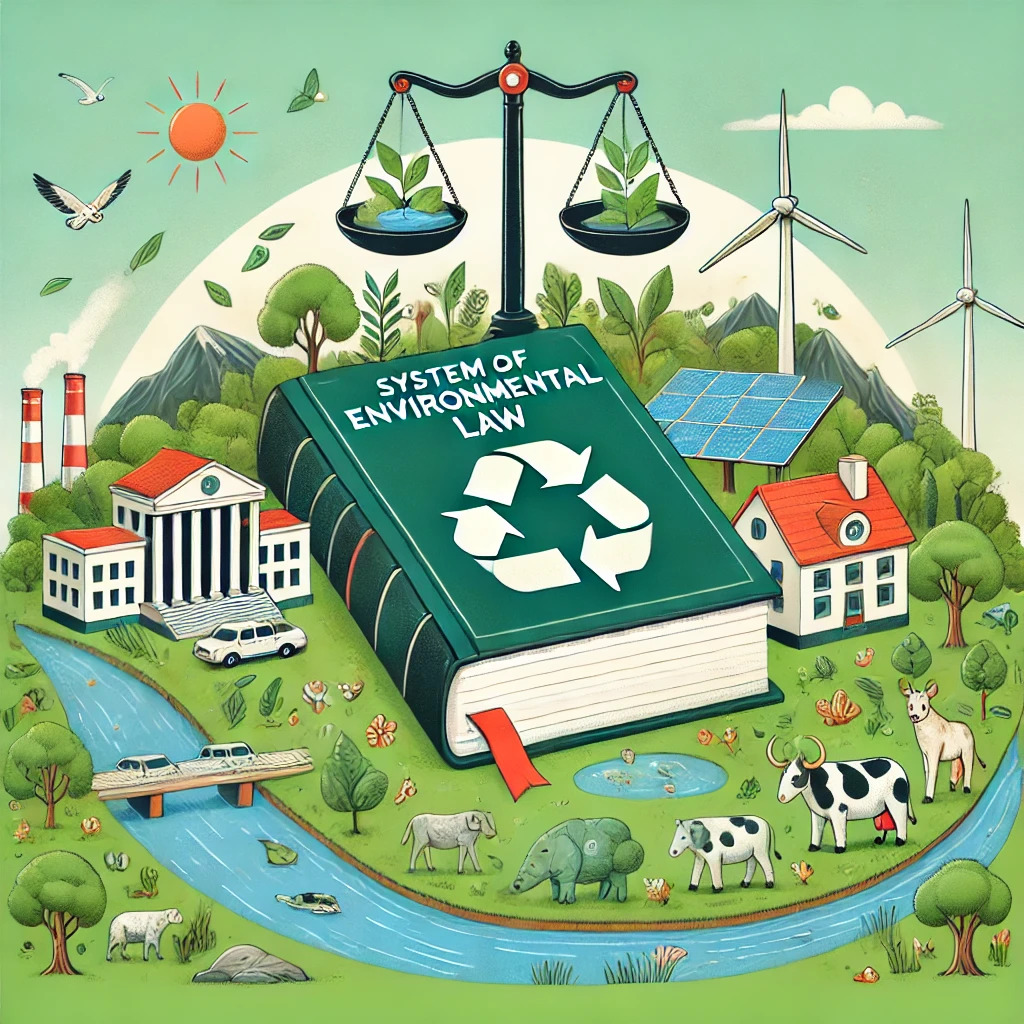
The system of environmental law represents an ordered structure comprising branches, sub-branches, institutions, and norms regulating social relations in the field of environmental protection and the rational use of natural resources.
It is formed on the basis of interaction between environmental protection law, natural resource law, and ecologized norms of other legal branches, including constitutional, administrative, civil, and criminal law.
Natural resource law ensures the protection and rational use of land, water, forests, mineral resources, and wildlife, while environmental protection law regulates relations concerning the protection of the entire environment.
In the structure of environmental law, legal institutions covering homogeneous relations are identified, as well as sub-institutions formed within them, for example, environmental insurance.
The system of environmental law differs from the academic discipline, although textbooks are structured according to general, specific, and special parts, ensuring a comprehensive understanding of the normative basis, regulation methods, legal institutions, and liability for environmental violations.
Representations of the system of law in scientific literature
According to the general theory of law, the legal system is an internal structure (or architecture) of law determined by the nature of social relations, expressed in the grouping of its constituent legal norms1 into institutes2, subbranches3 and branches of law4 (Lazarev V.V., Lipen' S.V. Op. cit. p. 221). A system is understood as the ordering of something based on certain classification criteria. Systematicity is an essential element of any branch of law, including environmental law5. According to S.A. Bogolyubov, the system of environmental law is an objective, determined by the system of social relations, multi-level internal division, a part of national law, consisting in grouping norms that are unified in their social essence and purpose in public life into internally coordinated parts called branches, subbranches, and institutes of law6. Then, M.M. Brinchuk understands the system of environmental law as the structure of the main elements and parts of this branch - sub-branches, institutions, norms7.
Approaches to Understanding Environmental Law
A broad approach to understanding environmental law allows for the identification within the structure of the branch of environmental law of nature conservation law, natural resource law, and ecologized norms from other branches of law8. Natural resource law regulates certain parts of the natural environment; it is intended to ensure the protection and rational use of individual natural resources – primarily land, as well as subsoil, water, forests, wildlife, and atmospheric air9. At the same time, branches of natural resource law become sub-branches of environmental law, its components10. Thus, natural resource law regulates social relations concerning the protection and rational use of individual natural resources (components of the natural environment).
The emergence of environmental law was conditioned by the fact that over time, in the second half of the XX century, it became clear that the natural resource approach was incomplete and insufficient. The non-renewability of many natural resources, their interdependence necessitated abstraction from each of them, a transition to a more general phenomenon - the environment. It became inevitable to generalize and include the regulation of social relations regarding the protection and use of natural resources into the regulation of the protection of the entire environment11. Thus, environmental law regulates social relations concerning the protection of the entire environment.
The third part of environmental law consists of norms from other branches of law, which also regulate environmental relations to a certain extent. It is difficult to find a branch of law or legislation that does not in some way support environmental law or depend on it. These include constitutional, civil, financial (tax, budgetary), administrative, labor, criminal and other branches of Russian law12.
Thus, environmental norms from other branches of law are norms from various branches of law (not being norms of environmental law) that regulate social relations concerning the protection of the environment and the rational use of natural resources (components of the natural environment).
For example, Chapter 8 of the Code of the Russian Federation on Administrative Offenses (hereinafter – RF Code of Administrative Offenses) establishes liability for administrative offenses in the field of environmental protection and natural resource use13. Chapter 26 of the Criminal Code of the Russian Federation provides for criminal liability for ecological crimes14.
Legal Institutions
The constituent parts of each branch of national law are referred to as legal institutions, which include a separate group of norms regulating homogeneous relations and distinguished by qualitative unity, for example, legal protection of land, specially protected natural territories, regulation of economic activity15.
Legal Sub-Institutions
In general theory of law, along with legal institutes, sub-institutes are also distinguished. For example, according to S.S. Alekseev, sub-institutes are organic formations of relatively independent character, forming within institutes16. As sub-institutes of environmental law, for example, voluntary and mandatory environmental insurance can be considered, which are organic formations of relatively independent character, forming within the institute of environmental insurance.
System of branch and academic discipline
The system of the environmental law sector should not be equated with the system of the corresponding academic discipline. The system of environmental law as an academic discipline is based on GOST17, which sets requirements for the minimum mandatory content of the basic educational program for training a lawyer in the specialty 021100 "Law". This list, among other things, includes the main sections of the discipline "Environmental Law"18. These sections, it seems, should be included in any textbook on environmental law.
The necessity of including the relevant sections in a textbook does not prevent authors of academic literature from structuring the corresponding material in their own way. Alongside mandatory provisions set by GOST, they also include additional parts in their books. In this regard, the structure of textbooks on environmental law often differs.
However, this literature usually includes general, special and specific parts. Such a structure appears to be justified, as it allows forming a comprehensive understanding of environmental law through a sequential transition from general issues to specific ones.
Content of the general, special and specific parts of environmental law
In the general part of textbooks on environmental law, specific institutions of the field of environmental law are usually considered: environmental regulation, environmental licensing, environmental audit. Important issues in the general part of environmental law also include consideration of the subject, methods, system and other, mostly basic provisions of environmental law. In the general part, questions of legal liability for environmental violations are also often discussed. In the special part of environmental law, issues related to the legal regime of natural resources (components of the natural environment) are often considered. For example, the legal regime of land, subsoil, water and others. The specific part of environmental law may include issues relating to the international legal mechanism for protecting the environment, protection of Lake Baikal and others.
"A legal norm is a rule of conduct established and enforced by the state, which is generally obligatory and intended for regulating relations in society" (Lazarev V.V., Lipen' S.V. Theory of the State and Law: textbook for higher educational institutions. Moscow, 1998. P. 201). ↩
"A legal institution is a set of legal norms forming part of a branch of law, regulating a particular aspect of homogeneous social relations" (Lazarev V.V., Lipen' S.V. Theory of the State and Law: textbook for higher educational institutions. Moscow, 1998. P. 221). ↩
"A sub-branch of law is a separate part of a branch of law, which regulates specific large subdivisions of social relations falling within the scope of relations regulated by the branch of law" (Lazarev V.V., Lipen' S.V. Theory of the State and Law: textbook for higher educational institutions. Moscow, 1998. P. 221). ↩
"A legal branch is a collection of legal norms that form an independent, distinct part of the legal system, regulating a qualitatively homogeneous sphere of social relations by its own special method" (Lazarev V.V., Lipen' S.V. Theory of the State and Law: textbook for higher educational institutions. Moscow, 1998. P. 220). ↩
Vinokurov A.Yu. Environmental Law: lecture notes. Moscow, 2008. P. 32. ↩
Institutions of Environmental Law / ed. by S.A. Bogolyubov. Moscow, 2010. P. 32–33. ↩
Brinchuk M.M. Environmental Law: textbook. Moscow, 2010. P. 75. ↩
See also Bogolyubov S.A. On the possibilities of environmental law // Journal of Russian Law. 2000. No. 11; Environmental Law: textbook / ed. by S.A. Bogolyubov. Moscow, 2010. P. 13. ↩
Environmental Law: textbook / ed. by S.A. Bogolyubov. Moscow, 2010. P. 14. ↩
Institutes of Environmental Law / ed. by S.A. Bogolyubov. Moscow, 2010. P. 31. ↩
Institutes of Environmental Law / ed. by S.A. Bogolyubov. Moscow, 2010. Pp. 30–31. ↩
Environmental Law: textbook / ed. by S.A. Bogolyubov. Moscow, 2010. P. 15. ↩
Chapter 8 of the Code of the Russian Federation on Administrative Offenses dated December 30, 2001, No. 195-FZ (Collection of Laws of the Russian Federation. 2002. No. 1. Art. 1.) establishes liability for: failure to comply with environmental requirements when carrying out urban planning activities and operation of enterprises, facilities or other objects (Article 8.1); failure to comply with environmental and sanitary-epidemiological requirements in handling waste from production and consumption, substances depleting the ozone layer, or other hazardous substances (Article 8.2); violation of rules for handling pesticides and agrochemicals (Article 8.3); violation of legislation on environmental expertise (Article 8.4); concealment or distortion of environmental information (Article 8.5); damage to land (Article 8.6); failure to perform obligations related to land reclamation, mandatory measures for improving land and soil protection (Article 8.7); use of land plots not in accordance with their designated purpose, failure to fulfill obligations to bring land into a condition suitable for use for the intended purpose (Article 8.8); violation of requirements for the protection of mineral resources and hydro-mineral resources (Article 8.9); violation of requirements for the rational use of mineral resources (Article 8.10); violation of rules and requirements for conducting geological exploration works on mineral resources (Article 8.11); violation of the regime of land plots and forests in water protection zones (Article 8.12); failure to ensure free access by citizens to a water object of general use and its shore zone (Article 8.12.1); violation of rules for the protection of water objects (Article 8.13); violation of water usage rules (Article 8.14); violation of rules for operating hydraulic or water protection structures and equipment (Article 8.15); failure to comply with rules for keeping ship documents (Article 8.16); violation of standards (norms, rules) or conditions of a license regulating activities in internal waters, territorial sea, continental shelf and (or) exclusive economic zone of the Russian Federation (Article 8.17); violation of rules for conducting resource or marine scientific research in the internal waters, territorial sea, continental shelf and (or) in the exclusive economic zone of the Russian Federation (Article 8.18); violation of rules for disposal of waste and other materials in the internal waters, territorial sea, continental shelf and (or) in the exclusive economic zone of the Russian Federation (Article 8.19); illegal transfer of mineral and (or) living resources on the continental shelf and (or) in the exclusive economic zone of the Russian Federation (Article 8.20); violation of rules for protection of atmospheric air (Article 8.21); putting into operation of mechanical transport means with exceeding of norms of content of pollutants in emissions or norms of noise level (Article 8.22); operation of mechanical transport means with exceeding of norms of content of pollutants in emissions or norms of noise level (Article 8.23); violation of the procedure for granting citizens and legal entities forests for their use (Article 8.24); violation rules of forest use (Article 8.25); unauthorized use of forests, violation of rules of forest use for agricultural purposes, destruction of forest resources (Article 8.26); violation of reforestation rules, afforestation rules, forest maintenance rules, and forest seed production rules (Article 8.27); illegal cutting, damaging forest plantations or unauthorized digging up of trees, shrubs, and vines in forests (Article 8.28); violation of requirements of forestry legislation regarding the accounting of timber and transactions with it (Article 8.28.1); destruction of animal habitats (Article 8.29); destruction of forest infrastructure as well as meadows and pastures (Article 8.30); violation of sanitary safety rules in forests (Article 8.31); violation of fire safety rules in forests (Article 8.32); violation of rules for the protection of habitats or migration routes of wildlife and aquatic biological resources (Article 8.33); violation of established procedures for creating, using, or transporting biological collections (Article 8.34); destruction of rare and endangered species violation of rules relating to the relocation, acclimatization or hybridization of animal world objects and aquatic biological resources (Article 8.36); violation of hunting rules, other rules for using animal world objects and rules for catching (fishing) aquatic biological resources and other rules regulating the conduct of industrial fishing, coastal fishing and other types of fishing (Article 8.37); violation of rules for protecting aquatic biological resources (Article 8.38); violation of rules for protecting and using natural resources on specially protected natural territories (Article 8.39); violation of requirements when carrying out work in the field of hydrology, monitoring the condition and pollution of the environment and active influence on meteorological and other geophysical processes (Article 8.40); failure to pay the fee for negative impact on the environment within the established time limits (Article 8.41); violation of the special regime for conducting economic and other activities in the coastal protective zone of a water object, water protection area zones of a water body or the regime for conducting economic and other activities within the sanitary protection zones of sources of drinking and household water supply (Article 8.42); violation of requirements for carrying out activities in Antarctica and conditions for their implementation (Article 8.43); violation of the regime for conducting economic and other activities within the boundaries of flooding and inundation zones (Article 8.44); failure to comply with requirements for equipping economic and other objects located within the boundaries of water protection zones with structures ensuring the protection of water bodies from pollution, clogging, siltation, and depletion of water resources (Article 8.45); failure or untimely fulfillment of obligations to submit an application for state registration of objects causing negative impact on the environment, and providing information for updating registration data (Article 8.46). ↩
Chapter 26 of the Criminal Code of the Russian Federation dated June 13, 1996 No. 63-FZ (Official Gazette of the RF. 1996. No. 25. Item 2954) establishes liability for: violation of environmental protection rules during work (Article 246); violation of rules for handling environmentally hazardous substances and waste (Article 247); violation of safety rules when dealing with microbiological or other biological agents or toxins (Article 248); violation of veterinary rules and rules established for fighting diseases and pests of plants (Article 249); water pollution (Article 250); air pollution (Article 251); pollution of the marine environment (Article 252); violation of Russian Federation legislation on the continental shelf and the exclusive economic zone of the Russian Federation (Article 253); land damage (Article 254); violation of rules for protection and use of mineral resources (Article 255); illegal harvesting (catching) of aquatic biological resources (Article 256); violation of rules for protecting aquatic biological resources (Article 257); illegal hunting (Article 258); unlawful hunting and trade of specially valuable wild animals and aquatic biological resources belonging to species listed in the Red Book of the Russian Federation and (or) protected by international agreements of the Russian Federation (Article 258.1); destruction of critical habitats for organisms listed in the Red Book of the Russian Federation (Article 259); unlawful cutting of forest plantations (Article 260); destruction or damage to forest plantations (Article 261); violation of the regime of specially protected natural territories and natural objects (Article 262). ↩
Institute of Environmental Law / ed. S.A. Bogolyubov. Moscow, 2010. P. 33. ↩
Aleksеev S.S. Collected Works. In 10 volumes. Volume 2: Special Issues of Jurisprudence (Structure of Soviet Law). Moscow, 2010. P. 131. ↩
"State Educational Standard for Higher Professional Education. Specialty 021100 - Jurisprudence. Qualification - Lawyer. Registration No. 260gum/sp" (approved by the Ministry of Education of Russia on March 27, 2000) // SPS "Consultant Plus". [Electronic resource]. URL: http://base.consultant.ru/cons/cgi/online.cgi?req=doc;base=EXP;n=339331 ↩
"Subject and system of environmental law; objects of environmental relations: history of legal regulation of environmental relations; emergence and main stages of development of environmental law; norms of environmental law and environmental legal relations; sources of environmental law; and ownership rights over natural resources; legal forms of using natural resources; legal protection of natural objects; organizational mechanisms for protecting the surrounding natural environment; economic mechanisms for protecting the surrounding natural environment; liability for environmental violations; legal forms of compensation for damage caused by environmental violations; environmental requirements for location, design, construction, commissioning of facilities; environmental requirements during operation of facilities; legal protection of the environment in cities and other populated areas; legal regime of the nature reserve fund; legal regime of natural resources in resort, health and recreational zones; legal mode of zones of extraordinary environmental situation and zones of environmental disaster; international legal mechanisms for the protection of the natural environment; legal protection of the natural environment in foreign countries (
State Educational Standard of Higher Professional Education. Specialty 021100 - Jurisprudence. Qualification - lawyer. Registration No. 260gum/sp(approved by the Ministry of Education of Russia on 27.03.2000)). ↩