Environmental Rights and Obligations



Проверьте себя
Право
Короткие вопросы помогут вспомнить главное в документе.
Загрузка вопросов…

Navigation
- General Provisions
- Environmental rights and obligations in scientific literature
- Ecological rights and obligations in legislation
General Provisions
This section outlines the content of human ecological rights as legally established opportunities for interaction with the natural environment. It considers the constitutional foundations of citizens' ecological rights and obligations in the Russian Federation, including the right to a favorable environment, information about its condition, and compensation for environmental damage.
Special attention is given to the interdependence of rights and obligations, as well as the role of the state in ensuring their implementation. Provisions of environmental legislation are analyzed, including the participation of citizens and public organizations in making environmentally significant decisions and the liability of officials for violating these rights.
Environmental rights and obligations are a key element of the legal system, ensuring the protection of the environment and the rational use of natural resources. They grant citizens and public organizations the right to a favorable environment, access to reliable information about its condition, as well as participation in decision-making that may affect the ecological situation. These norms form the basis for active societal involvement in nature conservation.
The Constitution of the Russian Federation guarantees every citizen the right to environmental protection and compensation for damage caused by environmental violations. Ownership and use of land and other natural resources is permitted only under the condition of compliance with environmental requirements and prevention of harm to the environment. These provisions establish the legal basis for sustainable resource use and ecosystem conservation.
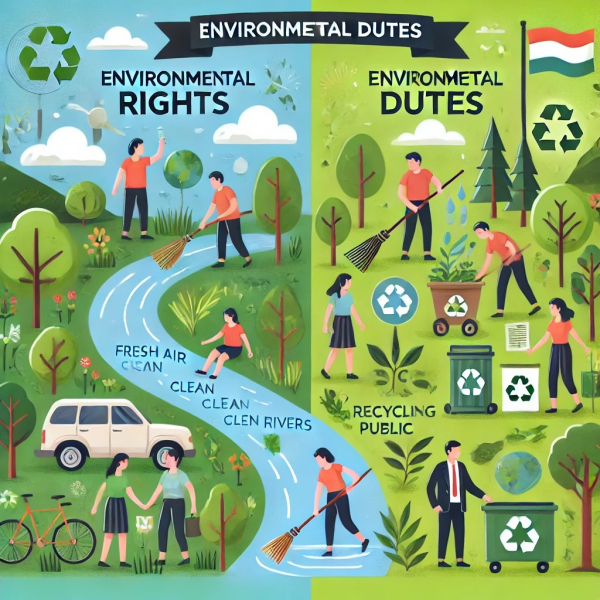
In addition to rights, citizens bear obligations aimed at preserving nature, careful treatment of natural resources, and compliance with environmental standards. Fulfillment of these obligations ensures the realization of the right to a favorable environment and prevents negative consequences of economic and other activities on the ecology.
The Federal Law "On Environmental Protection" clarifies the powers of citizens and public organizations, including participation in environmental impact assessment, lodging complaints with state authorities and courts to protect their rights, as well as assisting in addressing issues related to environmental protection. The law establishes a mechanism for interaction between the population and state bodies and local self-government when making environmentally significant decisions.
Violation of environmental rights entails liability for officials and organizations, while citizens and associations may protect their interests through court and government agencies. Overall, the system of environmental rights and obligations ensures a balance between the use of natural resources and their protection, creating a foundation for sustainable development and ecological safety of society.
Environmental rights and obligations in scientific literature
According to M.M. Brinchuk, environmental human rights are legally established claims of an individual to nature (or its separate resources), related to the satisfaction or potential satisfaction of his diverse needs through interaction with it and ensuring such satisfaction1.
The basic environmental rights and obligations are established by the Constitution of the Russian Federation. According to Article 36 of the Constitution of the Russian Federation, citizens and their associations have the right to own land in private ownership. Ownership, use, and disposal of land and other natural resources are carried out freely by their owners, provided that this does not cause damage to the environment or violate the rights and legitimate interests of other persons. The conditions and procedures for using land are determined based on federal law. Everyone has the right to a favorable environment, reliable information about its condition, and to compensation for damage caused to their health or property by an environmental violation (Article 42 of the Constitution of the Russian Federation).
According to S.A. Bogolyubov, the rights and obligations of a person and citizen are inextricably linked. It is known that certain rights cannot fail to correspond to appropriate obligations, i.e., there are no rights without obligations, and failure to fulfill these latter cannot but affect the degree and level of observance of rights. Therefore, it is necessary from time to time to return to the analysis and determination of obligations as a factor in ensuring rights2. Thus, Article 58 of the Constitution of the Russian Federation provides for the obligation of each individual to preserve nature and the environment, and to treat natural resources with care.
Ecological rights and obligations in legislation
The basic provisions of the Constitution of the Russian Federation regarding the environmental rights and obligations of citizens and public organizations are developed in Chapter 3 of the Federal Law "On Environmental Protection." Article 13 of this Law stipulates that federal government bodies, government bodies of the subjects of the Russian Federation, local self-government bodies, and officials are obliged to provide assistance to citizens, public and other non-commercial organizations in the exercise of their rights in the field of environmental protection. When placing objects whose economic or other activities may cause harm to the environment, decisions on their placement are made taking into account the opinion of the population or the results of a referendum.
Public officials who hinder citizens, public and other non-commercial organizations in carrying out activities in the field of environmental protection, and in the implementation of their rights provided for by the Federal Law "On Environmental Protection" and other federal laws and other normative legal acts of the Russian Federation, are held accountable in accordance with established procedures.