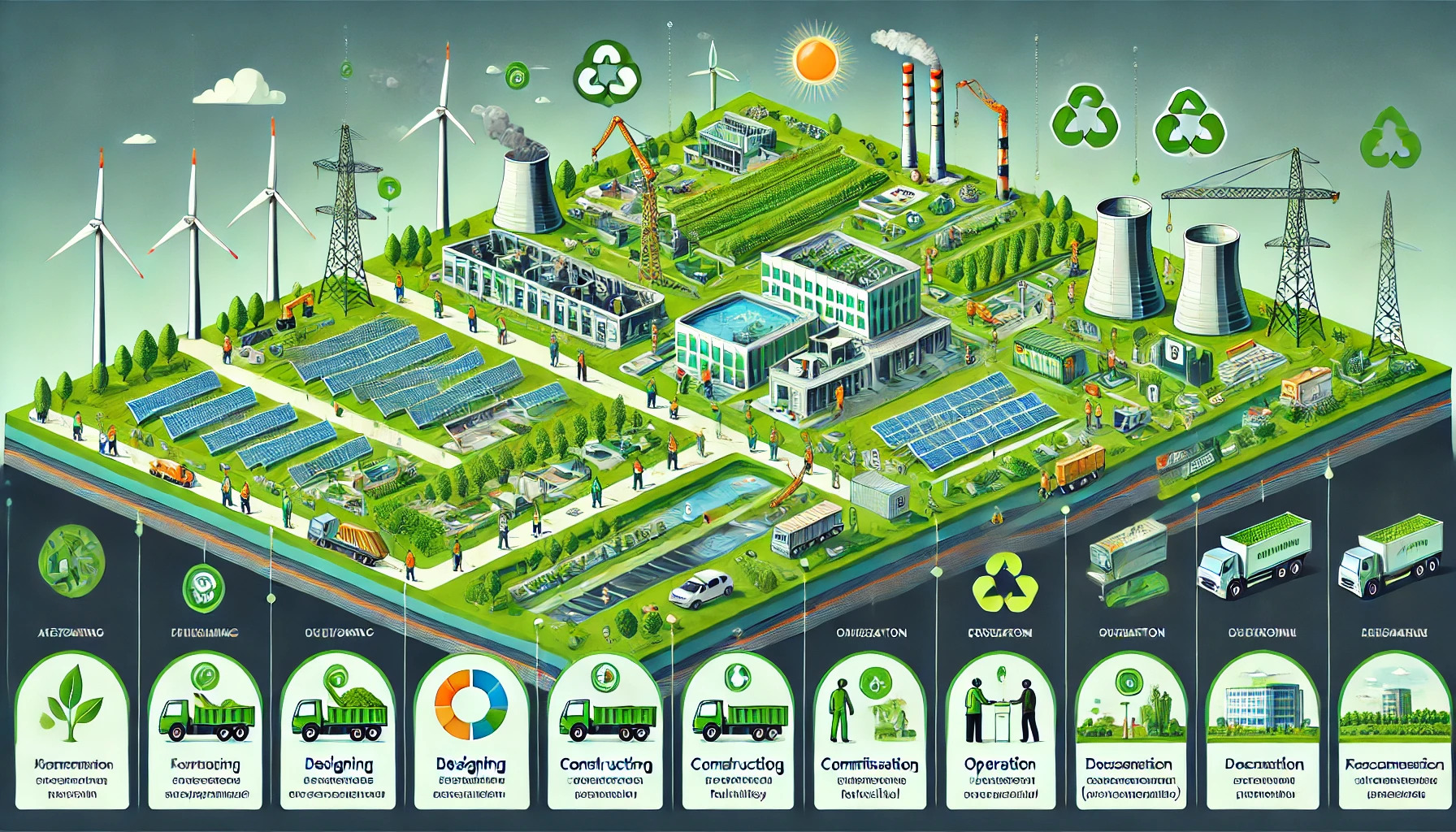
Environmental requirements for the placement, design, construction, commissioning, operation, and decommissioning of facilities



Проверьте себя
Право
Короткие вопросы помогут вспомнить главное в документе.
Загрузка вопросов…
Navigation
- General Provisions
- General Environmental Protection Requirements for placement, design, construction, reconstruction, commissioning, operation, conservation, and decommissioning of buildings, structures, facilities, and other objects
- Requirements in the field of environmental protection when placing buildings, structures, facilities, and other objects
- Requirements in the field of environmental protection during the construction and reconstruction of buildings, structures, facilities, and other objects
- Requirements for environmental protection when putting buildings, structures, facilities, and other objects into operation
- Environmental Protection Requirements for the Operation and Decommissioning of Buildings, Structures, Facilities, and Other Objects
- Environmental Protection Requirements for Placement, Design, Construction, Reconstruction, Commissioning, and Operation of Energy Facilities and Nuclear Energy Utilization Facilities
- Environmental protection requirements for the placement, design, construction, reconstruction, commissioning, operation, and decommissioning of military and defense objects, weapons, and military equipment
- Environmental Protection Requirements for Agricultural Facilities Operation
- Environmental protection requirements during land reclamation, design, construction, reconstruction, commissioning, and operation of irrigation systems and separately located hydrotechnical facilities
- Environmental protection requirements for the location, design, construction, and reconstruction of urban and rural settlements
- Environmental Protection Requirements in the Manufacturing and Operation of Motor Vehicles and Other Transport Means
- Environmental protection requirements for the location, design, construction, reconstruction, commissioning, and operation of oil and gas production facilities, processing, transportation, storage, and sale of oil, gas, and their processing products
General Provisions
Urban development activities represent a complex legal [institution](/enc/28452/ "Definition of the term «Institution» in the legal encyclopedia), closely related to issues of environmental protection and rational use of natural resources.
During the placement, design, construction, and operation of objects, the environment of human life activities is formed, which requires strict compliance with ecological requirements.
Legislation [/enc/32121/ "Definition of 'legislation' in the legal encyclopedia"] establishes the mandatory consideration of permissible environmental load, implementation of resource-saving technologies, and conducting activities [/enc/32588/ "Definition of 'PO' in the legal encyclopedia"] for restoring the environment.
Special attention is paid to all stages of the life cycle of objects – from design to decommissioning.
Violation of environmental regulations may result in suspension or cessation of activities pursuant to a court decision.
Specific requirements are provided for the energy sector, agriculture, transport, and the oil and gas industry.
Thus, environmental regulations serve as a key tool for ensuring the sustainable development of territories, preserving natural resources, and creating a safe environment for the population's life.
As noted by L.E. Bandorin, urban development activities – a comprehensive institution in Russian law and legislation, closely interrelated with natural resource and environmental protection relations. It is precisely through urban development activities that cities and other settlements, as well as real estate objects, emerge. Issues related to the establishment and implementation of ecological requirements during the conduct of this type of activity are regulated by numerous normative acts – from
from legislative to regulatory-technical. Without understanding the legal fabric of urban planning, it is impossible to orient oneself in issues related to the development of the environment of societal and human life activity1.
General Environmental Protection Requirements for placement, design, construction, reconstruction, commissioning, operation, conservation, and decommissioning of buildings, structures, facilities, and other objects
Placement, design, construction, reconstruction, commissioning, operation, conservation and liquidation of buildings, structures, facilities and other objects exerting direct or indirect negative impact on the environment are carried out in accordance with requirements in the field of environmental protection. When
In this, measures for protection of the environment, restoration of the natural environment, rational use and reproduction of natural resources, ensuring ecological safety should be provided for.
Violation of requirements in the field of environmental protection entails suspension by court decision of placement, design, construction, reconstruction, commissioning, operation, conservation and liquidation of buildings, structures, facilities and other objects2.
The complete termination of placement, design, construction, reconstruction, putting into operation, operation, conservation, and decommissioning of buildings, structures, facilities, and other objects due to violations of requirements in the field of environmental protection is carried out based on a decision court and (or) arbitration court.
Requirements in the field of environmental protection when placing buildings, structures, facilities, and other objects
When placing buildings, structures, facilities, and other objects, it must be ensured that requirements in the field of environmental protection, restoration of the natural environment, rational use and reproduction of natural resources, ensuring ecological safety, taking into account the nearest and distant ecological, economic, demographic, and other consequences of operating these objects, are met, while observing the priority of preserving a favorable environment, biodiversity, and rational use and reproduction of natural resources3.
When designing buildings, structures, facilities, and other objects, account should be taken of [norms of permissible anthropogenic load on the environment](/enc/17791/ "Definition of the term 'Norms of permissible anthropogenic load on the environment' in the legal encyclopedia), measures to prevent and eliminate pollution of the environment should be provided, methods for placing production and consumption waste should be applied, resource-saving, low-waste, zero-waste, and other best available technologies contributing to environmental protection, restoration of the natural environment, rational use and
reproduction of natural resources.
It is prohibited to change the cost of design works and approved projects at the expense of excluding planned environmental protection activities from such works and projects during the design of construction, reconstruction, technical re-equipment, conservation, and liquidation of buildings, structures, facilities, and other objects4.
Requirements in the field of environmental protection during the construction and reconstruction of buildings, structures, facilities, and other objects
Construction and reconstruction of buildings, structures, facilities and other objects must be carried out in accordance with approved projects while complying with requirements of technical regulations in the field of environmental protection.
Construction and reconstruction of buildings, structures, facilities, and other objects are prohibited until the projects are approved and until the boundaries of land plots are established on-site, as well as changing approved projects in a manner harmful to requirements in the field of environmental protection.
When carrying out construction and reconstruction of buildings, structures, facilities, and other objects, measures are taken to protect the environment, restore the natural environment, reclaim land, and improve territories in accordance with the legislation of the Russian Federation5.
Requirements for environmental protection when putting buildings, structures, facilities, and other objects into operation
Putting buildings, structures, facilities, and other objects into operation is carried out provided that all measures for environmental protection stipulated by the project documentation are fully implemented.
It is prohibited to commission buildings, structures, facilities, and other objects not equipped with technical means and technologies for neutralization and safe disposal of production and consumption waste, neutralization of emissions and discharges of pollutants, ensuring compliance with established requirements in the field of environmental protection. It is also prohibited to commission objects not equipped with means for monitoring pollution without completion of works provided by environmental protection projects, restoration of the natural environment, land reclamation, and territorial improvement in accordance with
the legislation of the Russian Federation6.
Environmental Protection Requirements for the Operation and Decommissioning of Buildings, Structures, Facilities, and Other Objects
Legal and physical persons, operating buildings, structures, facilities, and other objects, are obliged to comply with approved technologies and requirements in the field of environmental protection, restoration of the natural environment, rational use and reproduction of natural resources. Legal and physical persons, operating buildings, structures, facilities, and other objects, ensure compliance with environmental quality standards based on the application of technical means and
technologies for neutralization and safe disposal of production and consumption waste, neutralization of emissions and discharges of pollutants, as well as other best available technologies ensuring compliance with environmental protection requirements, conduct activities to restore the natural environment, land reclamation, and improvement of territories in accordance with legislation.
Decommissioning of buildings, structures, facilities, and other objects is carried out in accordance with legislation in the field of environmental protection and upon availability of approved project documentation in the established order. When decommissioning buildings, structures, facilities, and other objects, measures must be developed and implemented to restore the natural environment, including reproduction of components of the natural environment, in order to ensure a favorable environment. Reprofiling the functions of buildings, structures, facilities, and other objects
is carried out in accordance with urban planning legislation, housing legislation7.
Environmental Protection Requirements for Placement, Design, Construction, Reconstruction, Commissioning, and Operation of Energy Facilities and Nuclear Energy Utilization Facilities
In the design and construction of thermal power plants, their equipment with highly efficient means for cleaning emissions and discharges of pollutants, use of environmentally safe types of fuel, and safe disposal of waste from production must be provided for.
When locating, designing, constructing, reconstructing, commissioning, and operating hydroelectric power stations, actual electricity needs of the respective regions as well as terrain features must be taken into account.
When placing the aforementioned objects, measures must be provided to preserve water bodies, catchment areas, aquatic biological resources, land, soil, forests, and other vegetation, biodiversity, ensure sustainable functioning of natural ecological systems, preservation of natural landscapes, protected natural territories, and nature monuments, as well as take measures for timely disposal of wood and fertile soil layers during clearing and flooding of reservoir beds, and other necessary measures to prevent negative changes in the natural environment and maintain the water regime.
ensuring the most favorable conditions for the reproduction of aquatic biological resources.
When placing, designing, constructing, commissioning, and operating nuclear facilities (including nuclear power plants), radiation sources, storage points for nuclear materials and radioactive substances, storage points and repositories for radioactive waste, environmental protection from the radiological impact of such atomic energy utilization objects must be ensured, the established order and norms of technological process implementation, requirements
federal executive bodies authorized to conduct state supervision in the field of radiation safety, as well as state regulation of safety in the use of atomic energy should be carried out, measures should be taken to ensure full radiation safety of the environment and population in accordance with the legislation of the Russian Federation and generally accepted principles and norms of international law, preparation and maintenance of the qualifications of personnel at nuclear facilities should be ensured
in accordance with the legislation of the Russian Federation.
Placement of nuclear facilities (including atomic power plants), radiation sources, storage points for nuclear materials and radioactive substances, storage points and repositories for radioactive waste is carried out provided that project documentation and other justifying materials have received positive conclusions from state environmental assessment and other state assessments prescribed by Russian Federation legislation and confirming ecological and radiation safety of objects
Use of nuclear energy in accordance with the legislation of the Russian Federation.
Projects for the placement of nuclear facilities (including atomic power stations), radiation sources, storage points for nuclear materials and radioactive substances, storage sites for radioactive waste should include solutions ensuring their safe decommissioning or closure of radioactive waste repositories8.
Environmental protection requirements for the placement, design, construction, reconstruction, commissioning, operation, and decommissioning of military and defense objects, weapons, and military equipment
Environmental protection requirements applicable during placement, design, construction, reconstruction, commissioning, operation, and decommissioning of buildings, structures, facilities, and other objects apply fully to military and defense objects, arms and military equipment, except for emergency situations preventing compliance with environmental protection requirements.
List of extraordinary situations hindering compliance with environmental protection requirements during placement, design, construction, reconstruction, commissioning, operation, and decommissioning of military and defense objects, weapons, and military equipment is determined by the legislation of the Russian Federation9.
Environmental Protection Requirements for Agricultural Facilities Operation
When operating agricultural facilities, requirements in the field of environmental protection must be observed, and measures must be taken to protect land, soil, water bodies, plants, animals, and other organisms from the negative impact of economic and other activities on the environment.
Agricultural organizations, engaged in [production](/enc/31791/ "Definition of the term 'Production' in the legal encyclopedia), procurement and processing of agricultural products, and other agricultural organizations when carrying out their activities must comply with requirements in the field of environmental protection.
Agricultural facilities must have necessary sanitary protection zones and wastewater [facilities](/enc/2260/ "Definition of the term 'Facilities' in the legal encyclopedia), excluding soil contamination, surface and groundwater, catchment areas, and atmospheric air10.
Environmental protection requirements during land reclamation, design, construction, reconstruction, commissioning, and operation of irrigation systems and separately located hydrotechnical facilities
When carrying out land reclamation, designing, construction, reconstruction, commissioning, and operation of irrigation systems and separately located hydraulic structures, measures shall be taken to protect water bodies, land, soil, forests and other vegetation, animals and other organisms, as well as to prevent other negative impacts on the environment during implementation of reclamation activities. Land reclamation should not lead to deterioration of the environment, disrupt the sustainable functioning of natural ecosystems
ecological systems11.
Environmental protection requirements for the location, design, construction, and reconstruction of urban and rural settlements
When locating, designing, constructing, or reconstructing urban and rural settlements, environmental protection requirements must be observed to ensure a favorable state of the environment for human life activities, as well as for the habitation of plants, animals, and other organisms, and the sustainable functioning of natural ecological systems.
Buildings, structures, engineering structures and other objects must be located taking into account requirements in the field of environmental protection, sanitary-hygienic norms and urban planning requirements.
When planning and developing urban and rural settlements, requirements in the field of environmental protection must be observed, sanitation measures for cleaning, neutralization, and safe disposal of production and consumption waste must be taken, permissible limits for emissions and discharges of substances and microorganisms must be adhered to, as well as measures for restoring the natural environment, land reclamation, improvement of territories, and other actions aimed at ensuring environmental protection and ecological safety in accordance with legislation.
For the purpose of protecting the environment of urban and rural settlements, protective and [conservation zones](/enc/30934/ "Definition of the term 'Conservation Zones' in the legal encyclopedia), including sanitary protective zones, [greened areas](/enc/9438/ "Definition of the term 'Greened Areas' in the legal encyclopedia), green zones, forest-park zones and other protective and [conservation zones](/enc/30934/ "Definition of the term 'Conservation Zones' in the legal encyclopedia) removed from intensive economic use with a limited regime of natural resource use12.
Environmental Protection Requirements in the Manufacturing and Operation of Motor Vehicles and Other Transport Means
Production of motor vehicles and other transport means must be carried out in accordance with environmental protection requirements.
Legal entities and physical persons, operating motor vehicles and other means of transport exerting a negative impact on the environment, are obliged to comply with normative permissible emissions and discharges of substances and microorganisms, as well as take measures for neutralization of pollutants, including their neutralization, noise reduction and other negative impacts.
environmental impact
Relations in the field of production and operation of automotive and other transport vehicles are regulated by legislation13.
Environmental protection requirements for the location, design, construction, reconstruction, commissioning, and operation of oil and gas production facilities, processing, transportation, storage, and sale of oil, gas, and their processing products
Placement, design, construction, reconstruction, commissioning and operation of oil and gas production facilities, processing, transportation, storage and sale facilities for oil, gas and their by-products must be carried out in accordance with the requirements established by legislation on environmental protection.
When placing, designing, constructing, reconstructing, commissioning, and operating oil and gas production facilities, as well as facilities for processing, transportation, storage, and sale of oil, gas, and their by-products, effective measures must be provided for the cleaning and neutralization of waste, collection of associated (condensate) gas and mineralized water, reclamation of disturbed and contaminated lands, reduction of negative impact on the environment, as well as compensation for environmental damage caused during construction and operation of these facilities.
The construction and operation of oil and gas production facilities, processing, transportation, storage, and sale of oil, gas, and products of their processing are permitted provided that there are projects for the restoration of contaminated land in zones of temporary and (or) permanent land use, and a positive conclusion from the state expert review of the project documentation.
The construction and operation of oil and gas extraction facilities, as well as facilities for processing, transportation, and storage of oil and gas located within the waters of water objects, on the continental shelf, and in the exclusive economic zone of the Russian Federation are allowed only upon the presence of positive conclusions from state environmental expertise, state expertise of project documentation, and other state expertises established by legislation after the restoration of contaminated lands14.
- Environmental Law: textbook / Ed. by S.A. Bogolyubov. Moscow, 2010. P. 301. ↩
- Article 34 of the Federal Law "On Environmental Protection". ↩
- Article 35 of the Federal Law "On Environmental Protection". ↩
- Article 36 of the Federal Law "On Environmental Protection". ↩
- Article 37 of the Federal Law "On Environmental Protection". ↩
- Article 38 of the Federal
Law "On Environmental Protection". ↩ 7. Article 39 of the Federal Law "On Environmental Protection". ↩ 8. Article 40 of the Federal Law "On Environmental Protection". ↩ 9. Article 41 of the Federal Law "On Environmental Protection". ↩ 10. Article 42 of the Federal Law "On Environmental Protection". ↩ 11. Article 43 of the Federal Law "On Environmental Protection". ↩ 12. Article 44 of the Federal Law "On Environmental Protection". ↩ 13. Article 45 of the Federal Law "On Environmental Protection". ↩ 14. Article 46 of the Federal Law "On Environmental Protection". ↩