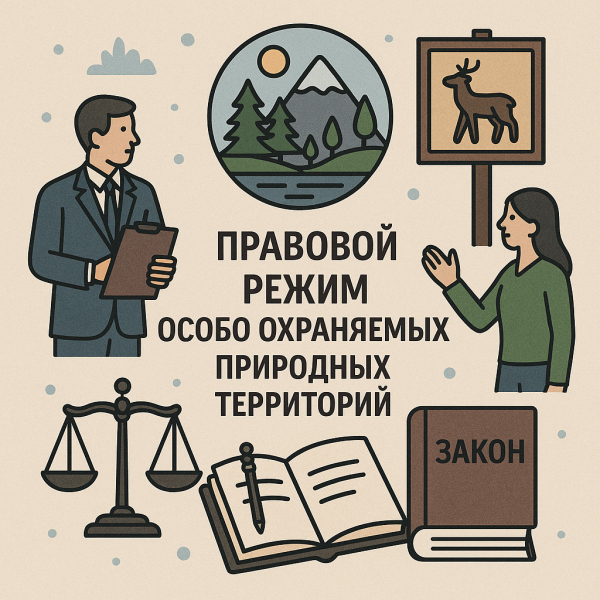
Legal Regime of Especially Protected Natural Territories



Проверьте себя
Право
Короткие вопросы помогут вспомнить главное в документе.
Загрузка вопросов…

Navigation
General Provisions
The legal regime of specially protected natural territories (OOPT) in the Russian Federation represents a set of regulatory rules and restrictions aimed at preserving unique natural complexes and maintaining ecological balance.
Establishing OOPT is considered a priority direction of state environmental policy and an important tool for fulfilling Russia's international obligations in the field of environmental protection.
Special Nature Conservation Territories (OOPT) include land areas land, water objects and airspace above them, possessing special nature conservation, scientific, cultural, aesthetic, recreational and health-promoting significance.
Special protection regimes are established for such territories, including prohibitions and restrictions on economic, recreational and other activities if they may cause damage to natural complexes or contradict the objectives of creating OOPT.
The legal regime of protected natural territories (OOPT) is determined by federal legislation, in particular the Federal Law "On Particularly Protected Natural Territories," as well as laws of the subjects of the Russian Federation.
Depending on the category and level of significance of OOPT, the management procedures, protection regime, and functional zones vary.
On the territories of national parks, there may be zones with limited economic use, while in nature reserves any activity is prohibited, except for scientific and protective activities.
For water objects of special significance, a regime of specially protected water objects is established.
Judicial practice confirms that the set of restrictions and prohibitions on specially protected natural territories must take into account the specific characteristics of the territory, as well as the objectives and goals of protection. The Supreme Court of the Russian Federation confirmed that authorized bodies are entitled to impose additional restrictions on activities that pose a threat
natural complexes, if it is necessary for the preservation of unique ecosystems and the restoration of wildlife populations.
Thus, the legal regime of protected natural areas (PNAs) represents a flexible system of nature conservation, combining restrictions with opportunities for scientific, recreational, and educational activities.
In the Russian Federation, the establishment of specially protected natural territories is a traditional and highly effective form of environmental protection activities. The Ecological Doctrine of the Russian Federation considers the creation and development of specially protected natural territories of different levels and regimes among the main directions of state policy in the field of ecology. The development and improvement of the network of specially protected natural territories ensures the fulfillment by the Russian Federation of its international obligations in the sphere of environmental protection1.
As of the end of 2011, there were more than 13 thousand specially protected natural territories in the Russian Federation of federal, regional, and local significance, with a total area of 211 million hectares, while the area of land territory with internal water bodies (land) amounted to 200.4 million hectares, or 11.7% of the area of Russia. Of these, there were 11,148 specially protected natural territories of regional significance, with a total area of
covers 125.8 million ha (7.3% of Russia's area) and 1598 protected natural territories of local significance, the total area of which is 27 million ha (1.6% of Russia's area)2.
According to the Constitution of the Russian Federation, protected natural territories are under the joint jurisdiction of the Russian Federation and the subjects of the Russian Federation3. Legislation of the Russian Federation on protected natural territories is based on the corresponding provisions of the Constitution of the Russian Federation and consists of the Federal Law "On Protected Natural Territories," adopted in accordance with it
other laws and other regulatory legal acts of the Russian Federation, as well as laws and other regulatory legal acts of the subjects of the Russian Federation.
Relationships arising from the use of land, water, forest and other natural resources on specially protected natural territories are regulated by the legislation of the Russian Federation and the legislation of the subjects of the Russian Federation. Property relations in the area of use and protection of specially protected natural territories are governed by civil law, unless otherwise provided for by this Federal Law (paragraph 1 of Article 1 of the Federal Law "On Specially Protected Natural Territories").
Among the federal laws defining the legal regime of specially protected natural territories, one can highlight: Federal Law «On Environmental Protection», Federal Law «On Particularly Protected Natural Territories», Federal Law «On the Protection of Lake Baikal», Federal Law «On Territories of Traditional Nature Use by Indigenous Small-numbered Peoples»
peoples of the North, Siberia, and the Far East of the Russian Federation», Federal Law «On Natural Medicinal Resources, Health Resort Areas, and Sanatoriums».
Specially protected natural territories represent land areas, water surfaces, and airspace above them where natural complexes and objects with special nature conservation, scientific, cultural, aesthetic, recreational, and health-improving significance are located. These territories have been excluded by decisions of state authorities either entirely or partially from economic use, and a special protection regime has been established for them (preamble of the Federal Law "On Specially Protected Natural Territories"
protected natural territories».
Regarding Special Protected Natural Territories (OOPT), E.A. Galinovskaya notes that the basis of protective activities is a special object – a new qualitative formation, consisting not of individual natural objects, but of a unique combination located at specific geographic coordinates. Thus, a special, unified comprehensive object of ecological legal relations is formed – a natural [territory](/enc/32236/ "Definition of the term 'territory' in
of the legal encyclopedia")4.
Article 66 of the Water Code of the Russian Federation provides for regulation of specially protected water objects. Water objects or their parts having special ecological and nature conservation, scientific, cultural, aesthetic, recreational, and health-improving value may be recognized as specially protected water objects. The status, special protection regime, and boundaries of territories within which the aforementioned water objects are located are established in accordance with legislation on specially protected natural areas.
Judicial Practice
The specific set of restrictions and prohibitions on territories of the corresponding national park is determined taking into account the characteristics of specially protected natural territories.
By an order of the authorized federal state authority, the Regulation on the national park (hereinafter - Regulation) has been approved, according to which any activity causing damage to natural complexes and objects of flora and fauna, cultural-historical objects, and contradicting the objectives and tasks of the national park is prohibited on its territory, in
including commercial, sports, and recreational hunting hunting; possession of firearms, pneumatic weapons, throwing weapons, traps, and other hunting equipment, along with hunted wildlife objects and products obtained from them, except in cases related to conducting activities PO state supervision in the field of protection and use of specially protected natural territories of federal significance, federal state supervision in the field of protection, reproduction, and use of wildlife objects.
of peace and their habitat environment, as well as within the framework of scientific research work by authorized officials.
Regional public organization (hereinafter - organization) submitted an administrative lawsuit petition to the Supreme Court of the Russian Federation, requesting the invalidation of the cited provisions, considering them incompatible with Article 15 of the Law on Protected Natural Areas (OOPT), which prohibits only commercial hunting within national parks, and limiting the rights of organization members to conduct hunting in recreational and economic areas.
zones where, according to other provisions of the Regulation hunting is allowed.
The Supreme Court of the Russian Federation refused to satisfy the submitted claim, with which the Appellate Chamber of the Supreme Court of the Russian Federation agreed.
Having concluded that the order was issued by an authorized federal state authority within its competence and in accordance with current legislation while observing the procedure for its implementation, the Supreme Court of the Russian Federation also noted the following.
According to the wording of sub-item "e" of paragraph 2 of Article 15 of the Law on Protected Natural Areas, any activity may be prohibited within national parks if it contradicts the objectives and tasks of the national park and may cause damage to natural complexes. Accordingly, the list of activities provided in Article 15 of the aforementioned law, the implementation of which is prohibited within a national park, is not exhaustive.
According to the meaning of paragraph 9 of the Regulation on National Natural Parks of the Russian Federation, approved by the Government Decree of the Russian Federation dated August 10, 1993 No. 769 (hereinafter - Regulation on National Natural Parks of the Russian Federation), any types of activities that lead to a reduction of ecological, scientific, aesthetic, cultural and recreational [value](/enc/23562/ "Definition
concepts of 'Values' in the legal encyclopedia") territories.
Specific features, zoning, and regime of each national natural park are determined in its charter (paragraph 11 of the Regulation on National Natural Parks of the Russian Federation).
Restrictions introduced by the disputed provisions of the Regulation are established based on the results of a comprehensive ecological survey of the territory, justifying the granting of its status as a federal-level specially protected natural area, and are necessitated by the need to restore the population numbers of wildlife objects, including hunting resources, within the boundaries of the national park and on adjacent territories.
Accordingly, the disputed provision contains a specific set of restrictions and prohibitions established within the territory of the national park, taking into account the characteristics of this specially protected natural area.
Source: Overview of judicial practice regarding the application of legislation on environmental protection (approved by the Presidium of the Supreme Court of the Russian Federation June 24, 2022)
- Part II of the Concept for the Development of the System of Particularly Protected Natural Territories of Federal Significance for the Period up to 2020 (approved by the Government Decree of the Russian Federation dated December 22, 2011 No. 2322-r // Collection of Laws of the Russian Federation. 2012. No. 3. Art. 452). ↩
- State Report «On the State and Protection of the Environment of the Russian Federation in 2011» p. 29 // Official Website of the Ministry of Natural Resources of Russia. [Electronic Resource]. URL: http://www.mnr.gov.ru/regulatory/list.php?part=1392. ↩
- Part 1, paragraph «d» of Article 72 of the Constitution of the Russian Federation. ↩
- Institutions of Environmental Law / Ed. by S.A. Bogolyubov. Moscow, 2010. p. 224.