Legal Regulation of the Use and Protection of Subsoil



Проверьте себя
Право
Короткие вопросы помогут вспомнить главное в документе.
Загрузка вопросов…

Navigation
- General Provisions
- Basic Requirements for Rational Use and Protection of Subsoil Resources
- Ownership of Subsoil
- Use of Subsoil
- Types of Use of Subsoil Resources
- Basic Rights and Obligations of Subsoil Users
- Grounds for the emergence of the right to use mineral resource plots
- Grounds for Termination of the Right to Use Minerals
General Provisions
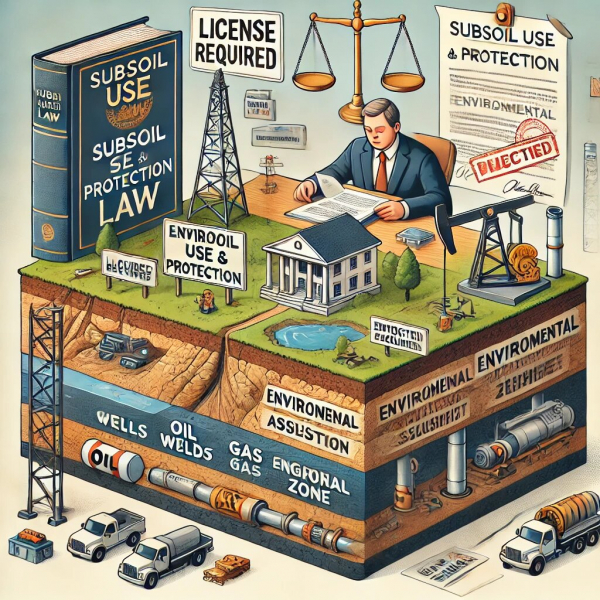
The legal regulation of the use and protection of subsoil resources in the Russian Federation is a key component of state policy in the field of natural resources. Subsoil resources, including minerals, energy resources, and groundwater, are owned by the state, which implies strict control over their rational use and protection. Legislation defines the procedure for granting subsoil resources for use, the rights and obligations of users, as well as liability measures for violations, ensuring a balance between economic benefits and preservation of natural potential.
The main requirements for the rational use of mineral resources include compliance with licenses, comprehensive geological studies, accounting for and preservation of mineral reserves, prevention of pollution and destruction of mineral resources. An important aspect is the conduct of state expert evaluation of projects, monitoring of underground resources, and compliance with environmental standards. Violation of these requirements may result in restrictions or termination of the right to use mineral resources by authorized bodies.
Granting mineral resources for use is carried out through licenses, geological and mining concessions, as well as production sharing agreements. Users acquire exclusive rights to develop or explore a mineral resource area and are obliged to comply with the license terms, ensure safe conduct of operations, and preserve natural resources. Mineral resources may be used simultaneously for geological exploration, prospecting, and extraction of minerals, which allows effectively combining scientific research with economic activities.
Mineral resource users have the right to use the land for various purposes, extract minerals, and manage waste from mining processes. At the same time, legislation imposes obligations on them to keep records, submit reports, comply with environmental standards, protect the environment, and ensure safety in mining operations. Special attention is paid to the qualifications of specialists and adherence to technical specifications, which ensures a professional and safe approach to mineral resource utilization.
The right to use mineral resources arises on the basis of decisions by federal and regional authorities, competitive or auction procedures, production sharing agreements, and state contracts. The termination, suspension, or restriction of the right to use mineral resources may occur in cases threatening human life, violation of license conditions, or emergency situations. Legislation guarantees the possibility of appealing such decisions, ensuring transparency and legal protection for users of mineral resources within the established legal framework.
As noted by N.I. Khludeyeva, the natural potential of mineral resources in the country is enormous; however, this does not mean they are inexhaustible or do not require the state to take timely measures, including those of a legal nature, aimed at rational use, restoration and protection of subsoil resources1.
Basic Requirements for Rational Use and Protection of Subsoil Resources
The main requirements for the rational use and protection of mineral resources are: 1) compliance with the order established by legislation for granting mineral resources into use and prevention of unauthorized use of mineral resources; 2) ensuring comprehensive geological study, rational integrated use and protection of mineral resources; 3) conducting advanced geological study of mineral resources ensuring reliable assessment of reserves of minerals or properties of a mineral resource area granted into use for purposes not related to mining of minerals; 4) conducting state expertise and state account of mineral reserves, as well as subsoil areas used for purposes not related to the extraction of minerals; 5) ensuring the most complete extraction from the subsoil of reserves of main minerals and co-occurring useful minerals and by-products; 6) reliable accounting of extracted and remaining in the subsoil reserves of main minerals and co-occurring useful minerals and by-products during the development of mineral deposits; 7) protection of mineral deposits from flooding, water ingress, fires and other factors reducing the quality of minerals and industrial value of deposits or complicating their development; 8) prevention of subsoil contamination during operations related to mineral resource use, particularly during underground storage of oil, gas, or other substances and materials, disposal of hazardous substances and production waste, and wastewater discharge; 9) compliance with established procedures for conservation and liquidation of enterprises engaged in mining and underground structures not related to mineral extraction; 10) prevention of unauthorized construction on areas where mineral deposits are located and adherence to the prescribed order of using these areas for other purposes; 11) prevention of placement of production and consumption waste on catchment areas
Areas of groundwater bodies and locations of groundwater occurrence used for drinking and household water supply or industrial water supply, or whose reservation has been carried out as sources of drinking and household water supply.
In the event of violation of the aforementioned requirements, the right to use the subsoil may be restricted, suspended, or terminated by authorized state bodies in accordance with legislation (Article 23 of the Law of the Russian Federation "On Subsoil").
Ownership of Subsoil
Subsoil within the territory of the Russian Federation, including underground space and minerals, energy resources, and other resources contained in subsoil, are state property. Issues concerning ownership, use, and disposal of subsoil are under the joint jurisdiction of the Russian Federation and the subjects of the Russian Federation. Subsoil plots cannot be the subject of purchase, sale, gift, inheritance, contribution to a company's capital, pledge, or alienation in any other form. Rights to use subsoil may be transferred or passed from one person to another to the extent permitted by federal laws. Minerals extracted from subsoil and
Other resources under the terms of the license may be owned by federal state property, property of subjects of the Russian Federation, municipal property, private property, and other forms of ownership (Article 1.2 of the Law of the Russian Federation "On Subsoil"). An object of property rights may also be geological and other information on subsoil (Article 27 of the Law of the Russian Federation "On Subsoil").
Owners of land plots, land users, landowners, and lessees of land plots have the right, at their discretion, within their boundaries, to carry out the extraction of commonly distributed mineral resources not listed on the state balance without the use of blasting operations, as well as to construct underground structures for their own needs to a depth of up to five meters, and to install and operate household wells and boreholes on the first aquifer that is not a source of centralized water supply, in accordance with procedures established by the executive authorities of the subjects of the Russian Federation2 (Article 19 of the Law of the Russian Federation "On Subsoil").
Use of Subsoil
Granting subsoil plots for use in the forms of geological concession and mining concession. In accordance with a license for subsoil use for mineral resource extraction, construction and operation of underground structures not related to mineral resource extraction, establishment of specially protected geological objects, as well as in accordance with an agreement on product sharing during exploration and extraction of mineral raw materials, the subsoil plot is provided to the user in the form of a mining concession - a geometrically defined block of subsoil (part 1 of article 7 of the Federal Law of the Russian Federation "On Subsoil"). A subsoil user who has received a mining concession has exclusive the right to use minerals within its boundaries in accordance with the issued license. Any activity related to the use of minerals within the mining area may be carried out only with the consent of the subsoil user to whom it has been granted (Part 4 of Article 7 of the Law of the Russian Federation "On Subsoil").
The subsurface area provided in accordance with a license for geological exploration without significant disruption of the integrity of the subsurface (without conducting heavy mining workings or drilling wells for mineral extraction or constructing underground structures for purposes not related to mineral extraction) is assigned the status of a geological reserve by decision of the federal executive authority managing the state mineral fund or its territorial body. Within the boundaries of the geological reserve, several users of the subsurface may simultaneously conduct operations. Their mutual relations are determined upon granting the subsurface area for use (paragraph 5 of Article 7 of the Law of the Russian Federation “On Subsoil”).
Types of Use of Subsoil Resources
Subsurface resources are provided for use for: 1) regional geological study, including regional geogeophysical work, geological surveying, engineering-geological investigations, scientific research, paleontological and other works aimed at general geological study of subsurface resources, geological work on earthquake prediction and study of volcanic activity, creation and maintenance of monitoring the condition of subsurface resources, control over the groundwater regime, as well as other works carried out without significant disruption to the integrity of subsurface resources; 2) geological study, including exploration and assessment of deposits
mineral resources, as well as geological surveys and assessment of the suitability of subsoil areas for construction and operation of underground structures not related to mineral extraction; 3) exploration and extraction of mineral resources, including utilization of waste from mining and associated processing industries; 4) construction and operation of underground structures not related to mineral extraction; 5) establishment of specially protected geological objects with scientific, cultural, aesthetic, sanitary-hygienic, and other significance (scientific and educational polygons, geological reserves, nature sanctuaries, monuments 6) gathering of mineralogical, paleontological, and other geological collection materials.
Subsurface resources may be provided for use simultaneously for geological study, prospecting, and mining of minerals. At the same time, prospecting and mining of minerals, except for prospecting and mining of minerals on federal subsurface territories, may be carried out both during the geological study of subsurface resources and after its completion. Prospecting and mining of minerals on a federal subsurface territory may be carried out based on a decision by the Government of the Russian Federation regarding the possibility of conducting prospecting and mining of minerals on this subsurface territory by the subsurface user only after its completion
geological exploration of mineral resources on this subsurface area (Article 6 of the Law of the Russian Federation «On Subsoil»). ### Basic Rights of Subsoil Users
The subsurface user has the right: 1) to use the subsurface plot provided to him for any form of entrepreneurial or other activity corresponding to the purpose specified in the license or production sharing agreement; 2) to independently choose forms of this activity not conflicting with current legislation; 3) to use the results of his activities, including extracted mineral raw materials, in accordance with the license or production sharing agreement and current legislation; 4) to use waste from his mining and related processing industries, unless otherwise stipulated in the license or in
agreements on product sharing; 5) limit construction on areas where mineral deposits are located within the boundaries of the mining lease granted to them; 6) conduct geological exploration of subsoil without additional permits at their own expense within the boundaries of the mining lease provided to them under a license or an agreement on product sharing; 7) apply to the licensing authorities for reconsideration of the license terms in cases where circumstances significantly differ from those existing when the license was issued (Article 22 of the Law of the Russian Federation "On Minerals").
Basic Rights and Obligations of Subsoil Users
The subsurface user must ensure: 1) compliance with legislative requirements, as well as approved standards (norms, rules) established in accordance with the procedure for technology of work performance related to subsurface use and primary processing of mineral raw materials; 2) compliance with technical project requirements, plans or schemes for development of mining operations, prevention of excessive losses, dilution and selective extraction of minerals; 3) keeping geological, surveying and other documentation during all types of subsurface use; 4) submission of geological information to the federal and corresponding territorial funds
geological information; 5) submission of reliable data on explored, extractable, and remaining in-situ reserves of minerals, their components, use of mineral resources for purposes not related to mining, to the federal and relevant territorial geological information funds, and to state statistical bodies; 6) safe conduct of operations related to mineral resource utilization; 7) compliance with established standards (norms, rules), regulating conditions for protection of mineral resources, atmospheric air, land, forests, water objects, as well as buildings and structures from harmful impact works related to the use of mineral resources; 8) restoration of land plots and other natural objects affected by the use of mineral resources to a condition suitable for their further use; 9) safety of mining workings, drilling wells and other facilities related to the use of mineral resources located within the boundaries of the mineral resource area provided for use; 10) preservation of exploratory mining workings and drilling wells that may be used in the development of deposits and (or) for other economic purposes; liquidation in accordance with established procedures of mining workings and drilling wells not subject to use; 11) compliance with conditions, established by license or product-sharing agreement, timely and proper payment for the use of subsoil resources; 12) preservation of valuable and hazardous goods, geological, surveying, and other documentation, special correspondence, as well as goods containing carriers of information classified as state secrets.
Requirements are imposed on users of mineral resources or entities involved by them in using such resources to possess special qualifications and experience confirmed by a state license (certificate, diploma) for conducting the relevant type of activity: geological surveys, exploration, mining, various methods of extracting minerals, construction and operation of underground structures, other forms of use of mineral resources (Article 22 of the Law of the Russian Federation "On Mineral Resources").
Grounds for the emergence of the right to use mineral resource plots
The grounds for the emergence of the right to use subsoil plots are: 1) the decision of the Government of the Russian Federation; 2) the decision of a federal executive authority responsible for managing the State Subsoil Fund or its territorial body; 3) the decision of a commission established by a federal executive authority responsible for managing the State Subsoil Fund; 4) the decision of a tender or auction commission on granting the right to use a subsoil plot; 5) the decision of an executive authority of a subject of the Russian Federation, coordinated with a federal executive authority responsible for managing the State Subsoil Fund or its territorial body; 6) adopted in accordance with legislation
subject of the Russian Federation decision by the state authority body of a subject of the Russian Federation; 7) transfer of the right to use mineral deposits in accordance with the grounds established by federal laws regulating mineral resource use; 8) an enforceable production sharing agreement concluded in accordance with the Federal Law "On Production Sharing Agreements"[^3]; 9) a state contract for conducting geological survey of mineral deposits (including regional), concluded by the federal executive authority responsible for state mineral fund management in accordance with the Federal Law «O» the contract system in the field of procurement of goods, works, services to meet the needs of state and municipal purposes"[^4].
Grounds for Termination of the Right to Use Minerals
The right to use minerals ceases: 1) upon expiry of the term specified in the license; 2) if the license holder renounces the right to use minerals; 3) upon occurrence of a specific condition (if such a condition is stipulated in the license), which leads to termination of the right to use minerals; 4) in cases of reissuance of the license in violation of the conditions provided by Article 17.1 of the Law of the Russian Federation "On Minerals"; 5) in cases provided for by the legislation of the Russian Federation on concession agreements.
The right to use minerals may be terminated early, suspended, or restricted by the authority that issued the license in the following cases: 1) emergence of an immediate threat to the life or health of people working or residing in the zone of influence of works related to mineral usage; 2) violation by the mineral user of essential terms of the license; 3) systematic violation by the mineral user of established rules for using minerals; 4) occurrence of emergency situations (natural disasters, military actions and other); 5) if the mineral user has not commenced using the minerals within the term specified in the license as provided for
in volumes; 6) liquidation of an enterprise or another subject of economic activity to which mineral resources have been granted for use; 7) at the initiative of the license holder; 8) non-submission by the mineral resource user of reports mandated by the Russian Federation's mineral resources legislation; 9) at the initiative of the mineral resource user upon their application.
The right to use federal mineral resources for exploration and mining under a combined license is terminated early by the authorities that issued such a license, based on a decision of the Government of the Russian Federation adopted in accordance with paragraph 5 of Article 2.1 of the Law. If the user of the subsoil disagrees with the decision to terminate, suspend, or restrict the right to use the subsoil, they may appeal it through administrative or judicial proceedings. When using the subsoil in accordance with an agreement on product sharing, the right to use the subsoil may be terminated, suspended, or restricted on the conditions and in the order provided by the specified agreement (Article 20 of the Law of the Russian Federation "On Natural Resources").
Articles 41 of the Land Code of the Russian Federation (LC RF). [^3]: A Product Sharing Agreement is a contract under which the Russian Federation grants a business entity (investor) on a remunerative basis and for a specified period of time exclusive rights to exploration, surveying, and extraction of mineral resources on the subsoil area stipulated in the agreement, as well as conduct related works, while the investor undertakes to carry out these works at its own expense and at its own risk. The Agreement defines all necessary conditions relating to the use of subsoil, including the terms and procedures for the division of produced products between the parties to the agreement in
in accordance with the provisions of the Federal Law "On Production Sharing Agreements" (Part 1 of Article 2 of the Federal Law "On Production Sharing Agreements"). [^4]: Federal Law of April 5, 2013 No. 44-FZ «On the Contract System in the Field of Procurement of Goods, Works, Services for State and Municipal Needs» // Collection of Laws of the Russian Federation (СЗ РФ). 2013. No. 14. Art. 1652.
Institutes of Environmental Law / Ed. by S.A. Bogolyubov, Chief Editor. Moscow, 2010. p. 288. ↩
Similar provisions are also contained in the Land Code of the Russian Federation. According to which, the owner of a land plot has the right to use, in accordance with established procedures, for their own needs, commonly occurring minerals, fresh groundwater, as well as ponds and flooded quarries in compliance with the legislation of the Russian Federation (subparagraph 1 of paragraph 1 of article 40 of the Land Code of the Russian Federation). At the same time, persons who are not owners of land plots (land users, landowners, and lessees of land plots), except for holders of servitudes, exercise the rights of land plot owners (paragraph 1 ↩