Territorial Zoning: Concept, Scope, Types



According to S.A. Bogolyubov, just as in other areas of legislation, in other branches of law, knowledge and science, the analysis of content-related representations in the field of legal ecology begins with the development, comparison of concepts and terms denoting them, which ultimately determine the scope, boundaries of the problems under consideration, a set of methods for their solution and prospects, effectiveness of legislation1.
The analysis of the terminological apparatus constitutes an important part of this study, since clarifying the meaning and content of key terms used in the dissertation will allow forming a necessary foundation for achieving the objective and accomplishing the research tasks. The absence of legal definitions for terms employed in legislation often gives rise to discussions, including regarding their essence, content, position within the system of branches of law (and/or individual branches), as well as their relationship with other concepts. This situation was no exception in the considered context concerning the definition of the term "territorial zoning." The aforementioned term
The concept of «Term» in the legal encyclopedia is used in a multitude of laws; however, its legal definition is absent. It should also be noted that in ecological law studies, significant attention has been devoted to researching individual issues of legal regulation of territorial zoning. However, a unified approach to defining the content of territorial zoning at present time has not yet formed.
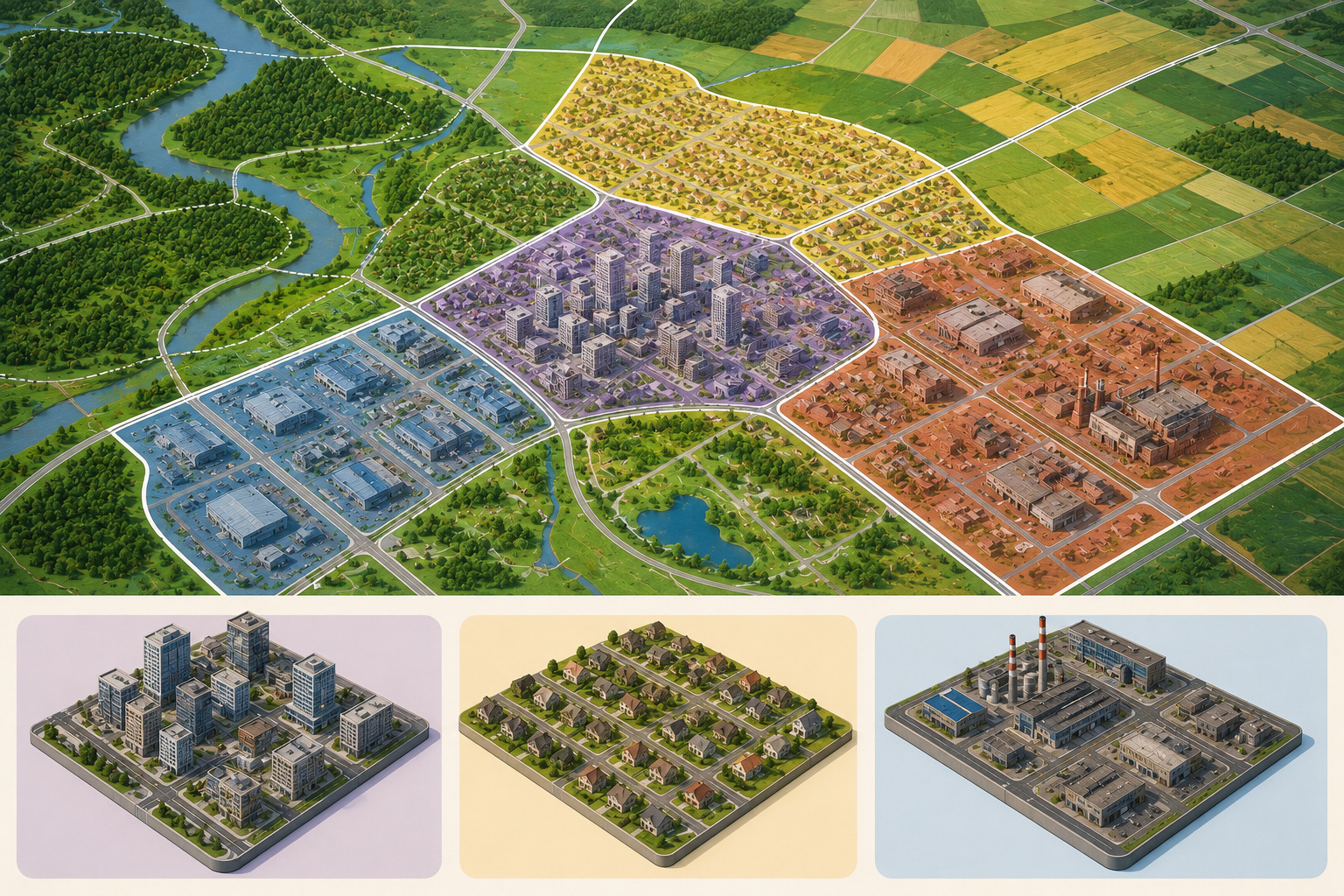
According to Yury G. Zharikov, territorial zoning is a legal measure for the development and implementation of construction rules for territories of urban and rural settlements, other municipal formations. During zoning, the territory of the settlement is divided into several zones with the determination of types of land use for urban planning in each individual settlement2. It is characteristic that zoning of territories in this definition is considered precisely as a legal measure. At the same time, it should also be emphasized that Yury G.
Жариков understands territorial zoning as urban planning zoning in the terminology of the Urban Planning Code of the Russian Federation (hereinafter - GrK RF).
Similar positions are also held by O.I. Krassov3, O.M. Kozyr'4. Some foreign scholars also equate territorial zoning with urban planning zoning. For example, one of the first prominent specialists in the field of zoning in the state of Massachusetts, Philip Nichols (The Massachusetts Law of Zoning and Planning, 1943), proposed the following description of the basic principles of modern zoning: zoning represents the division of a city into districts carried out by entities having [authority](/enc/33218/ "Definition
the concept of "authority" in the legal encyclopedia) organ; in each such area there is a ban on use land for certain purposes, which although safe themselves, cause harm to public welfare at account of creating obstacles to the use of land for those purposes for which it is best suited5.
At the same time, another position is also expressed in scientific literature. For example, according to N.V. Kichigin, zoning in general terms involves dividing a certain territory in accordance with established criteria into several zones, and defining a special regime for each of these zones (ecological restrictions on economic and other activities, differentiated sizes of rental payments, etc.)6. In this definition, a broader approach to zoning territories is expressed, under which zoning
Territorial planning does not reduce exclusively to municipal zoning, but represents the definition of zones and a special regime for such zones.
As noted by A.P. Anisimov, G.L. Zemlyakova, and N.N. Melnikov, currently zoning is generally understood as urban planning zoning, although the latter is no more than a specific case of the general zoning procedure as such7.
E.K. Trutnev considers zoning as a general term encompassing various types. To the types of zoning, E.K. Trutnev refers urban planning zoning, zoning in territorial planning documents, land plot zoning, as well as establishment of zones with special land use conditions8. Such approach to zoning is quite broad. However, E.K. Trutnev does not include in the definition of this term zoning of particularly protected natural territories (for example,
zoning of the Baikal natural territory, zoning of specially protected natural territories).
Some scholars define territorial zoning through the properties and qualities of land within defined zones. For example, according to V.E. Churkin, territorial zoning is the establishment of boundaries for territories (zones) within which land possesses properties and qualities necessary and sufficient for a specific economic activity9.
In scientific literature, zoning is also considered as the process of dividing territory into zones. As noted by O.A. Zolotova, analysis of legislation mentioning zoning allows us to conclude that zoning represents process of dividing territory into parts - zones, with the aim of establishing a uniform regime of territory use within the boundaries of this zone. Zoning of territory allows refining or detailing the legal regime of using this territory. Zoning may apply to a group of land plots or part of a land plot
area, which expands the legislature's opportunities to restrict economic and other activities of individuals and legal entities on certain territories[^11].
Then, according to M.Yu. Galyatin, land use zoning represents a legal method of state regulation of private land ownership, which consists in separating different types of land use and establishing their socially significant parameters by allocating target zones for land use within the territory of administrative units, setting up an appropriate legal regime within their boundaries, and monitoring its compliance10.
The territorial zoning proposed by N.L. Lisina includes two types of zoning11, in the terminology of this study referred to as functional zoning during the implementation of territorial planning12 and urban planning zoning13. At the same time, N.L. Lisina suggests distinguishing territorial zoning from special restricted zones14.
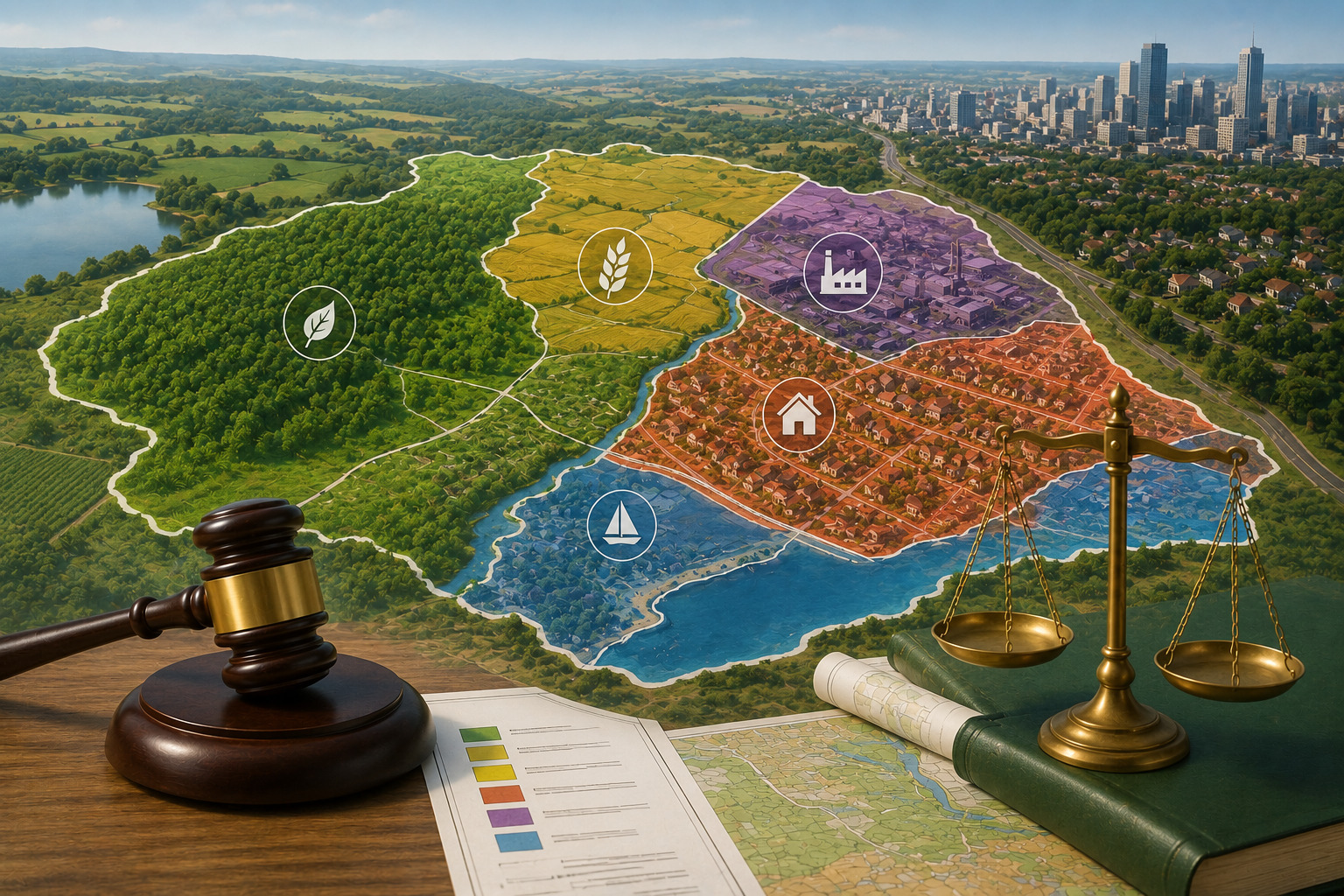
Analysis of the positions presented by scholars allows us to conclude that there are two approaches to zoning territories in legislation and scientific literature: broad and narrow. In the narrow sense, zoning of territories is equated with urban planning zoning. In the broad sense, zoning of territories includes a set of various types of territorial zoning (including urban planning zoning, ecological zoning, functional zoning).
In our opinion, adhering to a narrow approach to territorial zoning leads to the denial of the very possibility of the existence of other types of zoning, the object of which is territory, apart from urban planning zoning. The implementation of a narrow approach to territorial zoning is hindered by the presence in legislation of norms regulating social relations related to other types of zoning (not being urban planning zoning), the object of which is territory (for example,
ecological zoning of the Baikal Natural Territory15, functional zoning within the framework of the territorial planning institution16).
In turn, considering territorial zoning in a broad sense will contribute to the systematization of types of territorial zoning provided by legislation and sufficiently fragmented. Study of territorial zoning in a broad sense allows applying integrated and differentiated approaches to territorial zoning. Within the framework of an integrated approach, it is possible to study territorial zoning comprehensively, contributing to the formation of a system of types of territorial zoning.
Within the framework of a differentiated approach to territorial zoning, it is possible to consider each type of territorial zoning separately, including highlighting the specificity of each type of territorial zoning. A wide approach to territorial zoning will contribute to the systematization and development of norms on territorial zoning applicable to all categories of land. Thus, a wide approach to territorial zoning appears preferable.
An important direction in the systematization of norms regulating social relations related to land zoning is the distinction between the concept of "land zoning," used in the Land Code of the Russian Federation (hereinafter - Land Code of the Russian Federation), and the concept of "urban planning zoning," used in the Urban Planning Code of the Russian Federation. According to E.L. Minina, land zoning under the Land Code of the Russian Federation refers only to lands of populated areas, where territorial zones are established in accordance with urban planning regulations as per Article 85 territorial zones. Other [categories of land](/enc/23387/ "Definition
The concept of «Categories of land» in the legal encyclopedia") are not mentioned17.
A similar position is held by O.I. Krassov, who believes that one of the principal differences between territorial zoning and urban planning zoning lies in the following. As stipulated by the Land Code of the Russian Federation (ZK RF), territorial zoning was supposed to be carried out only with respect to land plots within populated areas. Since the interests of the construction lobby are not limited to the development of land plots within populated areas, urban planning zoning was extended to certain other categories of land18. However, there is also a position regarding the identity of territorial zoning under the ZK RF and
urban planning zoning in the Urban Planning Code of the Russian Federation19.
In scientific literature, emphasis is placed on the absence of a unified approach to zoning territories and permitted use of land plots concerning all categories of land. As noted by A.P. Anisimov, G.L. Zemlyakova, and N.N. Melnikov, at present time there is no unified understanding within land legislation for all categories of land regarding what zoning is and what permitted use, which follows from it. Most clearly, the content of the zoning procedure and permitted
use is defined by urban planning legislation. Meanwhile, the concept of "permitted use" is mentioned in the Urban Planning Code of the Russian Federation for all land plots (there are no exceptions even for reserve lands). This implies the necessity to supplement the Urban Planning Code of the Russian Federation with a special chapter that would establish general provisions on zoning, regulations, and content of the legal construct "permitted use of a land plot," as well as specifics of implementing these procedures for different categories of land. Special consideration is required regarding the question of how many types
permitted use for land plots of various categories (for example, in accordance with Article 37 of the Land Code of the Russian Federation there are three)20.
A similar position is held by P.N. Pavlov, who notes that the concepts of "territorial zoning" and "territorial zone" are not yet accepted for use in relation to lands of most land categories. However, the nature of relationships arising from the division of certain category lands (separating specific territories, establishing their boundaries, and determining a special legal regime for these territories) allows us to assert that norms regarding types of land are, in essence, norms regarding territorial zoning. For example, norms governing the division of forest fund lands into groups of forests,
The categories of forest protection in the first group and specially protected forest areas can be considered as territorial zoning norms 21.
As noted by S.A. Bogolyubov, the principles proclaimed in the law are not only abstract postulates recommended for study within the academic discipline but also serve as a guideline for law enforcement activities — administrative, judicial, and arbitral practice22. In our view, the principle of land legislation established by paragraph 8 of paragraph 1 Article 1 of the Russian Land Code (ЗК РФ)[/enc/32122/ "Definition of the term 'established' in the legal encyclopedia"]23, applies to all lands, not only to lands of populated areas. However, development in the Russian Land Code of the aforementioned principle of land legislation
the legislation has not been fully implemented, as the norms of the Land Code of the Russian Federation (ZK RF) provide for regulation of social relations related to zoning of territories exclusively on land plots of populated areas.
Taking into account the above, we consider that at present time the zoning system, which includes various types of land zoning, is yet to be fully developed. It appears that urban planning zoning within such a system should become one of the types of land zoning. However, we must agree with the positions presented by scholars, stating that at present land zoning under the Land Code of the Russian Federation (ZK RF) in content is identical to urban planning zoning under the Urban Planning Code of the Russian Federation (GPK RF). The difference lies only in the fact that in the GPK RF an attempt has been made to develop [provision](/enc/9743/ "Definition
the concept of "provision" in the legal encyclopedia") principles of land legislation (subparagraph 8 of paragraph 1 Article 1 of the Land Code of the Russian Federation) through the implementation of urban planning zoning not only in relation to land plots of populated areas, but also other categories of land which are not included in the exhaustive list of land for which urban planning regulations are not established24.
At the same time, the arguments of scholars deserve attention regarding how justified it is to refer to such zoning as urban planning (for example, concerning the zoning of agricultural land not classified as agricultural lands, for which an urban planning regulation is established according to paragraph 6 Article 36 of the Russian Urban Planning Code)). However, in order to accurately define the legal regime of lands, it appears that the object of zoning should not only be territories within the boundaries
land, for which urban planning regulations are established (part 6 Article 36 of the Land Code of the Russian Federation). This position is confirmed in scientific literature, for example, E.V. Pantin justified the necessity of zoning agricultural lands within land plots designated for agricultural purposes25. At the same time, E.V. Pantin proposes to carry out zoning of agricultural lands not within the framework of urban planning zoning, but as
an independent type of land use zoning, which appears to be justified.
As a result of comparing the provisions of the Civil Code of the Russian Federation (ZK RF) and the Urban Planning Code of the Russian Federation (GрК RF) in terms of urban planning zoning, one can conclude about duplication of certain provisions of these laws. First of all, this concerns the duplication of provisions of Article 85 of ZK RF and Article 35 of GpK RF, which provide for types and composition of territorial zones.
Also, it should be noted that duplication of provisions of the aforementioned laws occurs in part regarding the provision allowing right holders to independently choose land plots and capital construction objects of any type of permitted use provided by zoning regulations (paragraph 2 of point 2 of article 7 of the Land Code and part 4 of article 37 of the Russian Civil Code).
It is also important to note the collision of the aforementioned norms. In paragraph 2 of point 2 of article 7 of the Land Code, the possibility is established for right holders of land plots and capital construction objects to independently choose any type of permitted use as provided by zoning regulations. Whereas in part 4 of article 37 of the Civil Code of the Russian Federation the possibility is established for right holders of land plots and capital construction objects26 to independently choose only main and auxiliary types of permitted use. The aforementioned provision of the Civil Code of the Russian Federation appears to us more accurate, since the choice is conditional
The permitted type of use of the land plot and the capital construction object cannot be carried out exclusively at the discretion of the owner of the land plot and the capital construction object.
The selection of a conditionally permitted use of a land plot or a capital construction object is carried out in accordance with the procedure established by Article 39 of the Land Code of the Russian Federation (GK RF) (which, among other things, provides for conducting public hearings on this issue). Such a conflict may result in selecting a conditionally permitted use of a land plot and a capital construction object without following the procedure provided by Article 39 of the Land Code of the Russian Federation (GK RF) (including without taking into account the opinion of the population), which appears to be unjustified.
It appears that the presence of the aforementioned norms on urban planning zoning in the Civil Code of the Russian Federation was justified prior to the adoption of the Urban Planning Code of the Russian Federation (in which current issues related to urban planning zoning are now thoroughly regulated). After the adoption of the Urban Planning Code of the Russian Federation, there is no longer a need to regulate social relations related
In scientific literature, emphasis is placed on the comprehensive, multi-faceted legal nature of territorial zoning 27. Scholars consider territorial zoning, including as a method (method, a set of legal means) for determining the legal regime of land.
In scientific literature, it is noted that zoning is characterized by spatial and temporal features. The first of these means that the boundaries of a particular zone must be clearly defined and marked both in documents and on-site; the characteristics and total area of the zone are described. The second feature can manifest in two ways: when the zone is established for a certain period (in years), until a specific condition is met, for an indefinite period (zones in national parks) or when terms are set
review of zones28. However, taking into account the positions presented by scholars, we believe that alongside spatial and temporal characteristics, one can also identify a legal characteristic of territorial zoning.
O.I. Krassov also considers evaluative zoning. The purpose of this type of zoning is that as a result of evaluative zoning, a map (scheme) of evaluation zones is created and the cadastral value of a unit area within these zones is established. Evaluative zoning has no direct relation to defining the legal regime of land29.
It appears that in cases where a specific type of land zoning does not directly affect the legal regime of lands, it is appropriate to speak of the impact (indirect influence) of such a type of land zoning on the legal regime of lands (this issue is considered in more detail in paragraph 3 of Chapter II and in paragraph 1 of Chapter III of this dissertation).
Taking into account the above, for the purposes of this study, zoning is considered as the definition of zones within the boundaries of the territory that is the subject of a specific type of territorial zoning, and the determination of the legal regime or impact on the legal regime of such zones. In this context, defining zones involves: 1) establishing zone boundaries; 2) assigning names to zones (for example, "residential zone", "zone of atmospheric influence") and
in certain cases, the assignment of conditional designations to such zones (for example, «Ж-1», «О-1»).
In scientific literature, there is also an opinion expressed that zoning of individual land plots, provided for by sanitary-epidemiological rules (SP 2.2.1.1312-03) and the order of the Chief State Sanitary Doctor of the Russian Federation dated April 30, 2003, No. 88 does not affect the legal regime of land30. It should be noted that zoning of land plots is not equivalent to territorial zoning and, accordingly, is not the subject of this study.
A separate consideration is warranted for the issue regarding types of territorial zoning and establishing a list of types of territorial zoning. As noted by N.V. Kichigin, federal legislation provides for several varieties of zoning: ecological, pricing, and urban planning31. At the same time, scholars emphasize the lack of systematization of norms regarding various types of territorial zoning32.
In scientific literature, the specific content of the zoning principle is also noted. In connection with the tasks of environmental protection, legal regulation of natural resource use, and ensuring ecological safety of the population and territories, this principle is implemented as follows: a) establishing zones of extreme ecological situations or ecological disasters; b) establishing protective zones for individual environmental objects (water protection zones, mining-sanitary protective zones, etc.); c) zoning within specially protected areas (for example, zones of the Baikal Natural Territory); d) zoning in the implementation
urban planning activities, which in accordance with the Urban Planning Code of the Russian Federation (Federal Law No. 190-FZ dated December 29, 2004) is called territorial33.
I.F. Pankratov, presenting a sufficiently extensive list of types of ecological zoning, noted that this list of objects of ecological zoning is not exhaustive and cannot be made exhaustive, as new objects of ecological zoning may always appear34. The position presented appears to be justified and equally applicable both to ecological zoning (as a type of territorial zoning) and to territorial zoning in general.
Taking into account the above, it is concluded that an open list of types of territorial zoning is preferable, since it will allow the formation of new types of territorial zoning reflecting the dynamics of development of social relations related to territorial zoning, in order to most accurately determine the legal regime of land. In this regard, ensuring the systematization of various types of territorial zoning and defining the relationship between such types of territorial zoning and the classification of land into categories based on their intended use,
Establishment of zones with special conditions for the use of territories.
[11] Legal protection of Lake Baikal: scientific and practical guide / Ed. Y.I. Shuplecova. Moscow, 2011. Pp. 98 – 99. ---
- Bogolyubov S.A. Legislation in the field of ecology. Moscow, 2010. p. 42. ↩
- Commentary on the Federal Law "On State Land Cadastre" (article-by-article) / Ed. by E.A. Galinovskaya. Moscow, 2007. ↩
- For example, O.I. Krassov notes that territorial zoning is a procedure carried out by relevant authorities in accordance with established conditions, during the implementation of which certain coordination of proposed decisions on determining the regime of land use and real estate objects located there must be conducted with owners, holders and
Users of these lands. Zoning is carried out based on a normative legal act. As a result of territorial zoning, not only the legal regime of land plots but also the conditions for creating and operating real estate objects on them are determined in complex. Territorial zoning (urban planning zoning) represents an additional method, compared to land division, for determining the legal regime of lands in populated areas (Krassov O.I. Commentary on the Land Code of the Russian Federation (article-by-article). Moscow, 2009.). ↩ 4. According to O.M. Kozyr', zoning of territory is understood as demarcation of territories,
differing from each other in certain characteristics which cannot be compatible with one another, establishing on this basis boundaries of zones and subzones, lists of permitted uses and admissible construction changes within their limits - urban planning regulations. Justification of restrictions established in zoning for land use is carried out at the stage of analyzing existing land use and planning future land use. Establishment of territorial zones is carried out in such a way that this is territory, including homogeneous areas by
characteristics and parameters of permitted land use (Volkov G.A., Golichenkov A.K., Kozyr' O.M. Post-Article Scientific-Practical Commentary on the Land Code of the Russian Federation / Prepared for the "Consultant Plus" system. 2002.). ↩
5. Cited in: Busher G., Green M. Development of land and land use legislation in the state of Massachusetts, USA // Law and Policy. 2006. No. 11. ↩
6. Bogolyubov S.A., Kichigin N.V. Legislative regulation of activities of federal executive authorities to ensure environmental safety. Moscow, 2007. P. 241. ↩
7. Anisimov A.P., Zemlyakova G.L., Mel'nikov N.N. Zoning as a function
management of land fund: theoretical issues // Modern Law. 2012. № 8. Pp. 87-93. ↩
8. "Zoning" is a general term, encompassing various types and results of corresponding actions. For example, zoning is practiced at the stage of territorial development planning with fixation of general restrictions and representations about future land use (without establishing legally significant regulations), there exists zoning with establishment of legally significant property usage regulations ("legal zoning"), and there is zoning with establishment of boundaries
actions corresponding to the relevant restrictions (water protection zones, sanitary protection zones, monument protection zones and so on), there is functional and building zoning within parts of territories and individual land plots, functional zoning at the level of various floors of planned structures, etc. (Legal zoning of the city. Introduction to issues of urban regulation in market economies
in conditions / Ed. by E.K. Trutnev. M., 2002. P. 7.). ↩
9. Ulyukayev V.K., Churkin V.E., Nakhratov V.V., Litvinov D.V. Land Law. M., 2010. ↩
10. Galatin M.Yu. Zoning – a method of legal regulation of land relations in the USA // Jurisprudence. 1983. No. 6. P. 86–90. ↩
11. According to N.L. Lysina, the legal nature of territorial zoning lies in the fact that it is, on one side, an element of urban planning for land use in settlements, and on the other – a method of legal regulation of land use within the territory of settlements, in
as a result of which the types of permitted use of land plots and real estate objects located on them are determined (Lisina N.L. Legal Regime of Land in Settlements. M., 2004. P. 151.). ↩
12. Functional zoning is considered in detail in paragraph 3 of Chapter II of this dissertation. ↩
13. Urban planning zoning is considered in detail in paragraph 2 of Chapter II of this dissertation. ↩
14. According to N.L. Lisina, territorial zoning should be distinguished from other types of zoning provided for by current legislation - zoning of protected natural areas with the establishment
functional zones and ecological zoning, as well as special restricted zones (Lisina N.L., ibidem, p. 164.). ↩
15. Ecological zoning of the Baikal Natural Territory is discussed in detail in paragraph 1 of chapter II of the present dissertation. ↩
16. Functional zoning is discussed in detail in paragraph 3 of chapter II of the present dissertation. ↩
17. Minina E.L. Permitted Use of Land Plots: Issues of Establishment and Change // Journal of Russian Law. 2012. No. 1. Pp. 62-67. ↩
18. Krassov O.I. Permitted Use and Specific Purpose...
Designation of a Land Plot // Environmental Law. 2012. No. 2. Pp. 16-21. ↩
19. According to L.E. Bandorin, land legislation defines the content of the term "territorial zoning" exclusively as a procedure for determining territorial zones during preparation and adoption of rules of land use and construction. This follows from both the cumulative meaning of articles 1, 7, 34, 40, 42, 85, 87 of the Land Code of the Russian Federation (ЗК РФ), as well as from a direct reference to this in paragraph 11 of article 30, where rules of land use and construction are mentioned.
"encyclopedias") and territorial zoning are denoted as synonyms. In addition, despite the existing terminological discrepancy, the concept of "territorial zoning" (term of the Russian Civil Code) and the concept of "urban planning zoning" (term of the Russian Town Planning Code) are synonyms, denoting the same process of determining permitted land use (Bandorin L.E. Permitted Use of Land Plots: Dissertation ... Candidate of Juridical Sciences. Moscow, 2011. P. 91.). ↩
20. Anisimov A.P., Zemlyakova G.L., Melnikov N.N. Zoning as
function of land fund management: theoretical issues // Modern Law. 2012. № 8. Pp. 87 - 93. ↩
21. Pavlov P.N. Legal regulation of territorial zoning in the Russian Federation // Real Estate and investments. Legal Regulation. 2004. № 1 (18). ↩
22. Environmental Law: textbook / Ed. by S.A. Bogolyubov. Moscow, 2010. P. 45. ↩
23. Subparagraph 8 of paragraph 1 of Article 1 of the Land Code of the Russian Federation provides for the principle of division
land use by designated purpose into categories, according to which the legal regime of land is determined based on their belonging to a certain category and permitted use in accordance with territorial zoning and legislative requirements (a similar provision is contained in paragraph 2 of article 7 of the Land Code of the Russian Federation). ↩ 24. Urban planning regulations are not established for forest fund land, water-covered land, reserve land, and specially protected natural territories (excluding land
healing and health resort areas and resorts), agricultural lands within the category of agricultural land use, land plots located within the boundaries of special economic zones (part 6 Article 36 of the Land Code of the Russian Federation). ↩
25. Pantin E.V. Legal support for targeted rational use of agricultural land: abstract of dissertation ... candidate of legal sciences. Moscow, 2013. P. 10. ↩
26. With the exception of state authorities, local self-government bodies, state and municipal institutions, state and municipal unitary enterprises. ↩
27. Comprehensive
The nature of legal regulation of land relations within municipal boundaries raises the question of the scope of application of norms from various branches of law and the competition established by them between legal regimes for certain parts of the territory of the settlement. One of the methods of establishing different legal regimes on the territory of settlements is zoning for economic, environmental protection, urban planning, and other purposes, as a result of which state authorities and local self-government bodies are granted a range of additional powers (Anisimov A.P., Zemlyakova G.L., Melnikov N.N. Zoning as a Function of Land Fund Management: Issues in Theory //
Modern Law. 2012. No. 8. Pp. 87-93.). Zoning can be considered in three aspects: as a legal measure or tool for regulating economic and other activities, as a legal institution and as a function of management (Anisimov A.P., Zemlyakova G.L., Melnikov N.N. Zoning as a Function of Management of the Land Fund: Issues of Theory // Modern Law. 2012. No. 8. Pp. 87-93.). Institution of zoning: 1) represents a tool for planning and managing territorial development; 2) regulates the order
use, including land development; 3) establishes restrictions regarding the character of land use (Mel'nikov N.N., Savel'eva E.A. Legal regulation of territorial zoning in foreign countries // Russian Justice. 2012. No. 4. Pp. 15-18.). Zoning means: a) granting territory (water area) plots a special legal status; b) establishing a special or differentiated legal regimes, usually determined in special normative legal acts, sometimes - in legislative acts; c) introducing additional restrictions and prohibitions, for [violation](/enc/32659/ "Definition of the term «violation» in
"juridical encyclopedia") which provide (or may provide) enhanced liability, leading to a series of legal (and sometimes socio-legal) consequences (compensation for damage, other measures of social assistance); c) granting additional or exclusive powers (rights and obligations) to subjects of environmental management (for example, providing the population with complete and reliable information, taking additional physical protection measures for objects) (Commentary on the Federal Law 'On Environmental Protection' / Ed. by O.L. Dubovik. Moscow, 2013. P. 319.). Territorial zoning should be considered as a complex
(complex) phenomenon, the content of which can be most fully disclosed as: a complex legal institution; a method (a set of legal means) for determining the legal regime of lands; a legal procedure (Cherednikov A.V. Urban Zoning as a Means of Ensuring Public Ecological and Private Interests: Abstract of Dissertation … Candidate of Juridical Sciences. Moscow, 2012. P. 9.). ↩
28. Commentary on the Water Code of the Russian Federation dated 03.06.2006 No. 74-FZ (post-article) / Edited by O.L. Dubovik. Prepared for the "Consultant Plus" system. 2011. ↩
29. Krassov O.I. Commentary on the Land Code of the Russian Federation (post-article). Moscow, 2009.
↩ 30. In some cases, it is necessary to subdivide the land plot into zones. For example, sanitary and epidemiological rules SP 2.2.1.1312-03 "Hygienic requirements for the design of newly constructed and reconstructed industrial enterprises", introduced into force by the Order of the Chief State Sanitary Doctor of the Russian Federation dated April 30, 2003, No. 88, stipulate that the territory of an industrial facility must have functional zoning. Zoning is determined taking into account adjacency
territories of other functional purposes. The aforementioned types of land zoning do not affect the determination of the legal regime of lands (Krassov O.I. Commentary on the Land Code of the Russian Federation (Article-by-Article). Moscow, 2009). ↩
31. Bogolyubov S.A., Kichigin N.V. Legislative regulation of the activities of federal executive authorities in ensuring environmental safety. Moscow, 2007. P. 241. ↩
32. At present, the legislation mentions more than ten different types of zoning, loosely related to each other, including price zoning, economic zoning (designation of special economic zones),
territorial assessment zoning, etc. In a number of regulatory acts, land use zoning is mentioned, functional zoning, ecological zoning of several types (for example, zoning of the Baikal Natural Territory or functional zoning in national parks), and zoning for the placement of non-commercial gardening, vegetable growing, and dacha associations. It should also be noted Federal Law dated 03.12.2011 No. 392-FZ «On Zones of Territorial
development in the Russian Federation and amendments to certain legislative acts of the Russian Federation (Anisimov A.P., Zemlyakova G.L., Melnikov N.N. Zoning as a Function of Land Fund Management: Issues in Theory // Modern Law. 2012. No. 8. Pp. 87-93). ↩
33. Commentary on the Water Code of the Russian Federation dated June 3, 2006 No. 74-FZ (post-article) / Ed. by O.L. Dubovik. Prepared for the "Consultant Plus" system. 2011. ↩
34. Ecology. Legal Encyclopedic Dictionary / Ed. by Prof. S.A. Bogolyubov. Moscow, 2001. P. 136. ↩