Territory as an Object of Zoning



As noted by Yu.A. Tikhomirov, territory – this is the foundation of the vital activities of all people, states, and the global community. However, from a legal perspective, there exist different regimes of territory. In state theory, this concept is used as one of the characteristics of the state, specifically referring to a strictly defined state territory with fixed boundaries and secured by the sovereign potential of the state.
In constitutional law, the concept of territory may have federal, administrative-territorial, and municipal "cuts." In administrative law, this concept is used to establish territorial limits of the competence of executive authorities and to characterize special "administrative" districts. And in other areas of law, the concept of territory acquires an important norm-generating and legal application meaning, holding a special significance for the jurisdiction of courts.
In international law, the concept of territory also holds significant importance as it is intended to ensure sovereignty within the territories of states while simultaneously guaranteeing international regimes for territories with special status (for example, Antarctica), and international institutions within the framework of their constituent documents (rules). The rapid development of new transportation means has led to concentrated regulation of the corresponding "extra-territorial" issues in international maritime, air, and space law1.
At the same time, defining the content of the legal category «territory» as an object of legal regulation has significant importance for environmental law. Currently, time federal laws are in force, which serve as sources of environmental law and whose object of legal regulation is territory2. The concept of «territory» is frequently used in the Russian Civil Code3 and the Russian Land Code4.
At the same time, as noted by E.A. Galinskaya, a separate legal issue constitutes the absence of a clear legal definition of territory5. In achieving the goal of this research, the problem of the lack of a clear legal definition of territory appears particularly relevant, since it is precisely territory that serves as the object of the types of zoning considered in this dissertation6. Thus, it is important to determine the content of the concept of "territory."
As noted by A.N. Cherikov, in modern law, territory in the broad sense of this term refers to various spaces on Earth's surface, including its land and water surfaces, subsoil, airspace, as well as outer space and celestial bodies located therein7. The state territory comprises such natural components as land, waters, subsoil, airspace8. Thus, territory is considered as a complex legal object.
regulation consisting of multiple components. This position appears justified and finds its confirmation, including in the Constitution of the Russian Federation9.
According to S.V. Narutto, the territory of the state as a geographical space represents a part of the Earth's sphere belonging to a particular state. In addition to the land, the territory of the state includes water and air parts10.
In the context of the Convention on international civil aviation, the territory of a state refers to land territories and adjacent territorial waters under the sovereignty, suzerainty, protectorate, or mandate of that state11. "Territory" with respect to a state includes land surfaces, territorial and internal waters and airspace above them, under the sovereignty
of this state12.
According to V.G. Vishnyakov, the concept of 'territory' has different meanings: 1) [state territory](/enc/33349/ "Definition of the term 'State Territory' in the legal encyclopedia), sphere of state sovereignty, external limits and boundaries of its exercise; 2) geographical space, [natural environment](/enc/24461/ "Definition of the term 'Natural Environment' in the legal encyclopedia), land surface; 3) [object](/enc/31736/ "Definition of the term 'Object' in the legal encyclopedia) of economic activity, basis and condition
economic activity13.
As follows from the Urban Planning Code of the Russian Federation, urban planning regulation is established with respect to a territorial zone and is not limited to the surface of land plots but also applies to everything located above and below their surface14. At the same time, N.V. Kichigin notes that the concept of urban planning regulation should not be understood too broadly. Thus, urban planning regulation does not define the legal regime of subsoil resources, which is regulated by the Law of the Russian Federation "On Subsoil"15.
It should also be noted that in legislation a natural territory is separately identified as an object of zoning16. The legal regime of specially protected natural territories often constitutes the subject of scientific research17.
As noted by E.A. Galinskaya, at the basis of protective activities lies a special object – a new qualitative formation, consisting not of individual natural objects, but from a unique combination of them located at specific geographic coordinates. Thus, a special, unified complex object of environmental legal relations is formed – a natural territory18.
According to O.L. Dubovik, the concept of "natural territory" used in the Federal Law "On the Protection of Lake Baikal" is essentially related to the concept of "natural complex," but expands it by spatial characteristics and grants it a special status19.
As noted by V.V. Zozulya, the legal regime of nature reserves should be understood as normatively established rules, relating to the protection and use of natural complexes and objects, including land, subsoil, water, atmospheric air, flora and fauna, airspace within
within nature reserves, as well as the ownership and designated purpose of these natural complexes and objects. The reserve regime is considered to be a set of behavioral rules prohibiting the disruption of natural processes occurring within the territories of nature reserves and protected zones of national parks20.
Thus, a natural territory is considered in scientific literature as a special complex object of legal regulation. This conclusion, it appears, follows also from the relevant provisions of legislation21. In this regard, the territory may have a legal regime22.
At the same time, it should be noted that the concepts of "territory" and "land" are closely interrelated as objects of legal regulation23. In scientific literature, there are several approaches to the relationship between these scientific categories. According to Yu.G. Barsegov, "land and territory, of course, are not the same thing. They were equated during the feudal period (the 'state-estate' model), but subsequently they were distinguished. And if we use old terminology, we can speak about dominium publicum — the state-law ownership of the socialist state over land, but not over
"state territory"24. As noted by M.M. Brinchuk, "land – this is the territory of the state, the limit of its sovereign authority"25. According to E.A. Galinovskaya, "… land has significance as a territory for human settlement (lands of populated places) …"26.
Thus, analysis of legislation and scientific literature does not allow for a clear distinction between the concepts of "territory" and "land" as objects of legal regulation. However, it appears that the positions presented by scholars are not mutually exclusive. Acknowledging that the concepts of "land" and "territory" are not equivalent, it should also be acknowledged that land can sometimes be considered in the sense of territory.
The concept of «legal regime of land» is widely used in legislation27, scientific literature28 and is well-established. However, a legal definition of this term is absent in legislation. At the same time, in ecological jurisprudence there are quite a few approaches to defining the content of this concept. Let us consider some of them.
As noted by S.A. Bogolyubov, the legal regime of land is determined by a set of rules governing their use and inclusion into civil circulation, protection, accounting, and monitoring established by land, urban planning, forestry, water, environmental protection, and other legislation, mineral resources legislation, and applies to lands of a certain category29.
A.K. Golichenkov defines the legal regime of land as a system of elements including: a) principles applicable to the entire set of legal norms regulating relations concerning the use and protection of lands of a particular category; b) composition of right-holders for lands of this category; c) procedure for the emergence and termination of rights and obligations of right-holders for lands of this category; d) sanctions for [violation](/enc/32659/ "Definition of the term
"violation" in the legal encyclopedia") of legal norms regulating relations regarding the use and protection of land of a particular category; P.r.z. is determined based on their permitted use30.
According to O.I. Krassov, the legal regime of lands (all lands, individual categories and their types) represents a definition in legislation of the content of ownership rights, other rights on land plots, management of use and protection of lands, measures for protecting lands, expressed through the rights and obligations of persons using land plots by establishing the basic purpose of lands, zonization, restrictions on rights, public servitudes, and determining permitted use31.
Then I.A. Ikonitskaya considers the legal regime of land as established by legal norms possible and proper behavior towards land[^68].
A significant contribution to the research on the legal regime of land has been made by such Soviet scholars as G.A. Aksenenev[^69], I.I. Evtykhiev1, N.I. Krasnov[^71].
According to E.A. Galinskaya, a number of land relations (conclusion and performance of contracts aimed at transferring rights to land plots, taxation of land, etc.) can be implemented only with respect to a land plot[^72]. A land plot is a part of the earth's surface whose boundaries are defined in accordance with federal laws (article 11.1 of the Land Code of the Russian Federation (ZK RF)). It should be noted that not all scholars agree with such a definition of a land plot[^73]. However, in this case, we consider it appropriate
shall be guided by current legal norms.
Research on the legal regime of land plots is often part of scientific studies[^74], however scholars' positions regarding the content of the legal regime of land plots also lack uniformity[^75].
Scholars also differ in their views on the elements of the legal regime of land plots. For example, L.E. Bandorin justified the position, according to which permitted [use](/enc/32013/ "Definition of the term 'use' in the legal encyclopedia) of land plots is a primary and essential element of the legal regime of land plots[^76]. However, according to A.A. Minayeva, the main and mandatory element of the legal regime of a land plot is the property relationship[^77].
The position of O.I. Krassov is that the term "lands" is generic in relation to the term "land plot", and naturally, they are interrelated[^78]. At the same time, upon formation of a land plot, it does not lose the properties of land as a natural object and natural resource. This is due to the fact that the provisions of land legislation on rational use and protection apply to land plot
land[^79]. However, it is precisely from the moment of formation land plot that it becomes an object of property turnover[^80]. From the moment the land plot is formed, the legal regime applicable to the corresponding categories of land, within which this land plot is located, applies to it.
In addition, it is precisely the legal regime of lands, rather than land plots, that is determined based on their belonging to a specific category and permitted use in accordance with territorial zoning (subparagraph 8 of paragraph 1 Article 1 of the Land Code of the Russian Federation). It should be emphasized that types of permitted use are established with respect to land plots[^81]. Thus, the legal regime of lands is determined, among other things, based on the type of permitted use of the land plot.
In Chapter III of the Land Code of the Russian Federation (ZK RF), titled "ownership of land", the right of ownership over land plots[^82] is regulated. This indicates that the content of the concept "ownership of land" includes the concept "ownership of land plots".
Therefore, by considering within the framework of this dissertation the significance of zoning territories in determining the legal regime of lands, the content of the legal regime of lands will also include include the legal regime of land plots. At the same time, a territory, like a land plot, may have boundaries defined in accordance with federal laws. However, a territory is not an object of property circulation.
As noted by Yu.A. Tikhomirov, in recent years concepts close to the concept of "territory" have been applied both in domestic science and practice, as well as in foreign and international science and practice. Free trade zones, free economic zones, Common Economic Space, customs territory, border zone, area of sustainable cooperation and others[^83]. This position appears
justified, since in Russian legislation and international law norms, the term "zone" is often understood as a territory within the boundaries of which a special legal regime applies[^84].
Taking into account the above, it should be noted that the scientific categories of "land" and "territory" are closely related. The legal regime of land to a certain extent influences the legal regime of territory, as well as the legal regime of territory affects the legal regime of land. These scientific categories are sometimes equated in legislation and academic literature as objects of legal regulation.
Functional zoning is carried out within the framework of the territorial planning institution. The functional zones map includes: 1) schemes of territorial planning of the municipal district (paragraph 4 of part 1 Article 19 of the Land Code of the Russian Federation); 2) general plan of the settlement (paragraph 4 of part 3 Article 23 of the Land Code of the Russian Federation); 3) general plan of the city district (paragraph 4 of part 3 [Article 23 of the Land Code
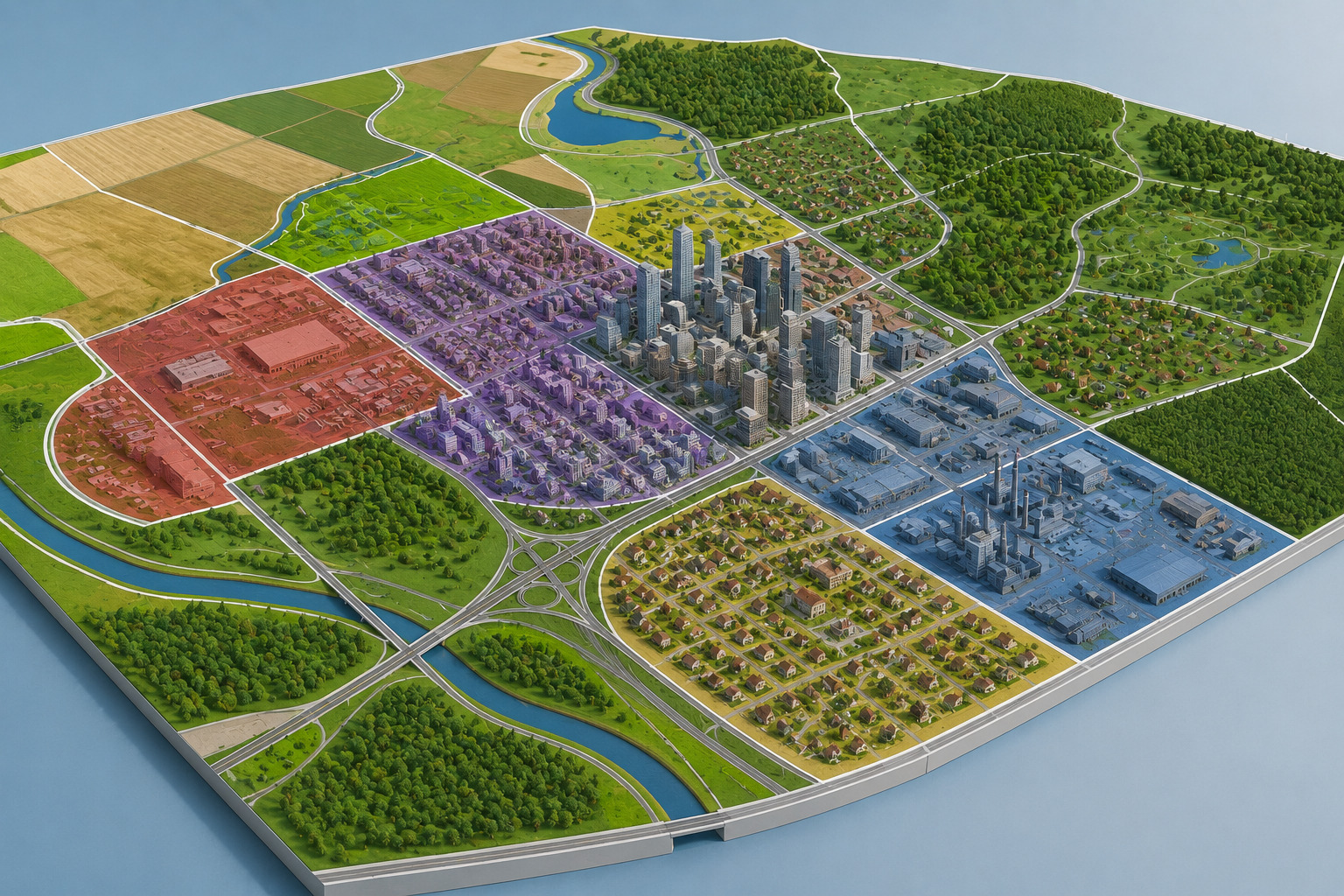
[RF](https://alexeyborisov.ru/law/grkrf/st23/ "Article 23 of the Russian Urban Planning Code (GPK RF)). Urban planning zoning - zoning of territories of municipal formations for the purpose of determining territorial zones and establishing urban planning regulations (paragraph 6 [Article 1 of the Russian Urban Planning Code (GPK RF)](https://alexeyborisov.ru/law/grkrf/st1/ "Article 1 of the Russian Urban Planning Code (GPK RF))).
[69] In the opinion of G.A. Akseneneck, determining the legal regime of any category of land means, first, defining these lands as an object of this land relationship, second, identifying the circle of land users, establishing their rights and obligations, third, revealing the order of state management of these lands, and finally, fourth, indicating the forms and measures of liability prescribed by law for users (Akseneneck G.A. The Legal Regime of Agricultural Lands // Agriculture and Law in the USSR. Moscow: Juridicheskaya Literatura, 1977. p. 55.).
the concept of «established» in the legal encyclopedia") order of proper behavior towards land as an object of exclusive state ownership rights, land use rights, and legal protection, aimed at ensuring its rational use as a universal working conditions and main (primary) means of production (Land Law / Ed. by G.A. Aksen'kov. Moscow, 1969. P. 250.). [^72]: Galinskaya E.A. Application of Land Legislation: Problems and Solutions:
scientific and practical guide. Moscow, 2012. P. 61. [^73]: According to O.I. Krassov, «Violation of land is often associated with intrusion into the subsurface area, into subsoil. In some cases, law does not recognize such actions as use of subsoil, in others - considers them as subsoil utilization. Therefore it is required to obtain a license for subsoil use rights, to formalize mining or
geological reservation. Violation of land leads to the fact that from the standpoint of law, the land surface on the plot is destroyed, for example, during open-pit mining, construction of underground structures not related to mineral extraction, such as underground shopping centers, underground garages, etc. In this regard, it is unlikely justified use of the term «[surface](/enc/8907/ "Definition of the term
«Surface» in the legal encyclopedia")» in the considered legal concept» (Krassov O.I. Land Plot - the Basis of the Conceptual Apparatus of Land Law // Ecological Law. 2011. No. 4. Pp. 4-12.). [^74]: See, for example, Anisimov A.P., Melikhov A.I. Legal Regime of Land Plots. A New Interbranch Approach to the Relationship Between Civil and Land Law Norms. // Law and Economy. 2008. No. 12; Bandorin L.E. Permitted Use of Land Plots: Dissertation ... Candidate of Juridical Sciences. Moscow, 2011; Bugrov D.S. Legal Regime of Land
land plots as real estate: diss. ... cand. jurid. sci. Saratov, 2004; Gerasin S.I. Legal regime of land plots and other real estate objects located on them // State and law. 2006. No. 5. Pp. 118 – 123; Kichigin N.V., Leon'tev A.E. Legal regime of land plots located within the boundaries of water protection zones and coastal protective strips // Ecological law. 2007. No. 4; Kramkova T.V. Civil-law regime of a land plot: diss. ... cand. jurid. sci. Moscow, 2006; Minayeva A.A. Ownership relations as a fundamental and mandatory element of the legal regime of a land plot //
Ecological Law. 2005. No. 6. [^75]: M.G. Piskunova's position is that the legal regime of a land plot is determined by: circulation capability (Article 129 of the Civil Code of the Russian Federation, Article 27 of the Land Code of the Russian Federation, Forestry Code of the Russian Federation, Water Code of the Russian Federation); land category - its intended purpose (Articles 1, 7 of the Land Code of the Russian Federation, Law on the circulation of agricultural lands); permitted use of the plot (Articles 1, 7 of the Land Code of the Russian Federation); territorial zone and urban planning regulations (for settlement lands) (Urban Planning Code of the Russian Federation, Article 85 of the Land Code of the Russian Federation
(RF")) (Piskunova M.V. Cadastre - the head of everything // Business-advocate. 2003. No. 24. Access mode: system "Consultant Plus"). D.S. Bugrov notes that the legal regime of land plots must be determined and disclosed in accordance with the categories of land established by land legislation. The legal regime of land plots is disclosed as an independent comprehensive institution of law, as a set of legal norms in the area of use and
land protection. One of the most important characteristics (criteria) of the legal regime of land plots is their primary purpose, provided in accordance with the features of land categories (Bugrov D.S. The Legal Regime of Land Plots as Real Estate: Thesis ... Candidate of Juridical Sciences. Saratov, 2004.). According to D.V. Kozlov's opinion, the legal regime of land plots as a private law category includes: cadastral survey (establishment of boundaries) and cadastral registration of land plots as objects of land and civil relations; the circle of holders of property and obligatory rights on land plots, their rights and obligations; civil-law
responsibility for violation legislation (Kozlov D.V. Comprehensive (Complex) Legal Regime of Land Plots // System GARANT. 2012.). [^76]: Bandorin L.E. Permitted Use of Land Plots: dissertation ... candidate of legal sciences. Moscow, 2011. P. 42. [^77]: Minayeva A.A. Property Relations as the Main and Mandatory Element of the Legal Regime of a Land Plot // Ecological Law. Moscow. 2005. No. 6. [^78]: Krassov O.I. Land Plot - the Basis of Conceptual
apparatus of land law // Ecological Law. 2011. No. 4. Pp. 4 - 12. [^79]: «Formation of land plots should not lead to interweaving, infiltration, broken boundaries, checkerboard patterns, impossibility of placing real estate objects and other defects hindering rational use and protection of land, as well as violate the requirements established by this Code and other federal laws» (paragraph 6 Article 11.9 of the Land Code of the Russian Federation). [^80]: «[Immovable property](/enc/32275/ "Definition of the term 'immovable property' in
from the legal encyclopedia"), real estate) include land plots, subsoil plots and everything firmly connected with the land, that is, objects whose movement without disproportionate damage to their purpose is impossible, including buildings, structures, incomplete construction objects" (paragraph 1 of Article 130 of the Civil Code of the Russian Federation). [^81]: "[urban planning regulations](/enc/24845/ "Definition of the term 'Urban Planning Regulations' in
"legal encyclopedia") - established within the boundaries of the corresponding territorial zone types of permitted use of land plots, as well as everything located above and below the surface of land plots and used during their development and subsequent operation of capital construction objects, limiting (minimum and/or maximum) sizes of land plots and limiting parameters of permitted construction, reconstruction of capital construction objects, as well as limitations on the use of land plots and objects
capital construction;» (point 9 article 1 of the Civil Code of the Russian Federation). [^82]: See, for example, point 1 article 15 of the Land Code of the Russian Federation, according to which land plots acquired by citizens and legal entities on grounds provided for by the legislation of the Russian Federation are property of citizens and legal entities (private property). [^83]: Legal Space and the Individual: Monograph / Eds. Yu.A. Tikhomirov, E.V. Pulyaeva, N.I. Khludeyeva. Moscow, 2012. p. 13. [^84]: For example, zone of emergency situation - this is
territory on which an emergency situation (paragraph 4 of Article 1 of Federal Law No. 68-FZ dated December 21, 1994 "On Protection of Population and Territories from Emergency Situations of Natural and Technological Nature" // RSZ RF. 1994. No. 35. Art. 3648.). Zone of Emergency Notification of the Population - this is a [territory prone to the risk of occurrence of rapidly developing dangerous natural phenomena and technological processes](/enc/22085/
"Definition of the concept 'Territory at Risk of Rapidly Developing Dangerous Natural Phenomena and Technogenic Processes' in the legal encyclopedia"), posing a direct threat to the lives and health of people located on it (paragraph 11 of Article 1 of the Federal Law "On Protection of Population and Territories from Emergencies of Natural and Technogenic Nature"). Term "Residential Area" (Жилая зона) refers to a specially equipped
territory on which special rules of road traffic apply and entries to which and exits from which are marked by appropriate signs (Convention on Road Traffic (concluded in Vienna 08.11.1968) // Treaty Series. Volume 1732. New York: United Nations, 1999. P. 396 - 587.). Water protection zones are territories adjacent to the coastal lines of seas, rivers, streams, canals, lakes, and reservoirs on which a special regime for conducting economic and other activities is established in order to prevent pollution,
prevention of pollution and silting up of the specified water bodies, depletion of their waters, as well as preservation of the habitat of aquatic biological resources and other objects of the animal and plant world (Part 1 of Article 65 of the Water Code of the Russian Federation dated June 3, 2006, No. 74-FZ // Collection of Laws of the Russian Federation. 2006. No. 23. Article 2381 (hereinafter – WCRF)).
- Legal Space and the Individual: Monograph / Resp. Eds. Yu.A. Tikhomirov, E.V. Pulyaeva, N.I. Khlyudeneva. Moscow, 2012. Pp. 12–13. ↩
- For example, Federal Law dated March 14, 1995 No. 33-FZ "On Particularly Protected Natural Territories" // Collection of Laws of the Russian Federation (СЗ РФ). 1995. No. 12. Art. 1024 (hereinafter – Federal Law "On Particularly Protected Natural Territories"); Federal Law dated May 7, 2001 No. 49-FZ "On Territories of Traditional Nature Use by Indigenous Small-numbered Peoples of the North,"
«On Traditional Nature Use Territories of Indigenous Small-numbered Peoples of the North, Siberia and the Far East of the Russian Federation» // Collection of Laws of the Russian Federation. 2001. No. 20. Art. 1972 (hereinafter - Federal Law «On Traditional Nature Use Territories of Indigenous Small-numbered Peoples of the North, Siberia and the Far East of the Russian Federation»). ↩
3. See articles 1, 3, 7, 11, 11.2, 11.3, 11.4, 11.7, 12, 13, 15, 18, 19, 22, 27, 29, 30, 30.2, 31, 34, 36, 38.2, 67, 68, 70.1, 72, 82, 84, 85, 86, 87, 90, 93, ,94, 95, 96, 97 of the Civil Code of the Russian Federation. ↩
4. See articles 1, 2, 4, 6, 7, 8, 8.1, 9, 10, 11, 12, 14, 15, 16, 18, 19, 20, 21, 23, 24, 25, 26, 27, 28, 30, 31, 32, 33, 34, 35, 36, 37, 38, 39, 41, 42, 43, 44, 45, 46, 46.1, 46.2, 46.3, 47, 48, 49, 49.1, 51, 52, 54, 55, 55.5, 55.8, 55.21, 55.22, 56, 57, 57.1, 59, 63 of the Urban Development Code of the Russian Federation
of the Russian Federation (article-by-article) / Ed. by S.A. Bogolyubov. Moscow, 2012. p. 77. ↩
6. Ecological zoning is carried out in relation to natural territories. Article 2 of the Federal law dated 01.05.1999 № 94-FZ "On the Protection of Lake Baikal"[42] //Collection of Laws of the Russian Federation. 1999. No. 18. Article 2220 (hereinafter – Federal law "On the Protection of Lake Baikal") provides for ecological zoning of the Baikal Natural Territory. According to paragraph 1 of article 15 of the Federal law "On Particularly Protected Natural Territories", for the purpose of establishing the regime of a national
parking is carried out by zoning its territory. ↩ 7. Cherikov A.N. Territorial Organization of the Russian Federation. Legal Foundations. M., 2009. P. 41. ↩ 8. Cherikov A.N. Territory of Russia and Ecological Priorities of International Cooperation. International Law and National Regulation of the Ecological Sphere of Society: Collection of Articles / Eds. S.A. Bogolyubov, Yu.S. Shemshuchenko. M., 2011. P. 174. ↩ 9. According to Part 1 of Article 67 of the Constitution of the Russian Federation, the territory of the Russian Federation includes the territories of its subjects, [internal
waters](/enc/24566/ "Definition of the term «Internal Waters» in the legal encyclopedia") and territorial sea, airspace above them. ↩
10. Territory in public law: monograph / S.V. Narutto, E.S. Shugrina, I.A. Isaev, I.A. Alebastrova. Moscow, 2013. P. 36. ↩
11. Article 2 Convention on International Civil Aviation (concluded in Chicago on 07.12.1944) // International Public Law. Collection of Documents. Vol. 2. Moscow, 1996. P. 412 - 433. ↩
12.
See, for example, paragraph "g" of part 1 of article 1 of the Agreement between the Government of the Russian Federation and the Government of the Republic of Belarus on air communication and cooperation in the field of air transport (concluded in Minsk on 12.12.1997) // Bulletin of international treaties. 1998. No. 6; paragraph "g" of part 1 of article 1 of the Agreement between the Government of the Russian Federation and the Government of the Republic of Tajikistan on air communication (concluded in Moscow on 12.09.1997) // Collection of Laws of the Russian Federation. 2004. No. 38. Art. 3773. ↩
13. Vishnyakov V.G. Special Economic Zones: Legal Issues and Development Paths // [Journal](/enc/3529/
"Definition of the term 'Journal' in the legal encyclopedia of Russian law." 2003. No. 1. ↩
14. The urban planning regulation consists of permitted uses of land plots established within the boundaries of the corresponding territorial zone, as well as everything located above and below the surface of land plots (paragraph 9 Article 1 of the Urban Planning Code of the Russian Federation) ↩
15. Bogolyubov S.A., Kichigin N.V. Legislative regulation of the activities of federal executive authorities in ensuring environmental safety. Moscow, 2007. P.
- ↩
- Article 2 of the Federal Law "On the Protection of Lake Baikal" provides for ecological zoning of the Baikal Natural Territory. According to Part 1 of Article 15 of the Federal Law "On Particularly Protected Natural Territories", zoning of its territory is carried out in order to establish the regime of a national park. ↩
- See, for example, Bogolyubov S.A., Zhuravleva L.V. Organization of use of an individual object of particularly protected natural territories // Law and Economy. 2010. No. 10; Bogolyubov S.A. [Legislation](/enc/1150/ "Definition of the term
"Law-Making" in the legal encyclopedia) in the field of ecology. Moscow, 2010; Galinskaya E.A., Kichigin N.V., Ponomarev M.V. Commentary on the Federal Law "On Particularly Protected Natural Territories" (Article-by-Article). Moscow, 2006; Dektireva L.P. Legal Regime of Particularly Protected Urban Natural Territories: Dissertation... Candidate of Juridical Sciences. Moscow, 2002; Zozulya V.V. Legal Regime of State Nature Reserves and National Parks: Dissertation... Candidate of Juridical Sciences. Moscow, 2006. p. 9; Commentary on the Federal Law "On Particularly Protected Natural Territories" (Article-by-Article) / Ed. by O.L. Dubovik. Prepared for the "Consultant Plus" system. 2009; Krotik A.S. Legal Issues of Organization and
functioning of specially protected natural territories of federal significance: diss... candidate of juridical sciences. Moscow, 2003; Okorokova L.Ya. Legal regime of state natural reserves in the USSR: diss... candidate of juridical sciences. Moscow, 1971; Chernushenko S.S. Legal regime of specially protected natural territories: diss... candidate of juridical sciences. Saratov, 1999. ↩
18. Institutions of Environmental Law / Ed. by S.A. Bogolyubov. Moscow, 2010. P. 224. ↩
19. Commentary on the Federal Law of January 10, 2002 No. 7-FZ "On Environmental Protection" (article-by-article) / Ed. by O.L. Dubovik. Prepared for the "Consultant Plus" system. 2010. ↩
20. Zozulya V.V. Legal regime of state natural
reserves and national parks: diss.... candidate of legal sciences. M., 2006. P. 9. ↩
21. In the preamble to the Federal Law "On Particularly Protected Natural Territories," it is noted that particularly protected natural territories are land areas, water surfaces, and airspace above them where natural complexes and objects with special nature conservation, scientific, cultural, aesthetic, recreational, and health value are located, which have been excluded by decisions of state authorities entirely or partially from
for economic use and for which a special protection regime is established. According to paragraph 1 of article 2 of the Federal Law "On the Protection of Lake Baikal", Baikal Natural Territory - an area that includes Lake Baikal, water protection zone adjacent to Lake Baikal, its drainage basin area within the territory
of the Russian Federation, strictly protected natural territories, adjacent to Lake Baikal, as well as the territory adjacent to Lake Baikal with a width of up to 200 kilometers to the west and northwest of it. ↩
22. In Chapter III of the Federal Law "On the Territories of Traditional Natural Resource Use of Indigenous Small-numbered Peoples of the North, Siberia and the Far East of the Russian Federation," provisions regarding the legal regime of traditional natural resource use territories are provided. In this chapter, in particular, it is stipulated that the legal regime of the territories
The territories of traditional land use are established by provisions on territories of traditional land use, approved respectively by the authorized federal executive authority of the Government of the Russian Federation, executive authorities of the subjects of the Russian Federation, local self-government bodies with the participation of persons belonging to small-numbered peoples and communities of small-numbered peoples or their authorized representatives. Land plots and other separate natural objects located within the boundaries of territories of traditional land use are provided to persons belonging to small-numbered
to the peoples and communities of small-numbered peoples in accordance with the legislation of the Russian Federation (Article 11 of the Federal Law "On Territories of Traditional Natural Resource Use of Indigenous Small-Numbered Peoples of the North, Siberia, and Far East of the Russian Federation"). ↩
23. For example, according to the Constitution of the Russian Federation, land and other natural resources are used and protected in the Russian Federation as the basis of life and activities of peoples residing on the corresponding territory (Part 1 of Article 9 of the Constitution of the Russian Federation). In the resolution
The Constitutional Court of the Russian Federation has provided an interpretation of the term "basis of life and activities." In particular, the ruling notes that the peoples residing within the territory of a certain subject of the Russian Federation must be guaranteed protection and use of land and other natural resources as the basis of their life and activities, i.e., as natural wealth, values (heritage) of public significance. However, this cannot
mean that ownership of natural resources belongs to the subjects of the Russian Federation. The Constitution of the Russian Federation does not prescribe mandatory transfer of all natural resources into the ownership of the subjects of the Russian Federation and does not grant them authority to delimit ownership of these resources (Decision of the Constitutional Court of the Russian Federation dated 07 June 2000 No. 10-P «On the case regarding checking
constitutionality of certain provisions of the Constitution of the Republic of Altai and the Federal Law "On the General Principles of the Organization of Legislative (Representative) and Executive Bodies of State Authority of the Subjects of the Russian Federation" // Collection of Laws of the Russian Federation. 2000. No. 25. Art. 2728.). ↩
24. Barsyev Yu.G. Territory in International Law. Moscow, 1958. p. 63. ↩
25. Brinchuk M.M. Environmental Law: textbook. Moscow, 2010. p. 414. ↩
26. Galinskaya E.A. Application of Land Legislation: Problems and Solutions: Scientific and Practical Guide. Moscow, 2012. p. 49. ↩
27. For example, "division of land by purpose...
«Assignment to categories in accordance with which the legal regime of land is determined based on their belonging to a specific category and permitted use in accordance with territorial zoning and legislative requirements;» (paragraph 8 of part 1 Article 1 of the Land Code of the Russian Federation). «Differentiated approach to establishing the legal regime of land, according to which when determining their legal regime, natural, social, economic and other factors should be taken into account;» (paragraph 10 of part 1 Article 1 of the Land Code of the Russian Federation).
«Adoption in territorial planning documents of boundaries of functional zones does not entail a change in the legal regime of lands located within these zones» (Part 12 Article 9 of the Land Code of the Russian Federation). «The boundaries of hunting grounds include lands whose legal regime allows for the conduct of activities in the field of hunting management» (Part 1 of Article 7 of Federal Law No. 209-FZ dated July 24, 2009 "On Hunting and on Conservation of Hunting Resources and on Amending Certain Legislative Acts of the Russian Federation" // RSZ RF. 2009. No. 30. P. 3735). ↩
28. See, for example, Aksenenev G.A. Legal Regime of Lands
agricultural purpose // Agriculture and Law in the USSR. Moscow, 1977; Anisimov A.P. Theoretical Foundations of the Legal Regime of Settlement Land in the Russian Federation: Abstract of a Dissertation ... Doctor of Juridical Sciences. Saratov, 2004; Balezin V.P. Main Issues of the Legal Regime of Land in Rural Settlements: Abstract of a Dissertation ... Candidate of Juridical Sciences. Moscow, 1972; Balezin V.P. The Legal Regime of Urban Development Land: Dissertation ... Candidate of Juridical Sciences. Moscow, 1960; Bedova E.S. The Legal Regime of Land in Settlements: Abstract of a Dissertation ... Candidate of Juridical Sciences. Moscow, 2012; Bogolepov R.D. The Legal Regime of Industrial and Transport Purpose Land: Abstract of a Dissertation ... Candidate of Juridical Sciences. Moscow, 1964;Evtikhiev I.I.
Regulation of land relations in cities. Горки. 1929; Erofeev B.V. Legal regime of urban land. Moscow, 1976; Galinskaya E.A. Application of land legislation: problems and solutions: scientific-practical guide. Moscow, 2012; Land and law: Guide for Russian landowners / Ed. by the authoring team and responsible editor S.A. Bogolyubov. Moscow, 1997; Zotova O.A. Legal regime of protected area lands: abstract of thesis ... candidate of legal sciences. Moscow, 2013; Iconitskaya I.A. Land law of the Russian Federation. Moscow, 1999; Krasnov N.I. Theoretical foundations of the legal regime of special-purpose lands in the USSR: abstract of thesis ... doctor of legal sciences. Moscow, 1966; Krassov O.I. Concept and content of the legal regime of land //
Environmental Law. 2003. No. 1; Lisina N.L. Legal Regime of Settlement Lands: Abstract of the Thesis ... Candidate of Legal Sciences, Moscow, 2003; Minina A.A. The Concept of "Legal Regime of Lands" and Its Significance in Land Law // Issues of Property Law. 2005. No. 1; Minina E.L. Permitted Use of Land Plots: Issues of Establishment and Change // Journal of Russian Law. 2012. No. 1. Pp. 62–67; General Theory of Soviet Land Law. Ed. by N.A. Syrodoyev. Moscow, 1983; Sivakov D.O. Legal Regime of Lands of the Water Fund: Thesis ... Candidate of Legal Sciences. Moscow, 2004; Tarasenko O.V. Legal Regime of Transport Lands. Moscow, 2009; Trifonov A.S.
Civil Law Regime of Industrial Lands: Abstract of Dissertation ... Candidate of Legal Sciences. Volgograd, 2006; Umerenko Yu.A. Some Issues of the Legal Regime of Reserve Lands // Modern Law. 2012. No. 7. pp. 74–79; Fatkullina D.F. Legal Regime of Nature Conservation Lands: Dissertation ... Candidate of Legal Sciences. Moscow, 2006. ↩
29. Land and Law: A Guide for Russian Landowners / Ed.-in-Chief and Resp. Editor S.A. Bogolyubov. Moscow, 1997. pp. 34–35. ↩
30. Golichenkov A.K. Environmental Law of Russia: Dictionary of Legal Terms. Moscow, 2012. p. 299. ↩
31. Krassov O.I. Concept and Content of the Legal Regime of Lands // Environmental Law. 2003. No. 1. ↩
In the opinion of I.I. Evtykhiev, under the common legal basis – state ownership of land – there exist different, non-overlapping land use regimes for individual categories of land. A land use regime is understood as the status of rights and obligations of land management authorities in relation to a particular category of land, i.e., the performance by land management authorities of basic functions – administrative, judicial, and regulatory (Evtykhiev I.I. Regulation of Land Relations in Cities. Gorky, 1929. P. 1.). [^71]: According to N.I. Krasnov, the legal regime of the state land fund should be understood as established ↩