Legal Regulation of Ecological Zoning



April 30, 2012, the President of the Russian Federation approved the Foundations of State Policy in the Field of Ecological Development of the Russian Federation for the period up to 2030 1 (hereinafter - Foundations). Development of the Foundations is driven by the necessity of ensuring ecological safety during economic modernization and in the process of innovative development (paragraph 4 of the Foundations). As one of the mechanisms for addressing the task of preserving the natural environment, including natural ecological systems, objects of fauna and flora, provision is made for strengthening protection and development
systems of specially protected natural territories of federal, regional, and local significance in strict accordance with their intended purpose (subparagraph (a) of paragraph 16 of the Foundations).
The object of ecological zoning includes protected natural territories. As noted by S.A. Bogolyubov, the regime of use for protected territories and objects currently has a fundamental significance and allows through targeted legislative activity to ensure their protection from encroachment by economic and entrepreneurial activities2. According to N.V. Kichigin, a characteristic of the regime
The management of particularly protected natural territories and objects consists in the ecological zoning of the aforementioned territories3.
The legal regime of specially protected natural territories is often the subject of research (including monographic) by environmental lawyers4. As noted by V.V. Zozulya, the legal regime of nature reserves should be understood as normatively established rules, relating to the protection and use of natural complexes and objects, including land, subsoil, water, atmospheric air, plant and [animal world](/enc/11979/ "Definition
the concept of "Fauna" in the legal encyclopedia"), airspace within protected areas, as well as ownership and designated use of these natural complexes and objects. The protected area regime is considered to be a set of rules governing behavior prohibiting the disruption of natural processes occurring on territories of protected areas and protected zones of national parks5.
In ecological law science, numerous approaches have been developed to define the content of ecological zoning. According to I.F. Pankratov, as per legislation, ecological zoning of territories is a system of measures provided for by legislation to accurately and clearly establish boundaries of territories, aquatic areas, air space, natural objects and resources with the aim of ensuring their rational use and protection. Ecological zoning
territories are directly related to land use and environmental protection. Lands, forests, waters, subsoil and other natural objects are divided into specific plots, territories, zones; zones are also designated in the atmosphere and even in space. Zoning is necessary for conducting relevant monitoring and cadastres, accounting of natural objects, proper and rational use of them, and adequate protection6.
As noted by V.V. Sosnovsky, the essence of zoning for environmental protection purposes typically lies in establishing within zones restrictions on activities that are more stringent than those applicable to adjacent areas of space. The establishment of zones implies setting spatial and temporal boundaries for the application of restrictions on economic or other activities7.
According to M.M. Kalenchenko, zoning is a scientifically justified division of territory of a national park into areas with different functioning and protection regimes. It is one of the most important elements of territorial organization of a national park. Functional zoning, reflecting spatial differentiation of nature conservation regimes and consequently differentiation of permissible and necessary activities, serves as the starting point for all organizational-management
activities8.
N.L. Lisina's position is that ecological zoning is a separate type of zoning. Its primary task is to preserve and maintain ecological balance, the quality of the environment, and natural environmental conditions9.
I.F. Pankratov noted that ecological zoning of territories plays an important role in regulating the organization and protection of the environment and natural resource use. In this regard, two special Federal Laws have been adopted and are currently in force: Federal Law No. 209-FZ dated December 26, 1995 "On Geodesy and Cartography" and Federal Law No. 152-FZ dated December 18, 1997 "On the Naming of Geographical Objects." Ecological zoning ensures accurate accounting and location of each natural object and resource, contributing to better organization of their use and protection10.
Various types of zones established for nature conservation purposes represent a specific case of particularly protected territories. Therefore, necessary elements of the legal regime of nature conservation zones include regime restrictions (regime of special protection), spatial and, if necessary, temporary boundaries of restriction application11.
As noted by N.I. Khlyudeneva, the stability of legal regulation of social relations in the field of environmental protection and natural resource use largely depends on the quality of the system of environmental law, which today is unbalanced and has internal contradictions (collisions)12.
It is important to note that the presence of conflicts is characteristic of ecological zoning. At present time legislation lacks a unified terminology regarding ecological zoning. The legislation provides for "zoning" and "functional zoning" of the national park13, "zoning"14 of the nature reserve, and "ecological zoning" of the Baikal Natural Territory15.
According to S.A. Bogolyubov, national parks, being nature conservation, ecological education, and scientific research institutions (which unites them with reserves), are also intended for regulated tourism. By the decree of the Council of Ministers - Government of the Russian Federation dated August 10, 1993, No. 769, the Regulation on national natural parks of the Russian Federation was approved. A serious practical problem arises as zoning and proper [use](/enc/32013/ "Definition of the term
“Use” in the legal encyclopedia) their territories16.
According to Part 5 of Article 15 of the Federal Law "On Particularly Protected Natural Territories," functional zoning is understood as a differentiated regime of special protection for national parks established by the authorized federal executive body. S.A. Bogolyubov and L.V. Zhuravleva note that the Federal Law "On Particularly Protected Natural Territories" provides only general requirements and contains general approaches to determining the legal regime of specially protected natural territories. The entire scope of regulation is entrusted to the respective federal, regional, and local authorities depending on the level
values of the protected object17.
In scientific literature, the content of the special protection regime is discussed. According to E.A. Galinskaya, the special protection regime is a system of administrative and legal measures prohibiting or prescribing the performance of specific actions on the territory, or prescribing the commission of certain actions, established by legislation and depending on the status of a specially protected natural territory. Based on this mechanism, nature reserves, national parks, and other specially protected [natural territories](/enc/2664/
"The definition of the term 'Natural Territories' in the legal encyclopedia provides a protection regime, in addition to the Federal law, through a territorial regulation which is adopted in accordance with established procedures and provides for the establishment of a differentiated protection regime on the territory through its functional zoning18."
In judicial practice, disputes arise regarding the determination of specific zoning characteristics of specially protected natural areas. In the Ruling of the Supreme Court of the Russian Federation dated February 8, 2012, in case No. 5-Г12-3, it is noted that the applicant filed an application with the [court](/enc/31724/ "Definition of the term 'Court' in the legal encyclopedia) requesting the invalidation of the first and second paragraphs of paragraph 2 of the [Moscow Government Decree](/enc/6285/ "Definition of the term 'Moscow Government Decrees' in the legal
"Encyclopedias") from December 29, 1998 No. 1012 "On project proposals for establishing boundaries of particularly protected natural territories: Natural-Historical Park 'Moskvoretsky', Natural-Historical Park 'Ostankino' and Complex Nature Reserve 'Petrovsko-Razumovskoye' in part relating to inclusion into the boundaries of the natural-historical park of a land plot allocated to the applicant for gardening. According to the applicant, inclusion of this land plot into the boundaries of the natural-historical park means de facto introduction of a prohibition on gardening, which violates the applicant's right to use the land plot allocated in 1956 to his family for
engaging in horticulture.
In the motivational part of the aforementioned Supreme Court ruling of the Russian Federation, it is noted that establishing the boundaries of a natural-historical park is not equivalent to defining specific features, zoning, or the regime of a specially protected natural territory, and even less so to imposing restrictions on activities—in our case, gardening and vegetable growing19.
In scientific literature, it is noted that one of the main approaches to establishing the regime of a national park is, as can be seen from the content of paragraph 1 of Article 15 of the Federal Law "On Protected Natural Territories," functional zoning. Zoning is carried out based on the regulations regarding the national park, adopted by the Ministry of Natural Resources of the Russian Federation, taking into account the basic requirements established by Article 15 of the Federal Law "On Protected Natural Territories." On [legal regime of land](/enc/18022/ "Definition of the term 'Legal Regime of Land"
"land regime» in the legal encyclopedia") of a national park are subject to provisions of the Russian Federation Land Code (ZK RF), establishing general provisions regarding the legal regime of land of particularly protected natural territories as an independent category, as well as special provisions concerning lands of national parks. At the same time, it should be noted that the legal status of land of particularly protected natural territories is based on several basic legal conditions. The legal regime of a land plot within whose boundaries a particularly protected natural territory is located, as a whole, should correspond to its established status and regime
the corresponding specially protected natural territory20.
At the same time, as noted by M.M. Kalenchenko, the issue of the legal status of functional zones has not been resolved either in doctrine, legislation, or even more so in judicial practice. Nevertheless, certain juridically significant foundations have already been developed and implemented in Russian legislation, although they bear a "mosaic character" (for example, types and restrictions on activities)21.
However, in scientific literature, the content of the legal regime of functional zones is disclosed. According to O.I. Krassov, [functional zones](/enc/23565/ "Definition of the term 'Functional Zones' in the legal encyclopedia), delineated on territories of national parks, are not the result of implementing a procedure specified by law. The establishment of functional zones is carried out administratively when creating a specially protected area, and they are indicated in the regulations of the corresponding specially protected area. Through such functional zones, types
use of land in particularly protected natural territories for specific purposes (permitted use definition of use in the legal encyclopedia). Such zoning has no resemblance to territorial zoning (urban planning zoning)22.
It is important to note that the differential special protection regime allows for the determination within the boundaries of the relevant specially protected natural territories of various zones, including recreational ones. For example, the recreational zone of the national park «Losinyi island» is intended for ensuring and carrying out recreational activities, developing physical culture and sports, as well as accommodating objects of the tourism industry, museums, and information centers (paragraph 10.3 of the National Park Regulations)
Thus, the legal regime of zones determined based on environmental zoning ensures the achievement of primarily environmental protection objectives. However, when implementing environmental zoning, it may provide for the designation of zones not directly linked to the protection of natural territories.
N.L. Lisina distinguishes between ecological zoning of the Baikal Natural Territory and zoning of specially protected natural territories with the establishment of functional zones24. Such a conclusion can quite logically follow as a result of formal-legal analysis of legislative provisions. However, within the scope of this paragraph it appears necessary to clarify the content of ecological zoning.
The position of Yu.V. Dobrushin is that the diversity of natural complexes and methods of managing them, as well as the multiplicity of impacts from parties such as various groups of visitors, local population, business entities, authorities, and other interested parties represent the main problem of territorial management in a national park. In order to effectively address the tasks set for the national park under these conditions, functional zoning of its territory is applied — that is, dividing it into areas with different priority purposes.
(function) and with various protection and usage regimes. Functional zoning is the most important tool for managing the territory and resources of a national park, allowing for the establishment of an optimal balance between usage measures and special protection for different areas. Functional zoning determines which management methods best ensure the achievement of the national park's objectives on individual parts of its territory. Functional zone is the primary unit of territorial management by the national park25.
The object of ecological zoning also includes the Baikal Natural Territory. As noted by S.A. Bogolyubov, new initiatives and specific features of environmental protection on the Baikal Natural Territory introduced during the lawmaking process have found practical implementation over the past ten years, although the principles and requirements stipulated in the Law on the Protection of Lake Baikal have not been fully implemented26.
The importance of protecting Lake Baikal and the Baikal Natural Territory was recognized quite early. In 1994, the Government of the Russian Federation approved a Comprehensive Federal Program for Ensuring the Protection of Lake Baikal and the Rational Use of Natural Resources in Its Basin (hereinafter referred to as the Program)27. In Section 3 of this Program, it was noted that the main objective of the Program is the optimization of relationships between humans and nature aimed at effective reproduction
natural resources, improving the state of the environment, and sustainable regional development. The program also provided for stimulating scientific and technical progress in the field of rational use of natural resources with the aim of creating production-technological potential meeting modern ecological requirements, particularly in areas where ecosystems are highly vulnerable. At the same time, ecological zoning of the Lake Baikal basin is noted as an organizational basis for addressing these issues, in accordance with refined territorial boundaries and regulations on economic activities within them.
The subsequent adopted Federal law "On the Protection of Lake Baikal" provided for ecological zoning of the Baikal Natural Territory in Article 2 (Article 2 of the Law on the Protection of Lake Baikal). In the opinion of M.M. Brinchuk, considering the potential of nature as a methodological basis can be viewed as an attempt to introduce legal regulation of natural resource use in the Baikal region with regard to ensuring the status of Baikal as a world heritage site28.
In accordance with Article 2 of the Federal Law "On the Protection of Lake Baikal", on the Baikal Natural Territory the following zones are designated: 1) Central Ecological Zone29; 2) Buffer Ecological Zone30; and 3) Ecological Zone of Atmospheric Influence31.
According to paragraph 1 of Article 11 of the Federal Law "On the Protection of Lake Baikal", in the central ecological zone the following are prohibited: 1) clear-cutting; 2) conversion of forest land occupied by protective forests into lands of other categories. At the same time, organization of tourism and recreation in the central ecological zone is carried out in accordance with rules ensuring compliance with permissible
permissible load norms on the environment in the central ecological zone. Rules for organizing tourism and recreation in the central ecological zone are approved by the state authorities of the Republic of Buryatia, the state authorities of the Irkutsk Region (article 12 of the Law on the Protection of Lake Baikal)32.
N.V. Kichigin notes that the regime of restriction of economic activity in the Central Ecological Zone is maximum, therefore when determining the boundaries of the zone it is necessary to take into account the fact that economic activity within its boundaries will be paralyzed, and sustainable economic development of these territories will be under threat. At the same time, the strict restriction regime for economic activities in the Central Ecological Zone allows to ensure protection and preservation of Lake Baikal to the maximum extent, therefore its size should guarantee
environmental safety of the lake and adjacent territories33.
D.O. Sivakov in a scientific article devoted to the legal protection of lakes noted the high level of legal technique of the Law of the Republic of Armenia dated 14.06.2001 № ZR-190 "On Lake Sevan"34(hereinafter – Law "On Lake Sevan"). In Chapter 2 of the aforementioned law, ecological zoning is provided for, which is carried out for the purposes of restoration, protection, reproduction and use of the ecosystem of Lake Sevan, regulation of economic and other activities on the lake and in its watershed basin (part 1 of article 5 of the Law "On Lake Sevan"). According to D.O. Sivakov's opinion, in order to regulate economic and
for other activities on the lake and within its catchment area, the method of ecological zoning is applied, providing for the establishment of a central ecological zone, as well as zones of direct and indirect impact. Nature reserves, protected areas, and territories with a free economic regime35 may be located within the zones of direct and indirect impact.
In 2009, the Government of the Russian Federation approved the Strategy for socio-economic development of the Far East and Baikal regions up to 202536. In section IV of the aforementioned Strategy (the current state and prospects for development of basic industries of the economy of the Far East and Baikal regions) it is noted that to address modern environmental problems, it is necessary to establish clear environmental standards
environmental quality standards based on territorial zoning principles, grounded in the principle of permissible environmental impact, as well as introduce an indicator system for assessing the state of the environment to enable systematic monitoring. Thus, taking into account the results of territorial zoning when preparing standards is aimed at addressing existing ecological problems. According to M.M. Brinchuk, differentiation of requirements regarding the use of natural resources in the region and protection of ecosystems contributes to the zoning of the Baikal Natural Territory37.
As noted by O.I. Krasov, ecological zoning of the Baikal Natural Territory does not represent any procedure. It is implemented on various categories of land in an administrative manner, and its objective is to establish certain restrictions on economic activities, including when using land for the purpose of protecting Lake Baikal. Ecological zoning - establishing restrictions on the rights of persons to land38.
According to O.A. Zolotova, the idea of zoning the territory adjacent to Lake Baikal emerged in connection with the need to control and reduce the impact of natural and anthropogenic factors on lake39.
As a result of analyzing scholars' positions and provisions of legislation, it can be concluded that zoning of national and natural parks, as well as zoning of the Baikal Natural Territory, provides for establishing a differentiated regime of special protection of the natural territory. Taking the above into account, it appears that in legislation, "zoning" and "functional zoning" of a national park, "zoning" of a natural park, and ecological zoning of the Baikal Natural Territory are understood as a single type of territorial zoning with identical content. In order to minimize conflicts in environmental legislation
It is advisable to ensure the unification of terminology applicable to norms regulating social relations related to ecological zoning.
However, the problem arises in choosing the most accurate term to denote the corresponding type of land zoning. Zoning is a general [term](/enc/7435/ "Definition of the term 'Term' in the legal encyclopedia), encompassing a set of special types of zoning. In this regard, the use of the general term "zoning" in relation to a specific type of land zoning appears unjustified. The [term](/enc/7435/ "Definition of the term 'Term' in the legal encyclopedia) "functional zoning" is also considered inadmissible
applicable to the zoning of specially protected natural territories, since it may lead to conflicts regarding the relationship with functional zoning carried out within the framework of territorial planning, due to the fact that one term will denote activities that are fundamentally different in content types.
Taking into account the above considerations, it appears that zoning of particularly protected natural territories should be regarded as ecological zoning. In this regard, it is appropriate to recognize the terminology used in the Federal Law "On the Protection of Lake Baikal" and ensure uniformity of terminology by replacing the terms "zoning"40 and "functional zoning"41 in relation to the territory of the national park, as well as the term "zoning"42 in relation to the territory of the natural park with the general term "ecological zoning." Furthermore, in order to achieve uniformity of terminology, it is also proposed to replace the terms used in the Federal Law
«On Particularly Protected Natural Territories» term «functional zones»43 by the term «ecological zones». Such changes to legislation, in our opinion, will contribute to minimizing conflicts between norms regulating social relations related to ecological zoning.
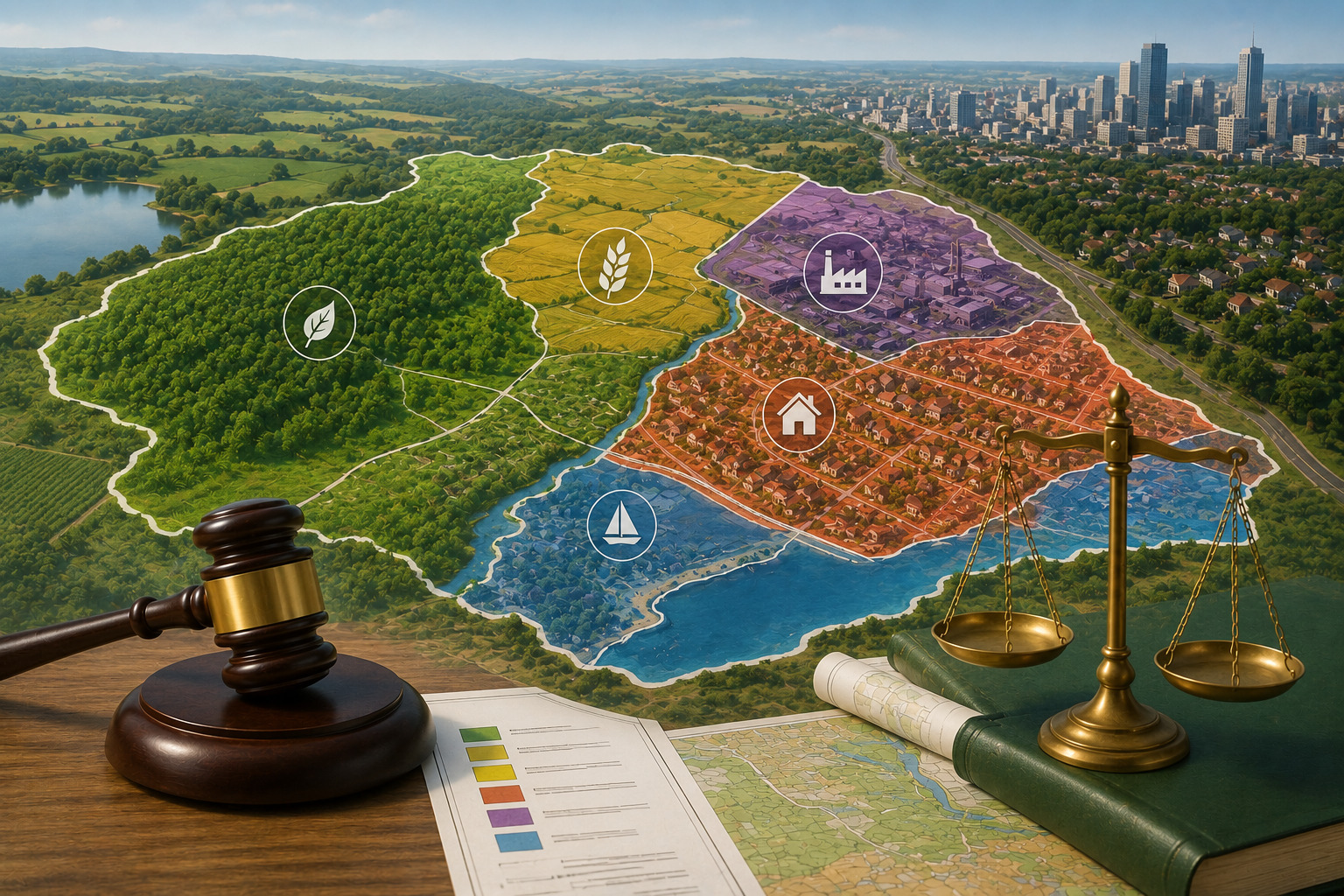
The analysis of legislation and scholars' positions allows asserting that ecological zoning is a method for determining the legal regime of land through the identification of corresponding zones. At the same time, the legal regime of zones determined on the basis of ecological zoning constitutes an element of the legal regime of land.
It should also be noted that a national park and a natural park are specially protected natural territories, in relation to which legislation provides for zoning. At the same time, it should be taken into account that, for example, article 9 of the Federal Law "On Specially Protected Natural Territories" (regime of special protection of territories of state nature reserves) does not contain any references to zoning of territories of state nature reserves.
However, in scientific literature, the specified activity is considered as zoning. M.V. Ponomarev notes that the aforementioned article of the Federal Law "On Particularly Protected Natural Territories" generally provides for ecological zoning of the territory of a state natural reserve: on land plots where any human intervention in natural processes is prohibited; on land plots where partial economic activity is allowed;
encyclopedias"). The specific zoning of protected areas, the definition of permissible economic activities within their territories, is determined in the relevant provisions on state natural reserves44.
Thus, ecological zoning is carried out primarily with the aim of preserving natural territories, within the boundaries of which certain types of economic activities are prohibited or restricted by legislation. At the same time, ecological zoning may be implemented with respect to natural territories regardless of whether such zoning is provided for by federal legislation.
Taking into account the above, it can be concluded that ecological zoning is a method of determining the legal regime of ecological zones. Legal regime of land is determined, among other things, based on their belonging to a certain ecological zone. Thus, ecological zoning can also be considered as a method of determining the legal regime of land. At the same time, the legal regime of an ecological zone is broader than the legal regime of land within the corresponding zone, since ecological zoning determines [legal regime of land](/enc/18022/ "Definition
the concept of «Legal regime of land» in the legal encyclopedia), as part of a natural complex located within the boundaries of the corresponding zone.
The legal regime of ecological zones is established from the moment the normative legal act on the corresponding natural territory comes into force. Ecological zoning is carried out without conducting the procedure of public hearings, which is provided for in projects of documents on territorial planning and land-use zoning.
The content of the legal regime of ecological zones consists of the order of permissible and required behavior of participants in legal relations in relation to the natural complex located within the boundaries of the respective zones, established by legal norms.
- Foundations of state policy in the field of ecological development of Russia for the period up to 2030 (approved by the President of the Russian Federation on April 30, 2012). Document was not officially published. Access mode: SPS «Garant». ↩
- Bogolubov S.A. Legislative activity in the field of ecology. Moscow, 2010. P. 275. ↩
- Bogolubov S.A., Kichigin N.V. Legislative regulation of activities of federal executive bodies to ensure environmental
safety. Moscow, 2007. p. 130. ↩
4. See, for example, Bogolyubov S.A., Zhuravleva L.V. Organization of use of an individual object of specially protected natural territories // Law and Economy. 2010. No. 10; Bogolyubov S.A. Lawmaking in the field of ecology. Moscow, 2010; Galinovskaya E.A., Kichigin N.V., Ponomarev M.V. Commentary on the Federal Law "On Particularly Protected Natural Territories" (article-by-article). Moscow, 2006; Dektireva L.P. Legal regime of specially protected urban natural territories: diss. ... cand. jurid. sci. Moscow,
2002; Zozulya V.V. Legal regime of state natural reserves and national parks: diss. ... candidate of juridical sciences. Moscow, 2006. P. 9; Commentary on the Federal Law "On Particularly Protected Natural Territories" (article-by-article) / Ed. by O.L. Dubovik. Prepared for the Consultant Plus system. 2009; Krotik A.S. Legal issues of organization and functioning of particularly protected natural territories of federal significance: diss. ... candidate of juridical sciences. Moscow, 2003; Okorokova L.Ya. Legal regime of state natural reserves in the USSR: diss. ... candidate of juridical sciences. Moscow, 1971; Petrov V.V. Nature reserve Fund:
object of management and protection // Ecological Law of Russia at the Turn of the 21st Century. Collection of Scientific Articles / Ed. by A.K. Golichenkov. Moscow, 2000. Pp. 148-153; Chernushenko S.S. Legal Regime of Particularly Protected Natural Territories: diss. ... candidate of legal sciences. Saratov, 1999. ↩
5. Zozulya V.V. Legal Regime of State Nature Reserves and National Parks: diss. ... candidate of legal sciences. Moscow, 2006. P. 9. ↩
6. Ecology. Juridical Encyclopedic Dictionary / Ed. by Prof. S.A. Bogolyubov. Moscow, 2001. P. 134. ↩
7. Commentary on the Federal Law of December 20, 2004 No. 166-FZ «On Fishing and Conservation of Aquatic Biological
"Resources» (article-by-article) / Ed. O.L. Dubovik. Prepared for the «Consultant Plus» system. 2011. ↩
8. Commentary on the Federal Law «On Particularly Protected Natural Territories» (article-by-article) / Ed. O.L. Dubovik. Prepared for the «Consultant Plus» system. 2009. ↩
9. Lisina N.L. The above-mentioned work, p. 164. ↩
10. Commentary on the Federal Constitutional Law «On the Government of the Russian Federation» (article-by-article) / Ed. L.A. Okunkova. M., 1999. ↩
11. Commentary on the Federal Law dated 20.12.2004 No. 166-FZ «On Fishing and Conservation of Aquatic Biological Resources» (article-by-article) / Ed. O.L. Dubovik. Prepared for the system «Consultant
Plus». 2011. ↩
12. Khlyudeneva N.I. Collisions in Environmental Law: Abstract of the Dissertation ... Candidate of Juridical Sciences. Moscow, 2007. p. 3. ↩
13. In part 1 of article 15 of the Federal law «On Specially Protected Natural Territories», it is stated that «in order to establish the regime of a national park, zoning of its territory ... is carried out», while in part 5 of the same article it is noted that «the differentiated regime of special protection (functional zoning) of national parks is established by the authorized federal executive body». ↩
14. Specific characteristics, zoning and regime of each natural park are determined by the regulations on this
natural park, approved by state authorities of the respective subjects of the Russian Federation in coordination with the federal executive authority in the field of environmental protection and the relevant local self-government bodies (paragraph 6 of article 21 of the Federal Law "On Specially Protected Natural Territories"). ↩
15. Article 2 of the Federal Law "On Protection of Lake Baikal" provides for ecological zoning of the Baikal natural territory. ↩
16. Bogolyubov S.A., Khludeyeva N.I. Commentary on the Federal Law No. 7-FZ dated January 10, 2002 "On Environmental Protection" (per-article). Moscow, 2009. ↩
17.
Bogolyubov S.A., Zhuravleva L.V. Organization use of a particular object of particularly protected natural territories // Law and Economy. 2010. No. 10. ↩
18. Institutions of Environmental Law / Head of the authoring collective S.A. Bogolyubov. Moscow, 2010. P. 237. ↩
19. Ruling of the Supreme Court of the Russian Federation from 08.02.2012 No. 5-G12-3. The Document was not published. Access mode: [system](/enc/23826/ "Definition of the term "System" in the legal
"encyclopedia") «Consultant Plus». ↩
20. Galinskaya E.A., Kichigin N.V., Ponomarev M.V. Commentary on the Federal Law «On Particularly Protected Natural Territories» (Article-by-Article). Moscow, 2006. ↩
21. Commentary on the Federal Law «On Particularly Protected Natural Territories» (Article-by-Article) / Ed. by O.L. Dubovik. Prepared for the system «Consultant Plus». 2009. ↩
22. Krassov O.I. Commentary on the Land Code of the Russian Federation (Article-by-Article). Moscow, 2009. ↩
23. Order of the Ministry of Natural Resources and Environment of Russia dated March 26, 2012 No. 82 «On Approval of the Regulations on the National Park «Losinyy island» //
Russian newspaper from 29.08.2012 (No. 197). ↩
24. See Lisina N.L., op. cit., pp. 164-165. ↩
25. How to create a plan for managing a national park. Practical recommendations / Auth.-comp. Yu.A. Buyvolov. Moscow, 2002. ↩
26. Buyvolov S.A. Legislation-making in the field of ecology. Moscow, 2010. P. 311. ↩
27. Resolution
Governments of the Russian Federation from 25.11.1994 № 1306 «On the Comprehensive Federal Program for Ensuring Protection of Lake Baikal and Rational Use of Natural Resources in Its Basin» // Collection of Laws of the Russian Federation. 1994. № 33. Art. 3440. ↩
28. Brinchuk M.M. The Potential of Nature as an Instrument of Environmental Law // Environmental Law. 2010. № 4. Pp. 8 - 14. ↩
29. Central Ecological Zone - territory, which includes lake Baikal with
islands, the water protection zone adjacent to Lake Baikal, as well as protected natural territories, adjacent to Lake Baikal; ↩
30. Buffer ecological zone - territory outside the central ecological zone, including the catchment area of Lake Baikal within the territory of the Russian
Federation; ↩
31. Ecological Zone of Atmospheric Influence - territory outside the watershed area of Lake Baikal within the territory of the Russian Federation, up to 200 kilometers wide to the west and northwest of it, on which economic facilities are located, the activities of which have a negative impact on the unique ecological system of Lake Baikal. ↩
32. Provisions relating to
ecological zoning of the Baikal Natural Territory is specified in the decree of the Government of the Russian Federation dated 06.09.2000 № 661 «On Ecological Zoning of the Baikal Natural Territory and Informing the Population about the Boundaries of the Baikal Natural Territory, its Ecological Zones and Features of the Regime of Ecological Zones» // Collection of Laws of the Russian Federation. 2000. № 37. Art. 3727. ↩
33. Bogolyubov S.A., Kichigin N.V. Legislative Regulation of Activities of Federal Executive Bodies in Ensuring Ecological Safety. Moscow, 2007. P. 132. ↩
34. Sivakov D.O. On Legal Protection of Lakes // [Journal](/enc/3529/ "Definition of the term «Journal» in
"Legal Encyclopedia") of Russian Law. 2012. No. 2. Pp. 36-45. ↩
35. Sivakov D.O. Ibid. ↩
36. Government Decree of the Russian Federation dated December 28, 2009 No. 2094-r "On Approval of the Strategy for Socio-Economic Development of the Far East and Baikal Region until 2025" // Collection of Laws of the Russian Federation (SZ RF). 2010. No. 4. Art. 421 ↩
37. Brinchuk M.M. Ecosystem approach in law // Ecological Law. 2008. No. 1. ↩
38. Krassov O.I. Commentary on the Land Code of the Russian Federation (Article-by-Article). Moscow, 2009. ↩
39. Legal protection of a lake
Baikal: Scientific and Practical Guide / Ed. Yu.I. Shuplecova. Moscow, 2011. p. 100 ↩
40. Paragraph 1 of Article 15 of the Federal Law "On Particularly Protected Natural Territories". ↩
41. Paragraph 5 of Article 15 of the Federal Law "On Particularly Protected Natural Territories". ↩
42. Paragraph 6 of Article 21 of the Federal Law "On Particularly Protected Natural Territories". ↩
43. Paragraphs 2 and 3 of Article 17, paragraph 2 of Article 21, paragraph 2 of Article 29, paragraph 3 of Article 38 of the Federal Law "On Particularly Protected Natural Territories". ↩
44. Galinovskaya E.A., Kichigin N.V., Ponomarev M.V. Commentary on the Federal Law "On Particularly Protected Natural Territories" (article-by-article).
M., 2006. ↩