Relationship Between Functional, Urban Planning, and Ecological Zoning




Software According to S.A. Bogolyubov, the relationship – delimitation and interaction – of competing norms in the urban planning and environmental sectors of Russian legislation presents an important task and a specific problem of their implementation, requiring qualified professional consideration and resolution with the aim of improving the effectiveness of provisions, mutual complementarity, preventing duplication, parallelism, and layering of norms and legal institutions1. Problems of the relationship between norms of urban planning and environmental legislation have not become
exception regarding territorial zoning.
In scientific literature, emphasis is placed on the lack of systematicity in norms regulating social relations related to territorial zoning. For example, A.P. Anisimov, G.L. Zemlyakova and N.N. Melnikov note that at present, legislation mentions more than ten different, loosely connected types of zoning2. According to O.I. Krassov's opinion, the term "zoning" is widely used in our legislation. However, a clear understanding of what zoning represents as a legal instrument,
by means of which tasks of regulating land use are solved is not yet present in the theory of land law and legislation3.
As noted by N.I. Khlyudeneva, among the main reasons for the low efficiency of regulatory possibilities in environmental law stands the issue of its collisionality (contradictoriness), caused by various factors and requiring an adequate solution4. For norms regulating social relations related to territorial zoning, the presence of collisions is characteristic. As examples, one can cite problems arising from the relationship between "territorial zoning" in the Land Code of the Russian Federation (Zemel'nyy Kodeks RF) and "urban planning zoning" in the Urban Planning Code of the Russian Federation (Gradostroitel'nyy Kodeks RF)5, as well as the absence of unified terminology applicable to norms on zoning of particularly protected natural areas
territories6.
To eliminate existing conflicts, it is necessary to systematize the norms regulating social relations related to territorial zoning. One of the activities aimed at systematizing such norms may serve as determining the relationship between the types of territorial zoning considered within the scope of this study.
As noted by N.V. Kichigin, uncertainty remains regarding the relationship between land use and development rules (ПЗЗ) and general plans of municipal formations. According to paragraph 3 of Article 31 of the Urban Planning Code of the Russian Federation7, when preparing land use and development rules, provisions of general plans should be taken into account. However, paragraph 9 of this same article8 establishes that the project of land use and development rules must be checked for compliance with the general plan. This formal but significant contradiction prevents making a clear conclusion regarding the relationship between general plans and land use and development rules9.
At the same time, it is also important to consider the provisions of paragraph 2 of part 1 Article 34 of the Land Code of the Russian Federation10 and paragraph 3 of part 2 Article 36 of the Land Code of the Russian Federation11, according to which the boundaries of territorial zones and urban planning regulations are established, including taking into account functional zones. Commenting on part 3 Article 31 of the Land Code of the Russian Federation12, E.K. Trutnev and L.E. Bandorin consider the relationship between the concepts of "in accordance with," "on the basis of," and "taking into account"13. As a result of such consideration, the authors come to the conclusion that the most flexible formulation of the condition is "with"
"taking into account», and the most stringent - «in accordance with»."
In scientific literature, both the close interconnection and significant differences between territorial planning and urban development regulation are emphasized. According to A.A. Vysokovsky's opinion, urban development activities are determined by two main components not duplicated in other areas of activity—territorial (or, as more accurately termed, spatial) planning and urban development regulation. Both these parts are closely related to each other, however they are completely
differ in terms of objectives, tools, subjects, and content of activities14. While the sphere of territorial planning is primarily aimed at developing and adopting long-term decisions regarding the development of urban communities and the city's physical infrastructure, the sphere of regulation encompasses the law enforcement aspect of administration associated with the daily, ongoing implementation of these decisions15.
As noted by N.V. Kichigin, based on territorial planning documentation, local self-government bodies of settlements, city districts, and municipal areas (regarding inter-settlement territories) develop documentation on urban planning zoning of territories: rules for land use and construction of municipal formations16. Thus, territorial planning documents serve as a basis for preparing the rules for land use and construction (PZZ).
According to A.P. Anisimov, development of territorial planning documents determines the strategy for the development of territory. Adoption of land use and construction rules determines the tactics for achieving set goals17.
Attempts to determine the relationship between functional zoning and territorial planning are made in judicial practice. For example, in the Decision of the Arbitration court of Samara Region dated October 19, 2009, in case No. A55-7571/2009, it is noted that territorial zones, established on the urban planning zoning map in the Rules of Land Use and Development, should correspond to the functional purpose of the territory established in
master plan18.
As noted by Steven Butler, functional zoning refers to the division of land use into different categories according to the general plan, whereas legal zoning refers to either law or provision, based on which the city is divided into zones, thereby simplifying the process of applying legislatively prescribed procedures and criteria. Legal zoning is one of the types of activities
on the regulation of land use19.
The relationship between functional zoning and urban planning zoning is sometimes defined in normative legal acts of municipal bodies. For example, paragraph 4 of the decision of the City Duma of Nizhny Novgorod dated 17.03.2010 № 22 "On the General Plan of the City of Nizhny Novgorod" 20 notes that the rules of land use and development in the city of Nizhny Novgorod, approved by the decision of the City Duma of Nizhny Novgorod dated 15.11.2005 № 89, apply to the extent they do not contradict the general plan of the city of Nizhny Novgorod.
The position on the mandatory absence of contradictions between functional zoning in territorial planning documents and land use and construction zoning in land use and construction rules is also expressed in scientific literature. For example, according to A.K. Shchukin, land use and construction zoning rules may clarify functional zoning, approved by the general plan, but cannot contradict it21. Whereas according to
According to E.K. Trutnev and L.E. Bandorin, professionals in urban planning sometimes make a mistake when preparing both the general plan project and the land use and development rules project "in one bottle," where there is no distinction between functional zoning of the first and urban planning zoning of the second22.
N.V. Kichigin notes that provisions of the Land Use and Development Plan (LUDP) should not strictly correspond to the general plan, since data documents have different purposes and functional purposes. This is confirmed by part 12 of Article 9 of the Federal Law of the Russian Federation "On Urban Planning" (ГрК РФ), according to which the establishment in territorial planning documents of boundaries of functional zones does not entail changes to the legal regime of land located within those zones. In contrast to the general plan, LUDP specifically define the legal regime of land
("legal encyclopedia"). It appears that provisions of the general plan are subject to mandatory consideration in terms of locating local-level capital construction objects. In any case, this issue requires special regulation in the Urban Planning Code of the Russian Federation23.
Discrepancies between territorial planning documents and land use zoning often lead to court disputes. In the ruling of the Arbitration Court of the Urals Circuit dated 27.07.2012 No. F09-6314/12, it is noted that after the company's appeal to the administration of City District P. regarding changes to lease agreement of the land plot, the disputed decision by the city council introduced changes to Land Use and Construction Rules for [territory](/enc/33369/ "Definition of the term 'Territory' in the Legal
encyclopedias") of the city district, namely: territory in the park of culture and recreation has been reclassified from zone Ж-3 to zone ОД (С-3), and changes in lease agreement have not been made.
In the motivational part of the Urals FAS District decision, it is noted that according to the General Plan of City P., territory of the disputed land plot is classified as an area for medium-rise multi-apartment residential buildings, court came to a lawful conclusion that changes introduced in Rules for land use and development of the city district P. by the contested decision of the city council do not correspond to the General Plan of City P., which, in turn, does not
is in accordance with the provisions of Articles 24, 31, and 33 of the Civil Code of the Russian Federation 24.
According to N.A. Andrianov, the general plan of the city, being a territorial planning document, should form the basis for developing land use and construction rules, which are documents of urban zoning. Together, the general plan of the city and land use and construction rules create conditions for implementing the principle of sustainable, enshrined in the Urban Planning Code of the Russian Federation.
development of urban territory. The basis of territorial planning is the principle of dividing the urban territory into functional zones, taking into account which territorial zones are formed, reflected in land use and construction rules. In order to avoid contradictions between territorial planning documents and the classification and composition of territorial zones provided for by legislation, it is necessary to consolidate [types](/enc/31972/
"Definition of the term 'Types' in the legal encyclopedia" and the composition of functional zones displayed in general plans25.
It is important to note that territorial planning documents are mandatory documents in accordance with which the preparation of the project of land use and construction rules (a document of urban planning zoning determining the legal regime of land)26. At the same time, the approval in territorial planning documents of functional zones does not entail a change in the legal regime of land located within the boundaries of these zones (Part 12 Article 9 of the Land Code).
According to N.V. Kichigin, functional zones themselves do not establish the legal regime of land plots; however, functional zones indirectly determine the [legal regime of land](/enc/18022/ "Definition of the term 'Legal Regime of Land' in the legal encyclopedia) and land plots through the specification within territorial zones established in the LUDP. We believe that [territorial zones](/enc/18453/ "Definition of the term 'Territorial Zones' in the legal encyclopedia) of the LUDP should
correspond to the functional zones of general plans. Thus, the relationship and interconnection between the general plan and ПЗЗ are established, as well as the continuity of these urban planning regulation documents27.
The presented position appears justified due to the fact that when implementing territorial planning, applicable to each functional zone, the functional purpose (residential, public-administrative, industrial, recreational, and others) is determined. At the same time, in land use and development rules, the functional purpose of functional zones may be specified by dividing functional zones into territorial zones. For example, within the boundaries of a residential functional zone, residential territorial zones for low-rise and medium-rise development may be defined. This conclusion finds confirmation
"confirmation" in the legal encyclopedia") in judicial practice. In the Ruling of the Supreme Court of the Russian Federation dated October 23, 2013 No. 78-АПГ13-1728 it is noted that within the boundaries of one functional zone there may be several territorial zones and subzones.
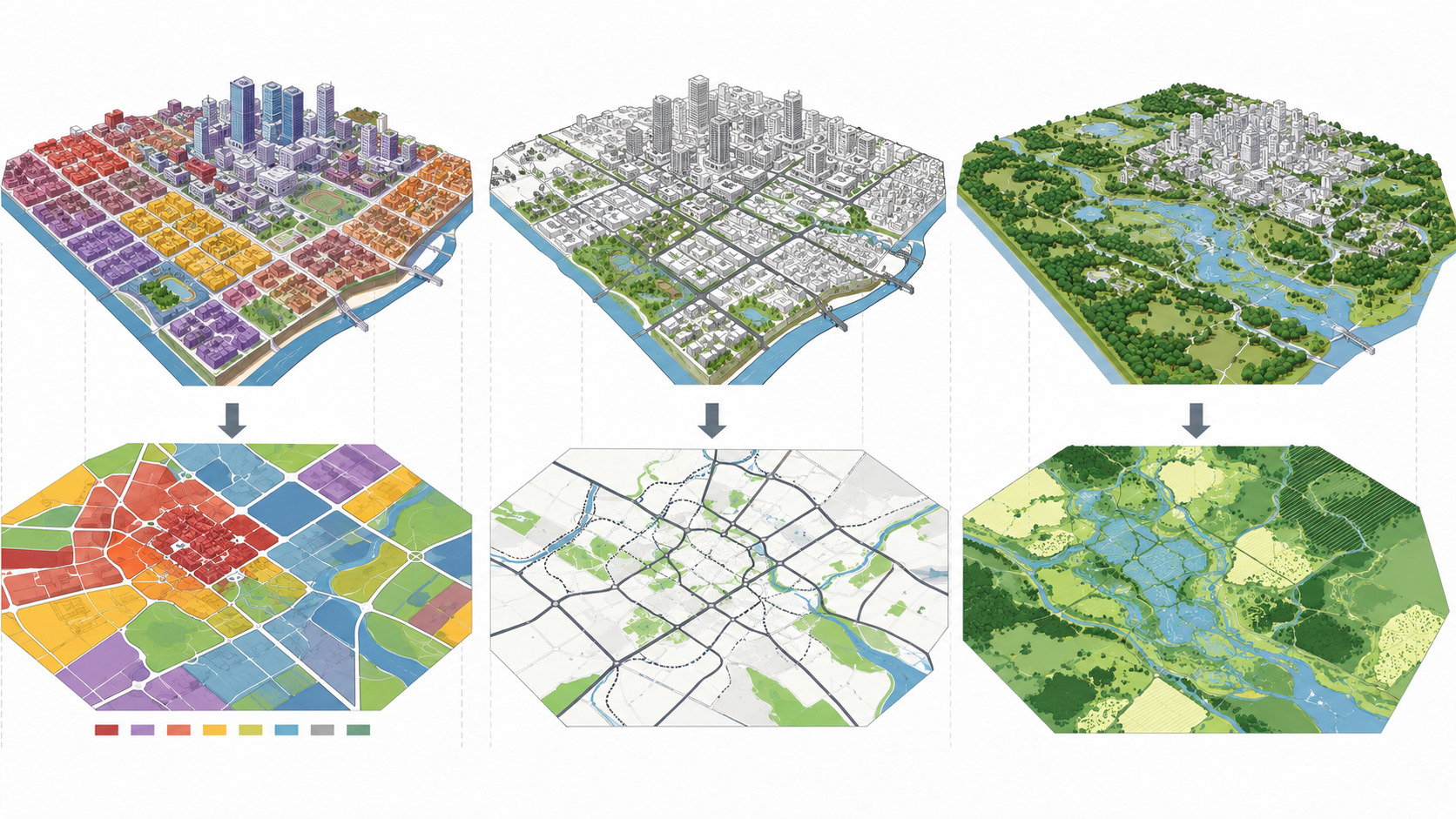
Thus, urban planning zoning is based on the established functional purpose of zones determined through the approval of territorial planning documents, primarily the general plan of the municipal formation.
Taking into account the analysis of legislation, judicial practice and scientific literature, we consider that functional zoning does not directly define but indirectly influences the determination of the legal regime of land through rules of land use and construction.
Urban Planning Zoning defines the legal regime of zones, while Functional Zoning affects the legal regime of zones primarily in order to ensure sustainable development of territories by achieving a balance between developed, to-be-developed, and recreational areas, preserving public-use areas. While ecological zoning is carried out with the aim of ensuring preservation of natural territories, within their boundaries
Legislation prohibits or restricts certain types of economic activity.
The zoning of protected natural territories established within the boundaries of categories of land populated areas has a specific character. For lands of populated areas, an urban planning regulation is established, and accordingly, urban planning zoning is carried out (part 6 of Article 36 of the Urban Planning Code of the Russian Federation). At the same time, according to this article, urban planning regulations are not established for lands of protected natural territories.
territories (excluding lands of curative resorts and health resort areas). In our opinion, the aforementioned article of the Land Code of the Russian Federation refers to a specific category of lands (Chapter XVII of the Land Code of the Russian Federation) for which an urban planning regulation is not established. Whereas, regarding specially protected natural territories created on lands of other categories, the aforementioned provision of part 6
Article 36 of the Civil Procedure Code of the Russian Federation (CPC RF) does not apply.
As noted by E.A. Galinskaya, despite the fact that OOPT are often formed as one or several land plots, categories such as «territory with a special usage regime» or «zone»29 are more suitable for OOPT. This position appears justified, since specially protected natural territories include not only land plots land, but also water surface areas and airspace above
them30.
The legislation on specially protected natural territories provides for the establishment of specially protected natural territories of federal, regional, or local significance, which as a general rule are federal property, property of the subjects of the Russian Federation, or property of municipal formations respectively31.
At the same time, urban planning zoning documents and functional zoning documents are approved by normative legal acts of local self-government bodies. Thus, it appears that the legal regime of particularly protected natural territories of federal and regional significance cannot be determined on the basis of functional zoning or urban planning zoning. The legal regime of such territories should be determined on the basis of ecological zoning, which can be carried out at both the level of state authorities of the Russian Federation and at the level of state authorities of the subjects of the Russian Federation.
of the Russian Federation.
The principle of urban planning legislation provides for the conduct of urban planning activities in compliance with requirements for preserving cultural heritage objects and particularly protected natural territories (paragraph 10 Article 2 of the Urban Planning Code of the Russian Federation). Land and urban planning legislation allows for the determination of zones of particularly protected territories within the boundaries of populated area lands32.
The presented position also finds confirmation in judicial practice. For example, as follows from the decision of the Arbitration Court of the North Caucasus District dated 14.03.2012 in case No. A63-1900/201133, the belonging of land of health resort areas and resorts to categories of land of populated places, absence of boundaries of the first, second or third sanitary (mountain-sanitary) protection zones on the territory does not change or cancel established
normative acts define the status of specially protected lands, their restriction on transfer and prohibition on privatization.
In the ruling by the Presidium of the Supreme Court of the Russian Federation dated June 16, 2009, No. 1882/09 in case No. A51-1334/20072-101, it was recognized that assigning the same land area to both specially protected territories and lands of populated areas does not contradict legislation34.
Thus, ecological zoning may be integrated into the structure of urban planning zoning through the definition of a corresponding territorial zone, whose legal regime may be determined during the implementation of ecological zoning, with the results of such zoning being formalized in the regulations governing the relevant specially protected natural area.
«On the basis of» indicates that the regulated relations have already been partially addressed somewhere else, usually in an act of higher legal force. The General Plan is not an act of higher legal force than land use and development rules. «Taking into account» is the softest formulation, allowing a certain degree of freedom when preparing documents or undergoing any other procedure. The question of the extent of consideration may be subject to evidence both within the community of citizens and during judicial proceedings. Plus, the formulation «taking into account» does not block the possibility of approval.
rules of land use and construction applicable to part of the territory of a settlement, city district in the absence of a general plan (Trutnev E.K., Bandorin L.E. Commentary on the Urban Planning Code of the Russian Federation. Moscow, 2010.)
There is no text provided for translation. Please provide the Russian text you would like translated into English.
- Bogolyubov S.A. The Relationship Between Urban Planning and Environmental Legislation // Ecological-Legal Issues of Sustainable Development of Settlements: Reports of the Scientific-Practical Conference / Ed. by E.L. Minina. Moscow, 2013. Pp. 10 - 11. ↩
- Anisimov A.P., Zemlyakova G.L., Melnikov N.N. Zoning as a Function of Land Fund Management: Issues of Theory // Modern Law. 2012. No. 8. Pp. 87 - 93. ↩
- Krassov O.I. Commentary on the Land Code of the Russian Federation. Moscow, 2009. ↩
- Khludeneva N.I. Collisions in Environmental Law: Abstract of Thesis ... Candidate of Legal Sciences. Moscow, 2007. P. 4. ↩
- Relationship between "Territorial Zoning" in the Land Code of the Russian Federation and
«urban planning zoning» in the Russian Federation's Urban Planning Code (GрK RF) is discussed in detail in paragraph 1 of chapter I of this dissertation. ↩
6. The problem of the absence of a unified terminology applicable to regulations on zoning of particularly protected natural territories is discussed in detail in paragraph 1 of chapter II of this dissertation. ↩
7. Preparation of land use and construction rules is carried out taking into account provisions on territorial planning contained in territorial planning documents, taking into account requirements of technical regulations, results
public hearings and proposals from interested parties (part 3 Article 31 of the Land Code of the Russian Federation). ↩
8. The local self-government body conducts a review of the project of land use and development rules submitted by the commission for compliance with technical regulations, the general plan of the settlement, the general plan of the municipal district, territorial planning schemes of municipal districts, territorial planning schemes of subjects of the Russian Federation, and territorial planning schemes of the Russian Federation (part 9
Article 31 of the Russian Urban Planning Code). ↩
9. Commentary on the Russian Urban Planning Code (per article) / Ed. S.A. Bogolyubov. Moscow, 2012. P. 170. ↩
10. According to paragraph 2 of part 1 Article 34 of the Russian Urban Planning Code, when preparing land use and development rules, boundaries of territorial zones are established, including taking into account functional zones and parameters of their planned development defined by the general plan of the settlement (except for the case provided in part 6 Article 18 of the Russian Urban Planning Code), the general plan of the municipal district, and the scheme
territorial planning of the municipal district. According to paragraph 6 Article 18 of the Land Code of the Russian Federation, the representative body of local self-government of a rural settlement has the right to adopt a decision on the absence of necessity for preparing its general plan and on preparing rules of land use and development provided that the following conditions are met: 1) there is no intention to change the existing use of territory of this settlement and an approved [program](/enc/396/ "Definition of the term 'Program' in
"legal encyclopedia") its comprehensive socio-economic development; 2) territorial planning documents of the Russian Federation, territorial planning documents of a subject of the Russian Federation, territorial planning documents of a municipal district do not provide for placement of federal-level objects, regional-level objects, local-level objects of the municipal district on the territory of this settlement. ↩ 11. Urban development regulations are established, including taking into account functional zones and
characteristics of their planned development, defined by documents of territorial planning of municipal formations (paragraph 3 of part 2 Article 36 of the Land Code of the Russian Federation). ↩
12. Preparation of the project of land use and construction rules is carried out taking into account provisions on territorial planning contained in territorial planning documents, taking into account requirements of technical regulations, results of public hearings and proposals of interested parties (part 3 Article 31 of the Land Code of the Russian Federation).
↩ 13. «In accordance with» implies the strictest condition, not allowing arbitrary interpretations and imposing a prohibition even on a single contradiction between documents. Furthermore, the absence of a document in accordance with which another document should be adopted means impossibility of adopting such a document. In other words, if the Land Code of the Russian Federation had provided that «rules for land use and construction are adopted in accordance with general plans of settlements, municipal districts», this would mean impossibility of approving rules applicable to part of the territory in the absence of
of the general plan. What would be wrong. ↩
14. Vysockiy A.A. Land Use and Construction Rules: A Guide to Development. Experience in Conducting Legal Zoning in Kyrgyzstan. Bishkek, 2005. P. 32. ↩
15. Vysockiy A.A. Ibid. P. 36. ↩
16. Kichigin N.V. The Environmental Potential of Instruments of Urban Planning Activities // Abstracts of Reports from the Scientific-Practical Conference / Ed. by E.L. Minina. M., 2013. P. 22. ↩
17. Anisimov A.P. On the "Ecology" of the Urban Planning Code of the Russian Federation // Modern Law. 2009. No. 4. ↩
18. [Decision of the Arbitration Court](/enc/3612/ "Definition of the concept «Decision of the Arbitration Court» in
"legal encyclopedia") of Samara region from 19.10.2009 in case № A55-7571/2009. / Official website of the Supreme Arbitration Court of the Russian Federation. Access mode: http://kad.arbitr.ru/PdfDocument/5c14b5b7-9532-4a77-8965-54d7c585706d/A55-7571-2009_20091019_Reshenie.pdf. ↩
19. Butler Stephen. Ibid. P. 5. ↩
20. Day of the city. Nizhny Novgorod. № 26 from April 9, 2010. ↩
21. Shchukin A.K. New paradigm of urban planning // Territory Development Management. 2009. № 2. P. 15. ↩
22. Trutnev E.K., Bandorin L.E. Commentary to the Urban Planning Code of the Russian Federation
Federation. M., 2010. ↩
23. Commentary on the Urban Planning Code of the Russian Federation (article-by-article) / Ed. S.A. Bogolyubov. M., 2012. P. 170. ↩
24. Order of the Federal Arbitration Court of the Urals Circuit dated 27.07.2012 No. F09-6314/12 // Official website of the Higher Arbitration Court of the Russian Federation. [Electronic resource]. URL: http://kad.arbitr.ru/PdfDocument/fc78ed3b-7953-4bb4-acc9-1d31ab7d7539/A60-9433-2012_20120727_Reshenija%20i%20postanovlenija.pdf. ↩
25. Andrianov N.A. Territorial planning as a basis for regulating urban development // Legal
questions of construction. 2005. № 2. ↩
26. The stated position is confirmed by the fact that authority of local self-government conducts checks on the project of land use and construction rules submitted by the commission for compliance with technical regulations, the general plan of the settlement, the general plan of the city district, territorial planning schemes of municipal districts, territorial planning schemes of subjects of the Russian Federation, and territorial planning schemes of the Russian Federation (part 9 [of Article 31 of the Land Code of the Russian Federation](https://alexeyborisov.ru/law/grkrf/st31/ "Article
31 Land Code of the Russian Federation (GrK RF)). Based on the results of this inspection, the local self-government body sends a draft of land use and development rules to the head of the municipal formation or, in case of detecting non-compliance with requirements and documents specified, to the committee for further processing (paragraph 10 Article 31 Land Code of the Russian Federation). ↩ 27. Kichigin N.V. Current issues in the application of general plans and land use and development rules // Property relations in the Russian Federation. 2014. No. 2. ↩ 28. Ruling of the Supreme Court of the Russian Federation dated October 23, 2013, No. 78-APG13-17. [Document](/enc/523/
"Definition of the term 'Document' in the legal encyclopedia") was not published. Access mode: system «Konsultant Plus». ↩
29. Institutions of Environmental Law / Head of the authoring team S.A. Bogolyubov. Moscow, 2010. P. 238. ↩
30. Protected Natural Areas - areas of land, water surface, and airspace above them, where natural complexes and objects are located that have
special conservation, scientific, cultural, aesthetic, recreational and health benefits, which have been completely or partially removed from economic use by decisions of state authorities, and for which a special protection regime has been established (preamble of the Federal Law of March 14, 1995 No. 33-FZ "On Protected Natural Areas"). ↩
31. According to paragraph 6 of Article 2 of the Federal Law "On Protected Natural Areas," protected natural areas may have federal, regional or local significance. [Protected
protected natural territories](/enc/24033/ "Definition of the term 'Protected Natural Territories' in the legal encyclopedia") of federal significance are federal property and are under the jurisdiction of federal state authorities, except for land plots located within resorts of federal significance that, in accordance with federal law, are subject to transfer to the ownership of subjects of the Russian Federation or municipal ownership, or are classified as the property of subjects of the Russian Federation or municipal ownership. Particularly protected [natural territories](/enc/2664/ "Definition
The concepts of "Natural territories" in the legal encyclopedia of regional significance belong to the subjects of the Russian Federation and are under the jurisdiction of state authorities of the subjects of the Russian Federation. Locally protected natural territories belong to municipal formations and are under the jurisdiction of local self-government bodies. ↩ 32. According to paragraph 10 of Article 85 of the Land Code of the Russian Federation, within the boundaries of populated areas may be allocated
zones of specially protected natural territories, which include land plots having special environmental protection, scientific, historical and cultural, aesthetic, recreational, health-improving, and other particularly valuable significance. A similar provision is provided by paragraph 1 of Article 35 of the Town Planning Code of the Russian Federation, according to which, as a result of urban planning zoning, multiple types of zones may be defined, including residential, public and business, [industrial zones](/enc/2022/
"Definition of the concept 'Production Zones' in the legal encyclopedia"), zones of engineering and transport infrastructure, agricultural use zones, recreational zones, zones of specially protected territories, special-use zones, zones for the placement of military facilities and other types of territorial zones. Territorial zones may include [zones of specially protected
territories](/enc/923/ "Definition of the term 'Zones of Particularly Protected Territories' in the legal encyclopedia"). Zones of particularly protected territories may include land plots having special value in terms of nature conservation, scientific significance, historical and cultural importance, aesthetic appeal, recreational use, health promotion, and other particularly valuable characteristics (paragraph 12 Article 35 of the Urban Planning Code of the Russian Federation). At the same time, urban planning regulations are established taking into account requirements for protection of cultural heritage objects, as well as particularly protected natural territories and other natural objects (paragraph 5 of part 2 Article 36 of the Urban Planning Code of the Russian Federation).
↩
33. Official website of the Higher Arbitration Court of the Russian Federation. [Electronic resource]. URL: http://kad.arbitr.ru/PdfDocument/f07c88ad-1dc5-469c-99e3-692f02cdb735/A63-1900-2011_20120314_Postanovlenie%20kassacii.pdf ↩
34. The fact of classifying the same land plot as belonging to specially protected areas and lands of populated places does not contradict the law, since in accordance with Article 85 of the Land Code of the Russian Federation and Article 35 of the Civil Code of the Russian Federation, within the boundaries of settlements, zones of specially protected areas may be established, which include plots with special nature conservation, scientific, historical and cultural, aesthetic,
recreational, health-improving or other particularly valuable significance (resolution by the Presidium of the Supreme Arbitration Court of the Russian Federation dated June 16, 2009 No. 1882/09 in case No. A51-1334/20072-101Official website of the Supreme Arbitrazh Court of the Russian Federation. [Electronic resource]. URL: http://kad.arbitr.ru/PdfDocument/c0767ab0-3d28-4980-b1cb-0988eec5ff81/A51-1334-2007_20090616_Reshenija%20i%20postanovlenija.pdf). ↩