Relationship Between Territorial Zoning and Classification of Land by Intended Use



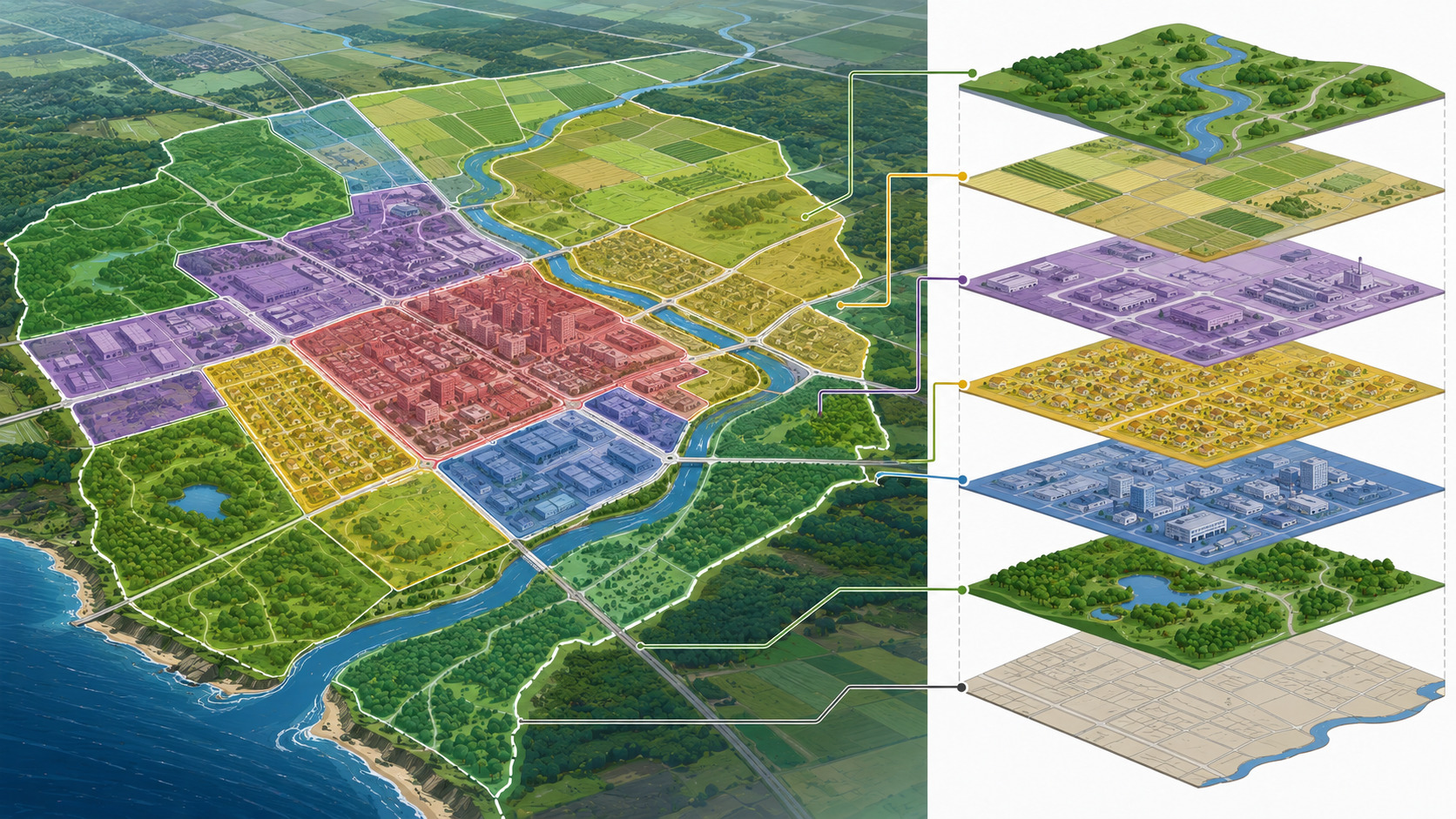

In scientific literature, emphasis is placed on the important significance of dividing land into categories in determining the legal regime of land. As noted by S.A. Bogolyubov, the division of all lands within Russia into categories according to their intended purpose is an exclusive prerogative of the Russian state, a characteristic feature of Russian land legislation and legal drafting, and serves as the basis for defining the peculiarities of the legal regimes of protection and use of land depending on their category and intended purpose. Stability of land's intended purpose, preservation above all of lands
agricultural purpose as irreplaceable, difficult-to-restore, preventing their unreasonable conversion into less efficient forms of farming have always been a cornerstone principle of Russian state land and environmental policy and implementation of land reforms1.
At present [time](/enc/33436/ "Definition of the term 'time' in the
The encyclopedias of the legal zoning of territories under the Land Code of the Russian Federation (GK RF) do not have institutional contradictions and do not duplicate each other2.
According to O.I. Krassov, territorial zoning in its most primitive form was borrowed from foreign experience. In the USA — the birthplace of zoning and in a number of countries, this legal tool is analogous to the general division of land into categories — the method of determining the legal regime of land used in our country. In reality, the practice of zoning has not yet become widespread3. Whereas I.F. Pankratov regarded the division of land into categories as one of the types of ecological zoning
Institutions for dividing land into categories and zoning territories imply the presence of a spatial element (boundaries). At the same time, as noted by E.A. Galinskaya, the absence of marked boundaries for land categories on-site is not a shortcoming of the institution itself, but of the organization of state management in this area5.
Zoning of territories and dividing land into categories have similar characteristics in the context of defining the legal regime of lands. Each category of land has an independent legal regime, which is established by the Russian Land Code. Direct determination of the legal regime of zones is provided within the framework of specific types of territorial zoning (for example, ecological zoning considered in this study, urban planning zoning). Ecological and [urban planning zoning](/enc/12137/ "Definition of the term 'Urban Planning
“Zoning” in the legal encyclopedia provides for the determination of the legal regime of ecological and territorial zones respectively.
Thus, the division of land into categories and the types of territorial zoning considered in this study types (ecological zoning, functional zoning, urban planning zoning) have both spatial (boundaries) and legal (definition of the legal regime or impact on [the legal regime of land](/enc/18022/
"Definition of the concept 'Legal regime of land' in the legal encyclopedia)) elements. In this sense, it appears particularly important to consider the relationship between such types of territorial zoning and the categorization of land in the context of defining the legal regime of land."
Some scholars emphasize the difficulties in distinguishing zoning regulations from land classification norms by target purpose. As noted by P.N. Pavlov, it is sometimes difficult to distinguish between land category norms and territorial zoning norms. It has been heard that there is no need to introduce territorial zoning in the Russian Federation, since we have long been classifying land into categories. In essence, the idea was put forward that classifying land into categories is equivalent to territorial zoning6.
At the same time, in scientific literature, an approach is proposed approach, aimed at determining the relationship between institutions for dividing land into categories and territorial zoning. According to E.A. Galinovskaya, it would be sufficient, as we believe, to analyze the content of established land categories, establishing the relationship of this institution with permitted use. At the same time, it is proposed to determine the list of types of permitted use on the basis of target
designations of specific land categories. Such a two-tiered approach, when permitted use is established not instead of, but in accordance with the land category, will not require radical changes to the legal regime of land, corresponds to the vast areas of the Russian Federation, and will form the basis for implementing not only local policy primarily aimed at territorial development, but also federal state land policy requiring consideration of all types of land use7.
As noted by O.I. Krassov, separating lands into categories does not at all mean that all lands of the corresponding category must be used strictly according to their target designation. Such position was characteristic not only for modern but also for previously applicable land legislation. Land legislation divides all lands into
certain categories, and at the same time within these categories allows for such types of land use for specific purposes that do not correspond to the intended purpose of the respective category. This is explained by the fact that the same category of land is often simultaneously used for various purposes. In order to resolve this contradiction, the Land Code employed the term "permitted [use](/enc/32013/ "Definition of the term 'Use' in
In addition, the division of land into categories applies to the entire territory of the Russian Federation. The types of territorial zoning considered in this study (ecological zoning, functional zoning, urban planning zoning) have a more localized character and are implemented with respect to individual
provided for by legislation. Urban planning zoning is carried out with respect to all territories for which an urban planning regulation9. [Functional zoning](/enc/8236/ "Definition of the term 'Functional Zoning' in the legal encyclopedia), within the framework of the territorial planning institution, is carried out with respect to territories of municipal formations10. Ecological zoning is carried out with respect to specially protected natural territories11.
Depending on the category to which the land belongs, legislation determines the most general legal regime of land. Based on the legal regime of territorial zones and ecological zones, legislation establishes a more detailed legal regime of land. For example, regarding land in populated areas, it may be specified what particular construction and what specific development can be carried out within the boundaries of each territorial zone. Thus, determination
The legal regime of lands based on specific types of territorial zoning is carried out in accordance with the legal regime of land categories and ensures the refinement of such a legal regime. In this regard, it seems reasonable to determine the relationship between the division of lands into categories and territorial zoning within the Land Code of the Russian Federation.
The issue of replacing the institution of land classification into categories based on purpose with the institution of urban planning zoning is currently a contentious and topical matter. The Government of the Russian Federation adopted an order on June 15, 2010, which approved a plan for improving supervisory and permitting functions and optimizing the provision of state services in the field of urban development
activities12(hereinafter - Plan). Item 20 of the Plan provides for the abolition of land categorization as an institution duplicating the institutions of territorial planning and urban zoning.
To achieve the stated objective, the Ministry of Economic Development of the Russian Federation (responsible executor of the relevant point of the Plan) developed a project of the Federal law "On introducing amendments to certain legislative acts of the Russian Federation regarding the abolition of certain categories of land and declaring obsolete the Federal law 'On transferring land or land plots from one category to another'13. In this draft law, among other things, provision was made for replacing certain categories of land with the institution
urban planning zoning («territorial zoning» in the terminology of the aforementioned draft law14), it was proposed to retain only three categories of land: 1) lands of the forest fund, 2) lands of the water fund and 3) lands of specially protected natural territories ([article](/enc/32056/ "Definition of the term «Article» in
"legal encyclopedia") 7 CPRF in the version of the draft law). This draft law was never adopted."
However, at present time a new project of federal law has been prepared and submitted for consideration by the State Duma of the Federal Assembly of the Russian Federation, providing for the replacement of the institution of dividing land into categories with the institution of territorial zoning15. The aforementioned bill provides for the exclusion of the institution of dividing land into categories by purpose from the legislation of the Russian Federation (and replacing this institution with the institution of territorial zoning), including,
annulment of the Federal Law of December 21, 2004 No. 172-FZ "On Reclassification of Land or Land Plots from One Category to Another"16(hereinafter - Federal Law "On Reclassification of Land or Land Plots from One Category to Another").
Problems related to the proposed replacement of the institution of dividing land into categories by intended use with the institution of territorial zoning are discussed in scientific literature. E.L. Minina, proposing a forecast of legislative development variants in the context of the institution of dividing land into categories and territorial zoning, comes to the conclusion that the least desirable option is the abolition of land categories. Not least because its implementation would require the most significant changes to legislation, including a radical revision of the Russian Land Code (ZK RF), establishing [legal regime of land](/enc/18022/ "Definition of the concept 'Legal regime of land' in"
depending on their belonging to a particular category. This will require reissuing documents establishing rights to land plots, which, as experience shows, is prolonged for a long period, creates obstacles in conducting entrepreneurial activities, imposes a heavy burden on citizens - holders of rights to land plots, contributes to the emergence of numerous conflicts in legal practice17.
According to E.A. Galinskaya, the abolition of categories and the establishment of a legal regime for the majority of land through urban planning regulations (which are adopted by local self-government bodies) significantly reduces the level of legal regulation of land relations, which is currently primarily carried out by federal laws18. It is not denied that the problem has become urgent and needs to be addressed. However, the radical approach of abolishing land categories cannot be considered the only possible solution19.
Commenting on point 20 of the Plan, M.V. Popov notes that this is, perhaps, the most revolutionary [proposal](/enc/19022/ "Definition of the term 'Proposal' in the legal encyclopedia), since the clear division of land into categories dates back to 1968, when the first Foundations of Land Legislation of the USSR and Union Republics were adopted. Many existing problems in the legal regulation of land relations are caused, among other things, by the parallel existence of two similar institutions - targeted purpose (categories of land) and permitted use. Therefore, in the opinion of M.V. Popov,
rational grain in the abolition of land categorization undoubtedly exists. But approaching the real implementation of this idea will be possible only with the presence of complete documents of territorial planning at all three levels and rules of land use and construction in all municipal formations. It is also necessary to ensure state cadastral registration of land plots on a large part of [territories](/enc/33369/ "Definition of the term «Territories» in the legal
encyclopedias) of the Russian Federation. Only then can the repeal of land categorization yield a positive effect20.
Then, according to V.A. Burkov, the abolition of land categories will disrupt continuity in legislation and will not rectify the shortcomings in the activities of public authorities21.
In scientific literature, emphasis is placed on the issues of the relationship between institutions for categorizing land and zoning territories. As noted by I.E. Manylov, currently, in most cases, changing the permitted use of a land plot requires two decisions: 1) a decision by an authority to change the category of the land plot; 2) a decision on changing its permitted use. At the same time, the procedure and grounds for changing the category and permitted use of a land plot differ. They also do not coincide [state authorities](/enc/32771/ "Definition of the term 'state authorities' in legal
("encyclopedias") and local self-government authorities, authorized to make decisions on changing the category of land plots and their permitted use, which creates difficulties for land plot owners22.
The indicated problem significantly hinders the realization of citizens' rights to use land plots. However, it should be noted that this issue can be resolved through judicial proceedings. As follows from the Ruling of the Urals Circuit of the Federal Arbitration Court dated June 3, 2009, No. F09-3523/09-S1, the entrepreneur submitted an application to the management of the Federal Agency for Cadastre of Real Estate (hereinafter - the management) requesting changes to documents of the state land cadastre in part indicating the category of the land plot owned by him on the right of ownership as "land of populated areas"
points](/enc/23525/ "Definition of the term 'Lands of Populated Areas' in the legal encyclopedia")» instead of «agricultural lands», type of permitted land use according to the established PZZ, territorial zone (zone of open wholesale markets). In this same statement, the entrepreneur requested the issuance of a cadastral plan of the land plot taking into account the revised cadastral registration data.
The Authority has decided to refuse state cadastral registration of changes to the real estate object due to the entrepreneur's failure to submit documents regarding the change in the category of the land plot and recommends submitting a corresponding petition to [authority](/enc/33186/ "Definition of the term 'authority' in the legal encyclopedia), authorized to make decisions on changing the category of the land plot.
Since any type of permitted use from the zoning areas provided by land use regulations is selected by the landowner independently, without additional permits or coordination procedures, and information regarding the main and auxiliary types of permitted land uses is entered into the cadastral plan pursuant to paragraph 2 of Article 7 of the Federal Law on Land and paragraph 4 of Article 37 of the Civil Code of the Russian Federation, FAS of the Urals
the district court satisfied application requesting recognition of the unlawfulness of the management's actions consisting in adoption of a decision to refuse cadastral registration of changes to the real estate land plot in terms of the category of the land plot and type of permitted use23.
Taking into account the above-mentioned ruling, it appears that the issue of the necessity to adopt two decisions (the authority's decision on changing the category of the land plot and the decision on changing its permissible use) for altering the type of permissible use of the land plot and the capital construction object may be resolved in court. Thus, amending legislation in the part concerning the abolition of land categories is not the only possible way to resolve this issue. Understanding that turning to court often leads to a sufficiently long
resolution of the dispute, it is justified to form an enforcement practice ensuring resolution of the specified problem in an administrative order without resorting to court.
V.A. Burkov notes that the argument put forward in favor of abolishing the institution of categories of land as the primary means of determining the legal regime of land plots is the greater diversity of permitted uses compared to the seven categories of land established by land legislation. At the same time, it is not taken into account that the number of categories has never been constant; it increased as social relations developed (the latest categories of land became [lands...
water fund](/enc/15942/ "Definition of the term «Water Fund Lands» in the legal encyclopedia") and particularly protected areas), and in the event that such a necessity arises, there are no obstacles to this. Thus, the aforementioned argument is not sufficiently substantiated24.
In addition, the flexibility of the institution of dividing land into categories by purpose is expressed in the possibility of transferring land or land plots from one category to another. The legal regulation of the transfer of land or land plots from one category to another is carried out within the framework of the Federal Law "On the Transfer of Land or Land Plots from One Category to Another." This Federal Law, among other things, provides mechanism for transferring agricultural land to [land](/enc/9280/ "Definition of the term 'Land' in the legal
encyclopedias") of other categories (including those land categories for which an urban planning regulation is established and applies.
Allowing for changes in the permitted use of land, legislation (/enc/32121/ "Definition of the term 'Legislation' in the legal encyclopedia") proceeds from the priority of preserving specially valuable lands and specially protected natural territories. Implementation of this principle is exemplified, for instance, by the possibility to change the permitted use of land plots designated as agricultural lands only after changing the land category. The validity of this approach is confirmed in judicial practice.
When considering the case, the court established that, pursuant to paragraph 7 of Article 36 of the Russian Land Code (GK RF), it is possible to change the permitted use for agricultural land only after changing the category of such land. Thus, failure to present evidence of the territory's zoning, within the boundaries of which is located the land plot belonging to the applicant, with an established permitted use for the land plot, does not constitute a basis for
satisfying the claims regarding the recognition of the refusal by the authorized body to change the permitted use of the land plot from conducting peasant (farmer) farming to dacha construction25.
At the same time, the absence of territorial zoning entails the necessity of using land in accordance with its designated purpose. The Federal Antimonopoly Service of the Moscow Region, decision dated December 30, 2009, No. KA-A41/12853-09, refused to satisfy the stated claims regarding the recognition of the decision by the Management of Rosnedvizhimost as unlawful and obliging it to make changes in information of the State Land Cadastre, changing the type of permitted use from "for agricultural purposes" to "for dacha construction". Court
stated that according to paragraph 2 of Article 7 of the Land Code of the Russian Federation agricultural land and other categories of land are used in accordance with their designated purpose, while evidence of zoning of the territory within which the disputed land plot is located, with established permitted use of land plots, have not been presented to the court26. The mentioned [approach](/enc/32461/ "Definition of the term 'Approach'
In the legal encyclopedia, the change in types of permitted land use is important since municipal zoning documents have not been prepared in all municipal entities.
As noted by P.N. Pavlov, without delving into the discussion of the expediency of maintaining the division of land into categories, it should be emphasized that legislation in countries with developed market economies does not contain the concept of "land categories." The only country with a market economy where land is divided into categories is Russia27. Whereas, according to E.A. Galinskaya, the institution of land categories under the Land Code of the Russian Federation (ZK RF) is, in essence, a form of zoning of land within the territory of the Russian Federation in
in general28. At the same time, land zoning based on main types of use (especially when it comes to particularly protected and valuable lands) is practiced worldwide29.
As noted by S.A. Bogolyubov, one should approach the modernization of any crucial law not from the perspective of "how can we perhaps further embellish it," but from the perspective of "without what changes to this law we cannot do today"30. As a result, replacing the institution of land categorization with the institution of territorial zoning legislation will undergo significant changes. However, it seems that such extensive changes to legislation can be avoided.
- Bogolyubov S.A. Legislation in the field of ecology. Moscow, 2010. P. 370. ↩
- Galinovskaya E.A. Application of Land Legislation: Problems and Solutions: Scientific-Practical Guide. Moscow, 2012. P. 51. ↩
- Krassov O.I. Commentary on the Land Code of the Russian Federation (per article). Moscow, 2009. ↩
- Ecology. Legal Encyclopedic Dictionary / Ed. by Prof. S.A. Bogolyubov. Moscow, 2001. P. 134. ↩
- Galinovskaya E.A. Ibid. P. 49. ↩
- Pavlov P.N. Legal Regulation of Territorial Zoning in the Russian Federation // Real Estate
"Real Estate" in the legal encyclopedia") and investments. Legal regulation. 2004. № 1 (18). ↩ 7. Galinskaya E.A. Ibid. P. 51. ↩ 8. Krassov O.I. Commentary on the Land Code of the Russian Federation (article-by-article). Moscow, 2009. ↩ 9. Urban planning regulations are not established for forest fund lands, water-covered lands, reserve lands, specially protected natural territories (except for health resort and recreational areas), agricultural land within agricultural use lands,
land plots located within the boundaries of special economic zones (part 6 Article 36 of the Russian Land Code). ↩ 10. The functional zone map includes: 1) schemes of territorial planning for municipal districts (paragraph 4 of part 1 Article 19 of the Russian Land Code); 2) general plan of the settlement (paragraph 4 of part 3 Article 23 of the Russian Land Code); 3) general plan of the urban district (paragraph 4 of part 3 Article 23 of the Russian Land Code). ↩ 11. For the purpose of establishing the regime of a national park
is carried out through zoning its territory (part 1 of article 15 of the Federal Law "On Particularly Protected Natural Territories"). Article 2 of the Federal Law No. 94-FZ dated May 1, 1999 "On the Protection of Lake Baikal" provides for ecological zoning of the Baikal Natural Territory. ↩ 12. Order of the Government of the Russian Federation dated June 15, 2010 No. 982-r "On Approval of the Plan of Measures to Improve Supervisory and Permitting Functions and Optimize the Provision of State Services in the Field of Urban Development Activities" // RSZ RF. 2010. No. 25. Art. 3220. ↩ 13. Russian newspaper
"Newspaper" in the legal encyclopedia") from 13.10.2011. Access mode: http://www.rg.ru/2011/10/13/zemlya-kategorii-site-dok.html ↩ 14. Chapter IV of the Land Code of the Russian Federation in the version of the Draft Law // Russian Newspaper from 13.10.2011. Access mode: http://www.rg.ru/2011/10/13/zemlya-kategorii-site-dok.html ↩ 15. Draft Law No. 50654-6 «On Amending the Land Code of the Russian Federation and Certain Legislative Acts of the Russian Federation in Respect to Abolishing Categories of Land and Declaring Obsolete the Federal Law "On Transfer of Land or Land Plots from One Category to
another"» // Automated system for ensuring legislative activities. [Electronic resource]. URL: http://asozd.duma.gov.ru/main.nsf/(Spravka)?OpenAgent&RN=50654-6 ↩ 16. Collection of Laws of the Russian Federation. 2004. No. 52. Art. 5276. ↩ 17. Minina E.L. Permitted use of land plots: issues of establishment and change // Journal of Russian law. 2012. No. 1. Pp. 62 - 67. ↩ 18. Galinovskaya E.A. Cited work. P. 50. ↩ 19. Galinovskaya E.A. Cited work. P. 51. ↩ 20.
Popov M.V. Here Will Be a City-Garden // Ezh-YURIST. July 2010, No. 27. ↩
21. Buruv V.A. Some Issues of Application and Improvement of Legislation on Changing the Purpose of Land Plots // Legislation and Economy. 2009, No. 8. ↩
22. Manilov I.E. Circulation of Real Estate in Russia: Economy and Law // Journal of Russian Law. 2012, No. 1. ↩
23. [Decree](/enc/7814/ "Definition of the term «Decree» in the legal
"encyclopedias") Federal Antimonopoly Service of the Urals District from June 3, 2009 No. F09-3523/09-S1 in case No. A60-13773/2008-S5. Document was not published. Access mode: system "Consultant Plus". ↩
24. Burkov V.A. Some issues of application and improvement of legislation on changing the purpose of land plots // Legislation and Economy. 2009. No. 8. ↩
25. Ruling of the Moscow Regional court from May 13, 2010 in case No. 33-9287. [Document](/enc/523/ "Definition of the term
"Document" in the legal encyclopedia") was not published. Access mode: system «Consultant Plus». ↩ 26. Decision of the Federal Antimonopoly Service Moscow Region dated 30.12.2009 № KA-A41/12853-09 in case № A41-9319/09 / Official website of the Higher Arbitration Court of the Russian Federation. Access mode: http://kad.arbitr.ru/PdfDocument/6aa3a6b0-bf7b-43e5-89d7-19067bca8dde/A41-9319-2009_20091225_Reshenija%20i%20postanovlenija.pdf. ↩ 27. Pavlov P.N. Legal regulation of territorial zoning in the Russian Federation //
Real Estate and Investments. Legal Regulation. № 1 (18). 2004. ↩
28. Galinskaya E.A. Op. cit. p. 51. ↩
29. Galinskaya E.A. Op. cit. p. 49. ↩
30. Bogolyubov S.A. Land legislation and the Concept of Development of Civil Legislation // Journal of Russian Law. 2010. № 1. p. 38-47. ↩