Relationship between Land Use Zoning and the Establishment of Zones with Special Land Use Conditions



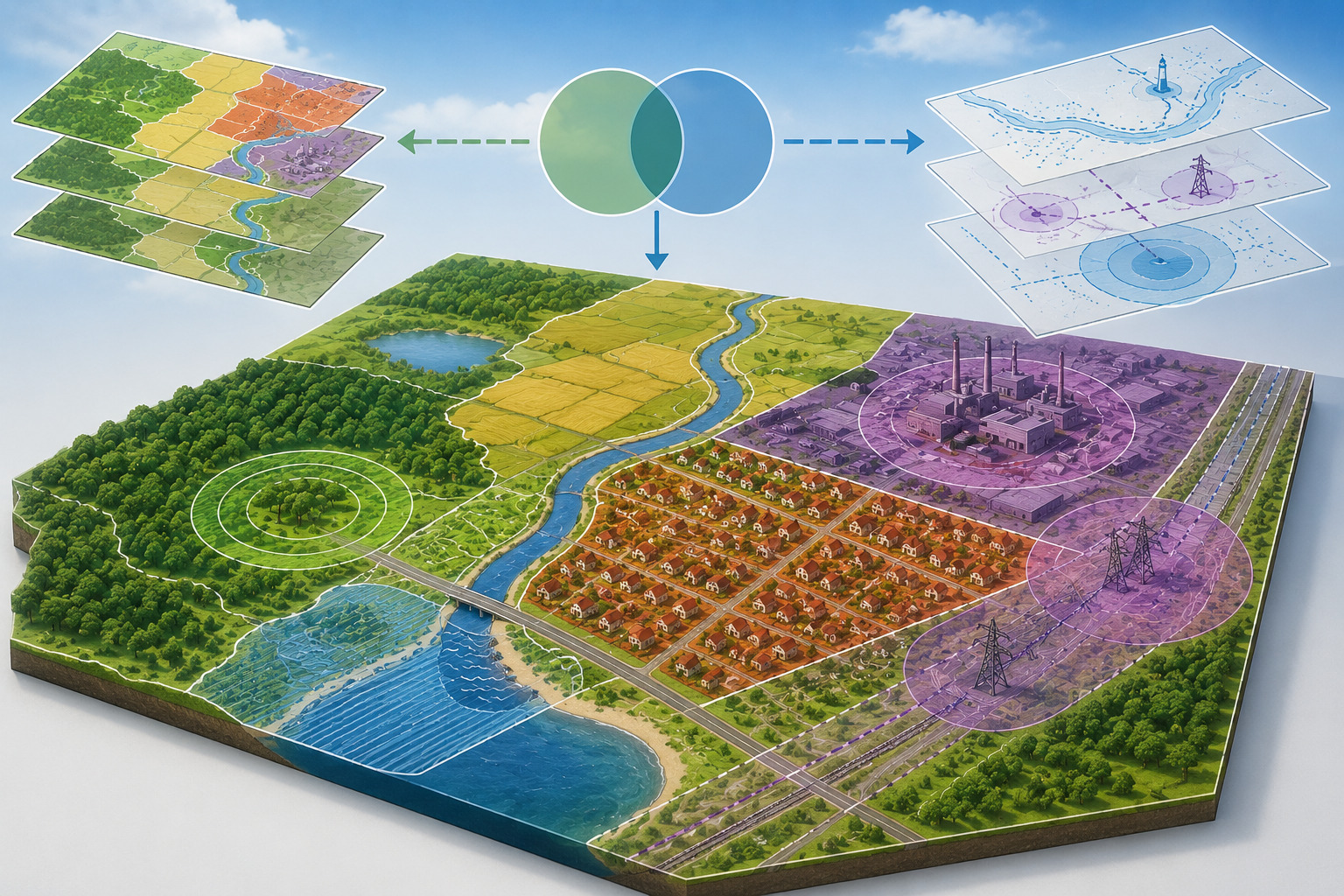
In the current legislation of the Russian Federation, there is no definition of the term «zones with special land use conditions». However, mentions of zones with special land use conditions, or individual types of such zones, are present in many federal laws1 and subordinate normative legal acts2.
In scientific literature, a definition similar in content to the concept of "protective zone" is proposed. According to O.A. Zolotova, a protective zone is a zone with special conditions for land use, representing a strip of land around an object of the protective zone, created
with a view to protecting the environment, life and health of citizens and/or the object of the protected zone from negative impact, within the boundaries of which normatively established restrictions on carrying out economic and other activities are set, including the use of land plots and their parts, as well as obligations to maintain land plots and their parts within the boundaries of the protected zone in a condition corresponding to the purpose of its establishment3. The given definition allows identifying similar characteristics between protected zones and zones determined on the basis of those considered in this text
Study of Types of Land Use Zoning
In scientific literature, emphasis is placed on the legal issues of protected zones. As noted by N.V. Kichigin, one of the problems is that many existing provisions regarding protected zones no longer correspond to current realities and require changes and additions taking into account the development of the economy, social relations, property rights, and should be brought in line with modern legislation. At times, provisions regarding protected zones remain unchanged for decades4.
In legislation, open lists of zones with special territorial use conditions are provided5. However, it is not possible to determine from these lists the impact of zones with special territorial use conditions on the legal regime of lands or to distinguish the establishment of such zones from zones defined based on the types of territorial zoning considered in this study. Thus, it is necessary to examine legislative provisions and academic positions regarding individual zones with special territorial use conditions.
M.M. Brinchuk considers the creation of water protection zones6 as part of environmental protection measures7. At the same time, establishing water protection zones does not entail expropriation of land plots from landowners, land possessors, land users or prohibition on transactions with land plots, except in cases provided by law. However, owners of land, land possessors and land users, on whose lands water protection zones and coastal areas are located,
protective strips must comply with the prescribed regime of their use. [Persons](/enc/31941/ "Definition of the term 'Persons' in the legal encyclopedia) responsible for violating the usage regime of territories within water protection zones and coastal protective strips bear liability under current legislation8.
According to O.N. Kolesova's opinion, water protection zones are areas with special conditions for land use, serving as a basis for establishing limitations on land rights. Limitations arise under Article 65 of the Water Code of the Russian Federation, which also defines their content, and are subject to cadastral registration in accordance with the legislation of the Russian Federation. Within a water protection zone, protective coastal strips and shore strips are distinguished, the boundaries of which are subject to cadastral registration. The boundaries of a land plot may not cross the boundaries of the shore strip.
State registration of a restriction on rights related to the location of a land plot within a water protection zone is not required9.
Individual provisions regarding sanitary protection zones are stipulated by SanPiN 2.2.1/2.1.1.1200-03. According to this SanPiN, sanitary protection zone is considered as a protective barrier that ensures the level of safety of the population during operation of the facility10. The above-mentioned provision is clarified in scientific literature11. This SanPiN also defines specific restrictions
use of land plots located within the boundaries of sanitary protection zones12.
In the project of the sanitary protection zone, the following should be defined: 1) - the size and boundaries of the sanitary protection zone; 2) measures for protecting the population from the impact of harmful chemical impurities in atmospheric air and physical effects; 3) functional zoning of the territory of the sanitary protection zone and its usage regime (point 3.10 of SanPiN 2.2.1/2.1.1.1200-03).
The legislation also provides for the definition of green zones13 and forest-park zones14. According to M.M. Brinchuk, the main element of the legal regime of green zones is the prohibition on economic and other activities within these territories that have a negative impact and hinder the realization of their ecological, sanitary-hygienic, and recreational purposes15.
As noted by N.V. Kichigin, legislation should more clearly distinguish urban forests, forest-park zones, and green zones based on their functional purpose and legal regime urban forests, to prevent duplication of legal regimes for these territories16. However, according to O.A. Zolotova, the legal regime and procedures for establishing green and forest-park zones are practically identical, although these territories differ functionally17.
E.K. Trutnev and L.E. Bandorin propose a distinction between sanitary-protection zones and water protection zones, noting that ``sanitary-protection and water protection zones are intended to prevent or reduce harmful [impact](/enc/9648/ "Definition of the term 'Impact' in the legal encyclopedia), in the first case - on other objects, in the second case - on the [source](/enc/31662/ "Definition of the term 'Source' in the legal encyclopedia) of establishing the zone. Preventing harmful [impact](/enc/9648/ "Definition of the term 'Impact' in the legal encyclopedia) means preventing the placement of new facilities.''18. A similar position is also held by D.F.
Abuzyarova19. While O.A. Zolotova proposes a more detailed classification of protected zones20.
In order to ensure the preservation of a cultural heritage site within its historical environment on the territory associated with it territory protection zones for the cultural heritage site are established: the protective zone21, zone for regulating construction and economic activities22, [protected natural landscape zone](/enc/12158/ "Definition of the term 'Protected natural landscape zone' in the legal
encyclopedias")23(paragraph 1 of Article 34 of Federal Law No. 73-FZ dated June 25, 2002 "On Objects of Cultural Heritage (Monuments of History and Culture) of the Peoples of the Russian Federation"24). The aforementioned zones with special land use conditions also have boundaries and a legal regime25.
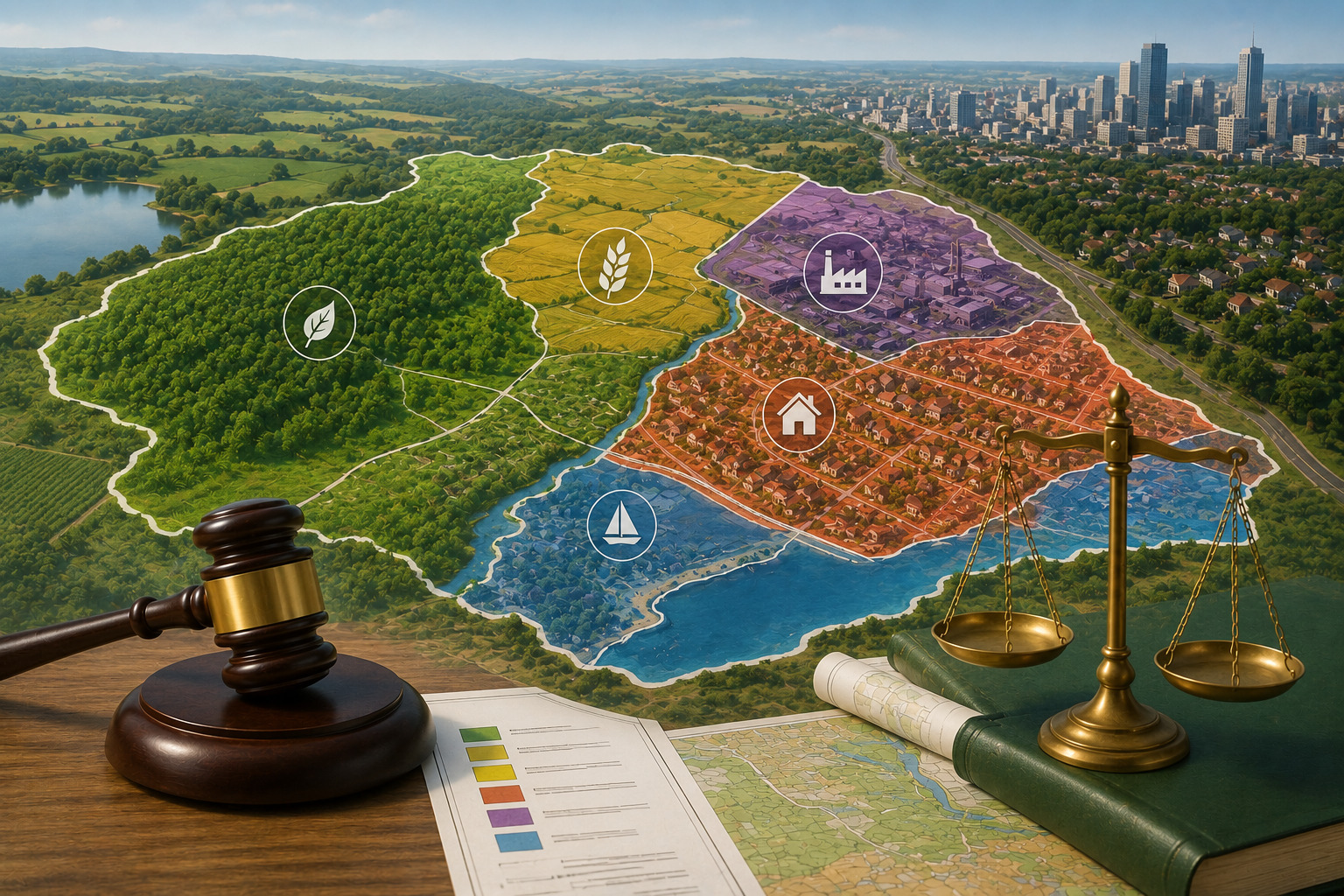
In scientific literature, there is no uniformity regarding the relationship between territorial zoning and the establishment of special use zones. For example, E.K. Trutnev includes the establishment of special use zones within the scope of zoning26. A similar position is held by O.M. Kozir'27. However, according to N.L. Lisina, territorial zoning should be distinguished from special restricted zones28. It is important to note that zones with special land use conditions, just like
territorial zones, are objects of land management29.
Taking into account the above, it can be concluded that zones with special land use conditions and zones defined on the basis of the types of territorial zoning considered in this study have both spatial (definition of zone boundaries) and legal (definition of the legal regime of lands or impact on the legal regime of lands) elements.
However, each type of territorial zoning considered in this study applies to [territory](/enc/33369/ "Definition of the term 'Territory' in the legal encyclopedia), not tied to specific objects (e.g., territory of a municipal formation, protected natural territory), which in turn serves as an object of the corresponding type of territorial zoning (has a comprehensive nature). In contrast, zones with special conditions for land use are established in relation to territories adjacent to specific objects for which such zones are designated (e.g., [industrial enterprise](/enc/12022/
"Definition of the concept «Industrial Enterprise» in the legal encyclopedia"), river) and have a local character."
According to O.A. Zolotova, protected zones are established in relation to land plots belonging to any category of land, regardless of the type of permitted use and irrespective of the form of ownership of such land plots30. As noted by N.V. Kichigin, zones with special land use conditions established in accordance with Russian Federation legislation may not coincide with territorial zones but may overlap [territorial zones](/enc/18453/
"Definition of the term 'Territorial zones' in the legal encyclopedia") of various types defined in Article 35 of the Russian Federation Land Code31.
Issues arising from the overlap of zones with special land use conditions and territorial zones are not uncommon subjects of judicial proceedings. As an example, consider the Appellate Ruling of the Supreme Court of the Republic of Bashkortostan dated September 27, 2012, in Case No. 33-9468/12. In the factual part of this Ruling, it is noted that N. and Sh. filed a claim with the court against the city administration seeking termination of the lease agreement and recognition of the illegality of the refusal by the Land Resources Management Department of the City Administration to provide...
ownership of the land plot, regarding the obligation to conclude Contract of Sale of the land plot and calculate its purchase price.
In support of their claims, the plaintiffs stated that according to the certificates of right to inheritance each of them is the owner of 1/2 share in the building. The [land plot](/enc/3419/ "Definition of the term «Land plot» in the legal encyclopedia) located under the said building has been leased to them on the basis of a contract. The defendant refused to transfer this land plot into ownership due to the fact that the [land plot](/enc/3419/ "Definition of the term «Land plot» in the legal encyclopedia) is located in the second sanitary belt
protection of water objects.
In this regard, the plaintiffs requested to terminate the lease agreement, declare unlawful the refusal by the Land Resources Management Office of the city administration, impose on the city administration an obligation to conclude a contract for the sale of the land plot and calculate its purchase price.
It was established during the court session that the disputed [land plot](/enc/3419/ "Definition of the term 'Land Plot' in the legal encyclopedia): 1) is located within the territorial zone: «Residential zone, index R-1»; 2) fully falls within the zone: «Sanitary protection zone of water intakes, II belt»; 3) fully falls within the zone: «Sanitary-protection zone from the industrial area».
Taking into account that the boundaries of the second zone sanitary protection zones of watercourses and water bodies are determined depending on natural, climatic, and hydrological conditions, i.e., established in each specific case according to data from the real estate cadastre and the Project "Sanitary-Topographic Survey of Sanitary Protection Zones of Water Supply Structures and Sources of Water Supply," approved by a decree of the Cabinet of Ministers, the disputed land plot is located within the boundaries
territories of the second zone sanitary protection zones of sources of drinking and household water supply of the city, and therefore, in accordance with the above-mentioned provisions of the law, cannot be transferred into private ownership.
In this regard, the legal basis for granting the claimants ownership of the disputed land plot by the court of first instance was absent, therefore the decision of the court cannot be considered lawful and justified and is subject to annulment32.
In the example provided, there is a conflict between the legal regimes of the territorial zone and the zone with special land use conditions. However, the court considered the case based on the priority of the legal regime of zones with special land use conditions over the legal regime of the territorial zone. Such an approach appears justified.
At the same time, it is important to observe the procedure for establishing zones with special land use conditions. For example, as follows from the Decision of the North-Western District Court of Appeal dated October 17, 2012, in case No. A21-6274/2011, on November 13, 2009, LLC "T." obtained a construction permit. By the decision of the City Council of the city of K. dated June 29, 2009, No. 146, the Land Use and Development Regulations for the municipal district "City of K." were approved.
The urban planning zoning map of the city district "City K.", which is Appendix No. 1 to the Rules of Land Use and Construction, establishes the boundaries of territorial zones. According to this map, the land plot leased to LLC "T." for construction, is entirely located within Territorial Zone ZH-2. This zone is designated for construction of multi-apartment medium-rise residential buildings with 5 - 8 floors; placement of objects of social and cultural services is permitted placement
of population, primarily of local significance, and other objects in accordance with urban planning regulations.
In accordance with the map of zones with special land use conditions for the purposes of protecting cultural heritage objects, which is Appendix No. 2 to the Rules of Land Use and Construction, the eastern part of the land plot has been classified as a zone with special land use conditions for the purposes of protecting cultural heritage objects - a zone of regulation of economic activities. In the specified zone, according to the Rules of Land Use and Construction, selective new construction of buildings close to the historical type of development is permitted, while new
multi-story and multi-apartment construction.
The Court has established, and the case materials confirm, that the Government of the K. region did not approve the boundaries of protected zones of cultural heritage objects, or land use regimes within these protected zones, as specified in the contested part of the Rules for Land Use and Construction.
In such circumstances, the court rightly found that the Rules of land use and construction in the disputed part by the Company do not comply with laws having greater legal force.
Having established that the application of the Land Use and Development Rules in the contested part creates obstacles for LLC "T." in carrying out its entrepreneurial activities related to the construction of residential buildings on the land plot provided to LLC "T." for this purpose, the court lawfully declared the disputed provisions of this regulatory legal act33 to be invalid.
In scientific literature, the relationship between the legal regime of protected zones, land categories and the type of permitted land use is considered. As noted by O.A. Zolotova, the legal regime of land of protected zones correlates with the category and type of permitted land use. This is manifested in the establishment of additional restrictions within the boundaries of the protected zone, which are required by the legal regime of the land plot34.
In our opinion, in order to most accurately determine the legal regime of lands, it is necessary to ensure an exhaustive representation of boundaries of zones with special territorial usage conditions in land use and development rules. To represent in land use and development rules the boundaries of zones with special territorial usage conditions established at the time of preparing the project of land use and development rules, legislation should provide for a procedure for coordination of such project with state authorities and local self-government bodies whose competence includes the establishment of zones with special...
Conditions for the Use of Territories, regarding the depiction of such zones in land use and development regulations.
- See, for example, Federal Law dated 10.01.2002 No. 7-FZ "On Environmental Protection" // Collection of Laws of the Russian Federation (SZ RF). 2002. No. 2. Art. 133, Civil Code of the Russian Federation (GK RF), Water Code of the Russian Federation (VK RF), Forest Code of the Russian Federation dated 04.12.2006 No. 200-FZ // SZ RF. 2006. No. 50. Art. 5278, Federal Law dated 30.03.1999 No. 52-FZ "On Sanitary and Epidemiological Well-being of the Population" // SZ RF. 1999. No. 14. Art. 1650, Federal law dated 24.07.2007 No. 221-FZ "On the State Cadastre of Real Estate" // SZ RF. 2007. No. 31. Art. 4017, Federal law dated 20.12.2004 No.
166-FZ "On Fishing and Conservation of Aquatic Biological Resources" // Collection of Laws of the Russian Federation. 2004. No. 52. Art. 5270. ↩
2. See, for example, Regulation on the determination of functional zones in forest park areas, areas and boundaries of forest park areas, green zones, decree of the Government of the Russian Federation dated January 10, 2009 No. 17 "On Approval of Rules for Establishing on the Ground Boundaries of Water Protection Zones and Shoreline Protective Strips of Water Objects" // Collection of Laws of the Russian Federation. 2009. No. 3. Art. 415, [decree](/enc/7814/ "Definition of the term 'Decree' in
("Legal encyclopedia") Government Decree of the Russian Federation dated October 7, 1996 No. 1170 «On Approval of the Regulations on Protective Zones and Protection of Geodetic Points within the Territory of the Russian Federation» // OG RF. 1996. No. 42. Art. 4803, decree of the Government of the Russian Federation dated February 27, 2004 No. 112 «On Use of Land Subject to Radioactive and Chemical Contamination, Conducting Land Improvement and Agronomic Works on Such Land, Establishment of Protective Zones, and Preservation of Objects Located on These Lands» // OG RF. 2004. No. 10. Art. 866. Order of Rosrybvydnya dated February 11, 2010 No. 86 «On Approval of the Procedure
«recognition of zones with special conditions for land use as fish protection zones and fishery reserve zones» // Russian Gazeta from 14.04.2010 (No. 78). ↩
3. Zolotova O.A. Legal regime of land protection zones: author's abstract of a dissertation ... candidate of juridical sciences. Moscow, 2013. Pp. 7–8. ↩
4. Bogolyubov S.A., Kichigin N.V. Legislative regulation of the activities of federal executive authorities to ensure environmental safety. Moscow, 2007. P. 127. ↩
5. According to paragraph 3 of Article 44 of the Federal Law
from January 10, 2002 No. 7-FZ "On Environmental Protection", in order to protect the environment of urban and rural settlements, protective and [conservation zones](/enc/30934/ "Definition of 'Conservation Zones' in the legal encyclopedia) are established, including sanitary protection zones, [green areas](/enc/9438/ "Definition of 'Green Areas' in the legal encyclopedia), green zones, forest-park zones and other protective and [conservation zones](/enc/30934/ "Definition of 'Conservation Zones' in the legal encyclopedia) excluded from intensive economic use with limited land-use regime. According to paragraph 4 of Article 1 of the Land Code of the Russian Federation
The Russian Federation](https://alexeyborisov.ru/law/grkrf/st1/ "Article 1 of the Land Code of the Russian Federation"), zones with special land use conditions - protective zones, sanitary protection zones, zones of protection for cultural heritage objects (monuments of history and culture) of the peoples of the Russian Federation, water protection zones, flood zones, waterlogging zones, sanitary protection zones, zones of protection for sources of drinking and household water supply, protected object zones, and other zones established in accordance with the legislation of the Russian Federation.
↩ 6. According to Article 65 of the Water Code of the Russian Federation water protection zones are territories adjacent to the shorelines of seas, rivers, streams, canals, lakes, reservoirs, and on which a special regime for conducting economic and other activities is established in order to prevent pollution, littering, silting of the aforementioned water bodies, depletion of their waters, as well as preservation of the habitat of aquatic biological resources and other objects of the animal and plant world. Within the boundaries of water protection zones, coastal protective strips are established, on the territories of which additional restrictions are introduced
economic and other activities. ↩ 7. In the opinion of M.M. Brinchuk, a water protection zone is created as an integral part of environmental protection measures, as well as activities aimed at improving hydrological regime and technical condition, landscaping of water bodies and their adjacent territories (Brinchuk M.M. Environmental Law: textbook. Moscow, 2010. P. 515.). ↩ 8. Sivakov D.O. Regime of water protection zones: protection of waters and forests // [Legislation](/enc/32121/
"Definition of the term 'legislation' in the legal encyclopedia") and economy. 2008. No. 10. ↩
9. Kolesova O.N. Legal regime of water protection zones // Journal of Russian law. 2012. No. 4. Pp. 50 - 57. ↩
10. From paragraph 2.1 of SanPiN 2.2.1/2.1.1.1200-03 it follows that in order to ensure public safety and in accordance with the Federal Law No. 52-FZ of March 30, 1999 "On Sanitary and Epidemiological Well-being of the Population" around objects and productions serving as sources of impact on the habitat and [health of a person](/enc/17026/ "Definition of the term 'Health of a person' in the legal
encyclopedias"), a special territory with a special usage regime is established, the size of which ensures reduction of pollution impact (chemical, biological, physical) on atmospheric air to values established by hygienic regulations, and for enterprises of I and II danger classes - both to values established by hygienic regulations and to acceptable risk levels for public health. In terms of its functional purpose [sanitary-protection
sanitary-protection zone](/enc/3242/ "Definition of the term 'Sanitary-Protection Zone' in the legal encyclopedia") serves as a protective barrier ensuring the level of safety of the population during normal operation of the facility. ↩
11. For example, according to M.M. Brinchuk, sanitary-protection zones are intended to create a barrier between residential areas and enterprises and other objects that are sources of harmful chemical, physical, and biological impacts on the state of the environment (Brinchuk M.M.
Environmental Law: textbook. M., 2010. P. 511.). ↩ 12. In sanitary protection zones, it is not allowed to place: residential buildings, including individual houses, landscape-recreational zones, recreation areas, resort territories, sanatoriums and rest homes, territories of gardening societies and cottage construction, collective or individual garden and orchard plots, as well as other territories with regulated quality indicators of the living environment; sports facilities, children's playgrounds,
educational and children's institutions, healthcare and preventive care institutions for general use (paragraph 5.1 of SanPiN 2.2.1/2.1.1.1200-03). ↩
13. Green zones are established to ensure protection of the population from adverse natural and anthropogenic impacts, preservation and improvement of the environment (paragraph 3 Regulation on defining functional zones in forest-park areas, areas and boundaries of forest-park zones, green zones). ↩
14. Forest-park zones are established for organizing public recreation, preserving sanitary-hygienic,
health-improving and aesthetic values of natural landscapes paragraph 2 Regulation on defining functional zones in forest-park areas, area and boundaries of forest-park areas, green zones). ↩
15. Brinchuk M.M. Environmental Law: textbook. Moscow, 2010. Pp. 510 - 511. ↩
16. Use and protection of forests: problem
Implementation of legislation: Collection of articles / Ed. E.L. Minina. Moscow, 2012. P. 116. ↩
17. Zolotova O.A. Green and forest park zones // Legal regulation of use and protection of forests: Collection of papers from a scientific-practical conference / Ed. by E.L. Minina. Moscow: State University of Forestry, 2011. P. 201. ↩
18. Trutnev E.K., Bandorin L.E. Commentary on the Urban Planning Code of the Russian Federation. Moscow, 2010. ↩
19. Protected zones are established both for the purpose of protecting state-protected objects and ensuring normal conditions for their operation, as well as for protecting the environment from
unfavorable impact emanating from the aforementioned objects (Abuzyarova D.F. Roadside Strips of Motor Highways as Zones with Special Usage Conditions // Jurist. 2010. No. 6. Pp. 37-39.). ↩
20. For the purposes of establishing typological and specific characteristics of protected zones and studying their legal regimes, taking into account whether the object of a protective zone belongs to natural or anthropogenic categories, O.A. Zolotova distinguishes two types of protective zones. According to the purpose of establishment, protective zones of the first type are divided into two groups: protective zones whose purpose of establishment is protection of protected objects
zones, and protective zones established for the purpose of protecting the environment, human life, and health; of the second type - into three groups: protective zones whose establishment aims at protection of protected zone objects, protective zones established for the purpose of protecting the environment, human life, and health, and protective zones established both for environmental protection and for a protected zone object (Zolotova O.A. Legal regime of land plots of protective zones: abstract of dissertation ... candidate of legal sciences. Moscow, 2013. P. 9.). ↩
21. Protective zone - [territory](/enc/32236/ "Definition of the term «Territory» in the legal
("encyclopedias"), within which, in order to ensure the preservation of a cultural heritage object in its historical landscape environment, a special land use regime is established, restricting economic activity and prohibiting construction, except for the application of special measures aimed at preserving and regenerating the historical and urban planning or natural environment of the cultural heritage object (paragraph)
first paragraph of subsection 2 of Article 34 of Federal Law No. 73-FZ dated June 25, 2002 "On Objects of Cultural Heritage (Monuments of History and Culture) of the Peoples of the Russian Federation"). ↩ 22. Zone of Regulation for Construction and Economic Activities - territory, within which a regime of land use is established, restricting construction and economic [activities](/enc/32150/
"Definition of the term 'Activity' in the legal encyclopedia"), requirements for the reconstruction of existing buildings and structures (paragraph 2 of point 2 of article 34 of the Federal Law No. 73-FZ of June 25, 2002 "On Objects of Cultural Heritage (Monuments of History and Culture) of the Peoples of the Russian Federation"). ↩ 23. Protected Natural Landscape Zone - territory, within which a regime is established
use of land prohibiting or restricting economic activity, construction and reconstruction of existing buildings and structures for the purpose of preserving (regeneration) natural landscapes, including river valleys, water bodies, forests, and open spaces compositionally linked to cultural heritage objects (paragraph 3 of point 2 of article 34 of the Federal Law dated June 25, 2002 No. 73-FZ "On Objects of Cultural Heritage (Monuments of History and Culture) of the Peoples of the Russian Federation"). ↩
24. RF Law Gazette. 2002. No. 26. Art.
- ↩
- Boundaries of protection zones for cultural heritage objects (excluding boundaries of protection zones for particularly valuable cultural heritage objects of the peoples of the Russian Federation and cultural heritage objects included in the List of world heritage), land use regimes and urban planning regulations within these zones are approved based on the protection zone project for cultural heritage objects of federal significance - by the state authority of a subject of the Russian Federation, in coordination with the federal authority for cultural heritage protection
objects of cultural heritage, while with regard to objects of regional cultural heritage significance and objects of local (municipal) cultural heritage significance - in accordance with procedures established by laws of the subjects of the Russian Federation (paragraph 3 of article 34 of Federal Law No. 73-FZ of June 25, 2002 "On Objects of Cultural Heritage (Monuments of History and Culture) of the Peoples of the Russian Federation"). ↩ 26. According to E.K. Trutneva, "zoning" is a general term, encompassing various types and results of corresponding
actions. For example, zoning is practiced at the stage of territorial development planning with the fixation of general restrictions and representations about future land use (without establishing legally significant regulations), there exists zoning with the establishment of legally significant property usage regulations ("legal zoning"), there is zoning with the establishment of boundaries for the application of relevant restrictions (water protection zones, sanitary protection zones, monument protection zones and so on), there is functional and [construction zoning](/enc/27579/
"Definition of the term 'Building Zoning' in the legal encyclopedia") within the limits of parts of territories and individual land plots, functional zoning at the level of different floors of planned buildings, etc. (Legal Zoning of the City. Introduction to Issues of Urban Regulation in Market Conditions / Ed. by E.K. Trutnev. Moscow, 2002. P. 7.). ↩
27. As noted by O.M. Kozyr', zoning of territory as a method for establishing restrictions on land use was previously already applied
in Russian legislation not only in relation to land plots of settlements, including in particular the establishment of protection zones for historical and cultural monuments, historical and cultural complexes and objects, specially protected natural territories, including sanitary (mountain-sanitary) protection zones; sanitary, protective and sanitary-protective zones; water protection zones and coastal protective strips; sanitary protection zones of water supply sources; zones of emergency ecological situations and ecological disasters and other zones in accordance with current sanitary, water, environmental legislation, legislation on the protection of historical and cultural monuments
(Volkov G.A., Golichenkov A.K., Kozyr' O.M. Article-by-Article Scientific-Practical Commentary on the Land Code of the Russian Federation / Prepared for the "Konsultant Plus" system. 2002.). ↩
28. Lisina N.L. Ibidem. P. 164. ↩
29. Objects of land management - territories of subjects of the Russian Federation, territories of municipal formations, territories of populated areas, territorial zones, zones with special conditions for land use, as well as parts of the aforementioned territories and zones
(paragraph third paragraph of article 1 of Federal Law No. 78-FZ dated June 18, 2001 "On Land Management" // RSZ RF. 2001. No. 26. Art. 2582.). ↩
30. Protective zones are located on land plots of any categories and types of permitted use, which are in ownership, possession, and use by the Russian Federation, subjects of the Russian Federation, municipal formations, physical and legal entities (Zolotova O.A. Legal Regime of Land in Protective Zones: Abstract of Dissertation ... Candidate of Legal Sciences. Moscow, 2013. p. 3.). ↩
31. Commentary on the Urban Planning Code of the Russian Federation (Article-by-Article) / Ed. S.A.
Bogolyubov. M., 2012. P. 179. ↩
32. Appellate ruling of the Supreme Court of the Republic of Bashkortostan dated 27.09.2012 in case No. 33-9468/12. The document was not published. Access mode: system «Konsultant Plus». ↩
33. Decision of the Federal Arbitration Court of the North-Western District dated 17.10.2012 in case No. A21-6274/2011. // Official website of the Supreme Arbitration Court of the Russian Federation. [Electronic resource]. URL:
Document was not published. Access mode: system «Consultant Plus». http://kad.arbitr.ru/PdfDocument/00463dbb-8f0a-4188-9df7-fa4b7f0eb4da/A21-6274-2011_20121017_Postanovlenie%20kassacii.pdf ↩
34. Zotova O.A. Legal regime of protected land zones: abstract of dissertation ... candidate of legal sciences. Moscow, 2013. p. 9. ↩